
EIA Sees Massive Uptick in US Crude Oil Inventories
 PriceONN Editorial Desk
Multi-source verification
PriceONN Editorial Desk
Multi-source verification
Surging Oil Inventories Signal Shifting Market Dynamics
The United States experienced a dramatic influx of crude oil into its commercial stockpiles, with a staggering 17.4 million barrel increase reported for the week concluding August 7. This substantial accumulation, detailed by the U.S. Energy Information Administration (EIA) on Wednesday, has elevated total reserves to 424.4 million barrels. This figure now sits remarkably close to the five-year seasonal norm, trailing it by a mere 2%.
This EIA disclosure arrived hot on the heels of preliminary data from the American Petroleum Institute (API), which had signaled an earlier inventory build of nearly 9.1 million barrels for the same period. The sheer volume of this latest stockpile expansion appears to have exerted downward pressure on oil prices, interrupting a recent upward trend.
Early trading on Wednesday saw crude futures waver. Brent crude contracts dipped by $0.39, or 0.44%, to trade around $88.52 per barrel. Despite this slight daily retreat, the international benchmark remains significantly higher, approximately $9 per barrel above its level from the previous week.
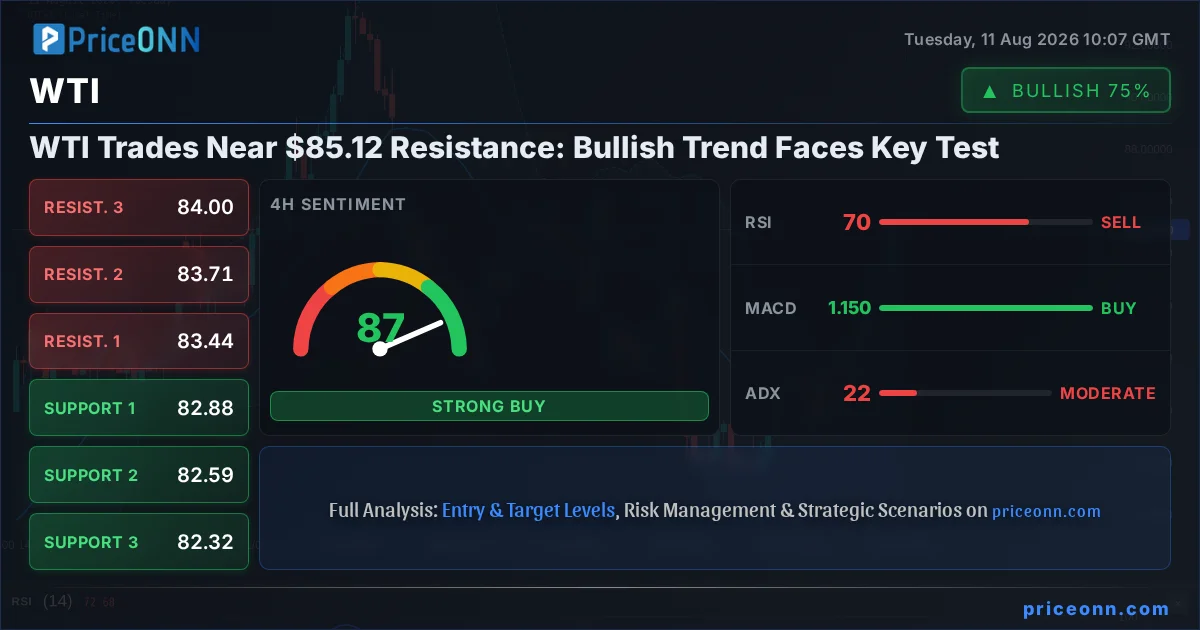
Similarly, West Texas Intermediate (WTI) futures experienced a modest decline, trading down $0.44, or 0.53%, at $82.76 per barrel. Nevertheless, WTI has also seen a robust gain of about $7.50 per barrel compared to its valuation a week prior.
Refined Product Stockpiles and Demand Picture
Beyond crude oil, the EIA's report painted a mixed picture for refined products. Motor gasoline inventories saw a decrease of 1.0 million barrels, following a similar draw of 1.6 million barrels in the preceding week. Daily gasoline production averaged 9.6 million barrels in the latest reporting period.
Inventories for middle distillates, which include products like diesel and jet fuel, contracted by 100,000 barrels. Production in this category increased, averaging 5.3 million barrels daily. Notably, distillate stockpiles are now considerably lower than average, sitting 12% below the five-year benchmark.
Looking at overall consumption, total products supplied, a key indicator of U.S. oil demand, averaged 20.7 million barrels per day across the last four weeks. This represents a 2.1% decrease compared to the same four-week span in the prior year. Breaking this down, average gasoline demand over the past month stood at 9.0 million barrels per day. The four-week average for distillate supply showed a year-over-year increase of 1.9%, averaging 3.7 million barrels per day.
Reading Between the Lines
The colossal build in U.S. crude oil inventories is a stark signal that the market's perception of demand may be diverging from reality, or that supply is significantly outpacing current consumption. While refined product inventories showed some draws, the overwhelming surplus in crude suggests a potential overhang that could cap price gains in the near term.
The data implies that refiners may be scaling back operations or that imports have surged, contributing to the dramatic increase in stored crude. The fact that total product demand is down year-over-year, despite a slight uptick in distillate demand, points to underlying weakness in key sectors of the economy or a seasonal lull that is more pronounced than anticipated.
Traders will be closely watching the reaction of crude futures in the coming sessions. A sustained drawdown in refined products could offer some support, but the sheer size of the crude inventory build presents a significant hurdle. This development could also signal a shift in inventory management strategies, with companies opting to store more oil rather than sell it into a potentially weakening demand environment.
The market's resilience, as seen in the weekly gains for both Brent and WTI despite Wednesday's pullback, indicates underlying bullish sentiment may still be present, perhaps driven by geopolitical factors or anticipation of future demand recovery. However, this inventory data introduces a tangible bearish counterpoint that cannot be ignored.
Track markets in real-time
Empower your investment decisions with AI-powered analysis, technical indicators and real-time price data.
Join Our Telegram Channel
Get breaking market news, AI analysis and trading signals delivered instantly to your Telegram.
Join Channel PriceONN News
Indian state-controlled oil refiners continue to search the market for spot crude supply as term deliveries are constrained by the ongoing crisis in the Middle East and its key oil chokepoint, the Strait of Hormuz. Mangalore Refinery and Petrochemicals Limited (MRPL) and Hindustan Petroleum Corporation Limited (HPCL) are looking to buy a combined 6 million barrels of crude oil via spot tenders, Reuters reported on Wednesday, citing tender documents it has seen. HPCL is seeking up to 4 million...
PriceONN News
The IEA has slashed its 2026 global oil supply forecast, with output now expected to plunge 4.3 million barrels per day this year as the failure to reopen the Strait of Hormuz pushes the market deeper into deficit. The latest forecast is considerably worse than the 3.7-million-bpd decline the agency projected just last month and would leave global supply at 102.02 million bpd, its lowest forecast for 2026 yet. Supply is now expected to fall 1.27 million bpd short of demand for the year,...
PriceONN News
The American Petroleum Institute (API) estimated that crude oil inventories in the United States rose by 9.072 million barrels in the week ending August 7, compared to analyst expectations for a 500,000-barrel draw. In the week prior, U.S. crude oil inventories rose by 2.69 million barrels. The larger-than-expected build was driven in part by higher crude imports relative to exports during the week. Commercial crude oil inventories excluding the SPR have lost just over 49 million barrels over...
PriceONN News
(RTTNews) - Crude oil prices have surged on Tuesday, extending the gains from the two previous sessions as the U.S.-Iran stalemate over new demands for compensation for war-related damages continued, diminishing the expectations of an early reopening of the Strait of Hormuz.
PriceONN News
Five months after the U.S. and Israel opened a war with Iran, global fuel markets still haven't settled down, and the latest IEA data prove it. The IEA's monthly end-use price tracker, updated Aug. 7 and covering prices through July, shows the average per-liter cost of automotive diesel across the countries it tracks sitting near $1.94 in U.S. dollar terms. That's roughly 14% above where it stood in February, before the war started, and it's actually higher than June, even as crude oil kept...
PriceONN News
Hormuz tensions are flaring again as Iranian exports collapse, pushing Brent toward $87 and raising the risk of another run toward $100. China’s Crude Drawdown Puts Iranian Barrels Back in Demand - Shrinking crude inventories in China might spur a buying spree over the upcoming weeks, particularly for Russian and Iranian crude, buoyed by a record-high July stock draw in Shandong. - Chinese teapots are expected to boost their purchases of Iranian oil in the upcoming days as stockpiles in the...
PriceONN News
The national oil company of the United Arab Emirates has issued its eighth spot tender since June, trade sources told Reuters on Tuesday, as the Gulf producer that has just left OPEC pushes to sell increased crude volumes to international markets. Abu Dhabi National Oil Company (ADNOC) is offering in the latest spot tender cargoes of the Upper Zakum, Umm Lulu, and Das crude grades for loading in October and November’ sources. These crudes are produced within the Persian...
PriceONN News
OPEC’s total oil production jumped by 1.17 million barrels per day in July from June as many Gulf producers restored some output that was shut in for three months due to the closed Strait of Hormuz. Output at the 11-member OPEC rose to 19.85 million bpd in July, extending the monthly increases for the second consecutive month, according to a based on ship-tracking data and information provided by sources at OPEC, oil companies, and consultants. In May, when major Gulf producers...
PriceONN News
China’s independent refiners are likely to return to buying higher volumes of Iran’s crude oil this month as stockpiles in Shandong, home to the independent Chinese refiners, have dropped to the lowest level this year after the biggest estimated monthly draw in a decade. For most of the Middle East conflict, now in its sixth month, China’s independent refiners, the so-called teapots, have drawn on their reserves and limited purchases and imports amid spiking international crude oil prices and...
PriceONN News
The U.S. oil industry got a scare last week. News reports claimed that the Trump administration may be considering an export ban on crude oil and refined petroleum products such as gasoline and diesel in order to bring those prices down-prices which have been elevated considerably by the reduction of oil supplies worldwide in the wake of the Iran war. But a Trump administration spokesperson said the administration has no plans to ban exports of oil or natural gas products. It's important to...
PriceONN News
ADNOC Gas, the gas business of the Emirati energy major, will spend more than $8 billion on its Rich Gas Development project, the company said today, as it eyes 60% growth in its earnings before interest, tax, depreciation, and amortization by 2030. The Rich Gas Development project covers several gas production facilities, including the Habshah gas project, which is the UAE’s largest gas processing facility, and the Ruwais LNG project, also in the UAE. Of the total investment, $3.9 billion...
PriceONN News
As energy companies explore innovative ways to increase clean power production and gain public support for new projects, many solar firms are investing in developing dual-purpose operations that utilise agricultural land for solar farms. A common criticism of solar farms is that installing panels on arable land for the sole purpose of energy production restricts land use for other purposes. However, installing solar panels on agricultural land, where farming practices can still take place,...