
Crude Oil Soars As Strait Of Hormuz Remains Closed Amid U.S.-Iran Standoff On Reparation Costs
 PriceONN Editorial Desk
Multi-source verification
PriceONN Editorial Desk
Multi-source verification
Oil Prices Surge Amid Diplomatic Impasse
A significant uplift in crude oil valuations was observed this Tuesday, marking a continuation of the gains seen over the preceding two trading sessions. The primary catalyst appears to be the persistent diplomatic deadlock between the United States and Iran concerning demands for compensation related to past conflicts. This standoff has substantially diminished the likelihood of the Strait of Hormuz, a vital global energy transit route, reopening in the near future.
West Texas Intermediate (WTI) Crude Oil futures for September delivery were trading approximately $0.89 higher, representing a 1.08% increase, reaching the $83.02 per barrel mark. This escalation follows a period where Iran indicated that negotiations regarding the shared management of shipping traffic through the Strait of Hormuz were nearing completion. However, Iran unexpectedly presented a list of demands to the U.S. stipulating that the strait's reopening was contingent upon the U.S. meeting these conditions.
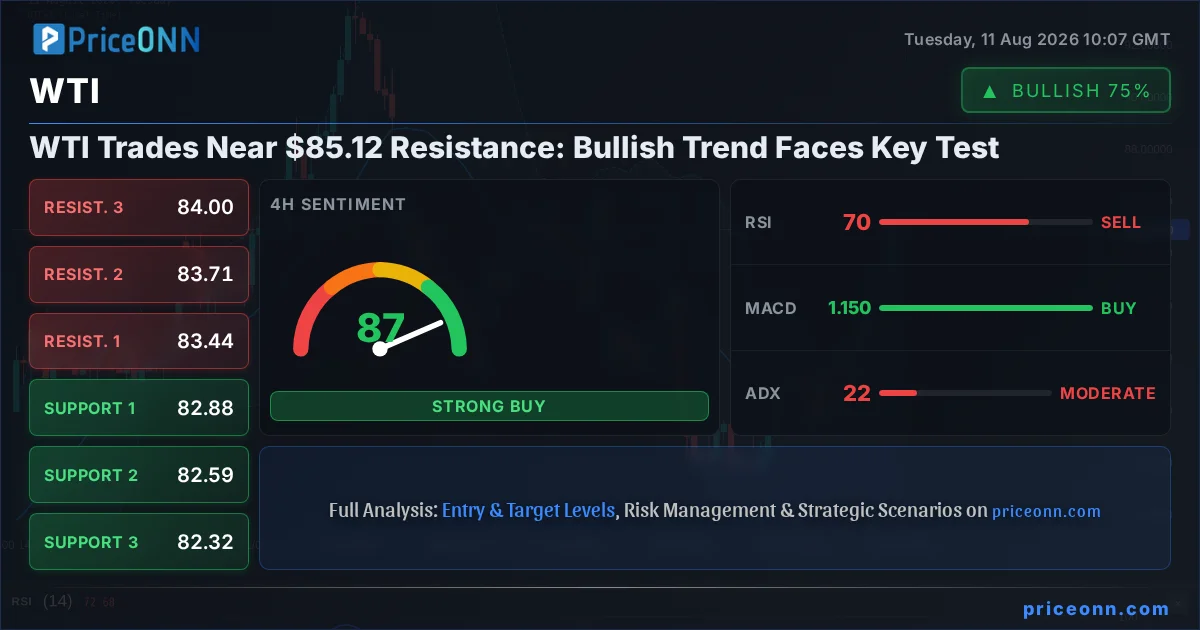
At the forefront of Iran's demands was a request for reparations to address extensive damages allegedly caused by the U.S. during a recent war. In a strong retort, U.S. President Donald Trump took to social media, demanding that Iran first account for and compensate for all lives lost and property damaged by Iranian actions across numerous global conflicts over the past five decades. Trump also insisted on compensation for the thousands of Iranians who perished during recent domestic anti-government demonstrations. He further directed U.S. representatives to incorporate this demand into all future discussions with Iran.
The hardline postures adopted by both nations have led many market observers to conclude that the chasm between them has widened. Consequently, concerns regarding an extended, indefinite closure of the strait have intensified. Yesterday, this heightened geopolitical risk premium provided a substantial boost to crude oil prices, which saw a jump exceeding 5%.
Shifting Sands of Diplomacy and Market Reaction
Amidst the escalating tensions, Pakistan's Defense Minister, Khawaja Asif, reportedly indicated that recent diplomatic signals suggest the U.S. and Iran are nearing some form of agreement. He was quoted as expressing optimism that developments were moving towards a peaceful resolution. Qatar's Foreign Ministry spokesman, Majed al-Ansari, also noted that negotiations between Iran and Oman concerning the future management of shipping traffic through the Strait of Hormuz had reached an advanced stage. Pakistan's Interior Minister, Syed Mohsin Raza Naqvi, is currently in Iran as part of Pakistan's ongoing mediation efforts, further fueling expectations of a potential breakthrough in resolving the U.S.-Iran conflict, though investors remain cautiously optimistic.
The situation is further complicated by related incidents in the region. Yemen's ruling government reported that a commercial vessel, the Tihamah, transiting the Bab al-Mandeb Strait in the Red Sea, was targeted by Houthi rebels, though the Houthis have not yet confirmed these claims. Shipping data from Kpler revealed a stark drop in traffic through the Strait of Hormuz on Monday, with only six commodity vessels passing through in either direction, a notable decrease from the 10-day average of 11 ships. Traffic at Bab el-Mandeb remained consistent with its 10-day average of approximately 24 transits.
In Europe, the conflict in Ukraine has seen an intensification of attacks on Russian energy infrastructure. Following a drone strike on Tatneft's Taneco Refinery earlier this week, Ukraine's military claimed responsibility for another drone attack on the Orsknefteorgsintez oil refinery in Orsk, located in the Orenburg region, in the early hours of Tuesday. Meanwhile, the U.S. dollar index was observed trading at 99.84, showing a slight increase of 0.07%.
Reading Between the Lines
The current surge in crude oil prices is a clear manifestation of heightened geopolitical risk. The stalemate over reparations and the potential indefinite closure of the Strait of Hormuz are creating significant upward pressure on oil benchmarks. While diplomatic efforts are reportedly underway, the hardline rhetoric from both the U.S. and Iran suggests that a swift resolution is unlikely, meaning the geopolitical risk premium embedded in oil prices could persist.
The drone attacks on Russian refineries by Ukraine add another layer of complexity to the global energy supply picture. Although these refineries may not directly impact global crude oil supply in the same way as a Hormuz closure, they can disrupt refined product availability and signal an escalation of the conflict. Traders will be closely watching for any confirmation or denial of the Bab al-Mandeb incident, as further disruption in that waterway would exacerbate supply concerns.
The cautious optimism surrounding potential diplomatic progress should be tempered by the historical volatility of U.S.-Iran relations. Any perceived de-escalation could lead to a swift correction in oil prices, while further provocations could see prices climb higher. The market's reaction to these conflicting signals will be critical in the coming days.
Track markets in real-time
Empower your investment decisions with AI-powered analysis, technical indicators and real-time price data.
Join Our Telegram Channel
Get breaking market news, AI analysis and trading signals delivered instantly to your Telegram.
Join Channel PriceONN News
Indian state-controlled oil refiners continue to search the market for spot crude supply as term deliveries are constrained by the ongoing crisis in the Middle East and its key oil chokepoint, the Strait of Hormuz. Mangalore Refinery and Petrochemicals Limited (MRPL) and Hindustan Petroleum Corporation Limited (HPCL) are looking to buy a combined 6 million barrels of crude oil via spot tenders, Reuters reported on Wednesday, citing tender documents it has seen. HPCL is seeking up to 4 million...
PriceONN News
The IEA has slashed its 2026 global oil supply forecast, with output now expected to plunge 4.3 million barrels per day this year as the failure to reopen the Strait of Hormuz pushes the market deeper into deficit. The latest forecast is considerably worse than the 3.7-million-bpd decline the agency projected just last month and would leave global supply at 102.02 million bpd, its lowest forecast for 2026 yet. Supply is now expected to fall 1.27 million bpd short of demand for the year,...
PriceONN News
Brent Crude oil prices rose above $89 per barrel in early trade in Europe on Wednesday as Iran and the United States offered contrasting claims about who controls the Strait of Hormuz. Brent Crude prices were up by 0.64% at $89.60 in the morning in Europe, and WTI Crude was rising by 0.94% at $83.90, amid persistent supply concerns and risks despite claims from the U.S. that traffic at Hormuz had normalized. Iran, for its part, said on Tuesday that the Strait of Hormuz will remain closed unless...
PriceONN News
Oil flows from the Middle East have normalized, with Sunday traffic alone above pre-conflict averages, U.S. Secretary of Energy Chris Wright said on Tuesday in a claim that appears not to be backed by ship-tracking data. On Tuesday, Secretary Wright posted on X that “Thanks to the coordinated efforts of the U.S. military and our gulf allies, the seven-day average for oil leaving the Strait of Hormuz is currently up to almost 9 million barrels per day.” He went on to add that “When combined with...
PriceONN News
The American Petroleum Institute (API) estimated that crude oil inventories in the United States rose by 9.072 million barrels in the week ending August 7, compared to analyst expectations for a 500,000-barrel draw. In the week prior, U.S. crude oil inventories rose by 2.69 million barrels. The larger-than-expected build was driven in part by higher crude imports relative to exports during the week. Commercial crude oil inventories excluding the SPR have lost just over 49 million barrels over...
PriceONN News
Five months after the U.S. and Israel opened a war with Iran, global fuel markets still haven't settled down, and the latest IEA data prove it. The IEA's monthly end-use price tracker, updated Aug. 7 and covering prices through July, shows the average per-liter cost of automotive diesel across the countries it tracks sitting near $1.94 in U.S. dollar terms. That's roughly 14% above where it stood in February, before the war started, and it's actually higher than June, even as crude oil kept...
PriceONN News
The national oil company of the United Arab Emirates has issued its eighth spot tender since June, trade sources told Reuters on Tuesday, as the Gulf producer that has just left OPEC pushes to sell increased crude volumes to international markets. Abu Dhabi National Oil Company (ADNOC) is offering in the latest spot tender cargoes of the Upper Zakum, Umm Lulu, and Das crude grades for loading in October and November’ sources. These crudes are produced within the Persian...
PriceONN News
OPEC’s total oil production jumped by 1.17 million barrels per day in July from June as many Gulf producers restored some output that was shut in for three months due to the closed Strait of Hormuz. Output at the 11-member OPEC rose to 19.85 million bpd in July, extending the monthly increases for the second consecutive month, according to a based on ship-tracking data and information provided by sources at OPEC, oil companies, and consultants. In May, when major Gulf producers...
PriceONN News
Libya’s National Oil Corporation may declare force majeure on exports from the Zawya oil terminal as a result of drone attacks on the facility. The Zawya terminal has a daily capacity of 120,000 barrels, sourced from the country’s largest oil field, Sharara, which can produce up to 300,000 barrels daily, Reuters noted in a report on the possibility of a force majeure declaration. According to reports, a drone strike had destroyed a storage tank and another drone had targeted an oil blending...
PriceONN News
Crude oil inventories in the United States saw a massive increase of 17.4 million barrels during the week ending August 7, according to new data from the U.S. Energy Information Administration (EIA) released on Wednesday. The increase brings commercial stockpiles to 424.4 million barrels, according to government data, which are now just 2% below the five-year average for this time of year. The EIA’s data release follows API’s figures that were released a day earlier, which reported that crude...
PriceONN News
A drone has struck a power station at the Zawiya oil export terminal in Libya, suggesting continued attacks on one of the country’s main oil hubs. The power plant is in close proximity to the largest oil refinery in Libya, the AP noted in a report on the news. The attack follows earlier ones that caused an explosion at an oil storage tank. No one has claimed responsibility for the drone attacks, the AP also reported. The tank, according to the company operating the facility, had 4.5 million...
PriceONN News
Whatever officially occurs next in the on-again/off-again negotiations towards a peace deal between the U.S. and Iran, unofficially Tehran knows that it has established de facto control over both the world’s two key maritime energy transit routes -- the Strait of Hormuz and the Bab el-Mandeb Strait -- for at least as long as the Islamic regime remains in place in Iran. Washington, London, Brussels, Beijing, and Moscow know it too. The Strait of Hormuz remains effectively controlled by vast...