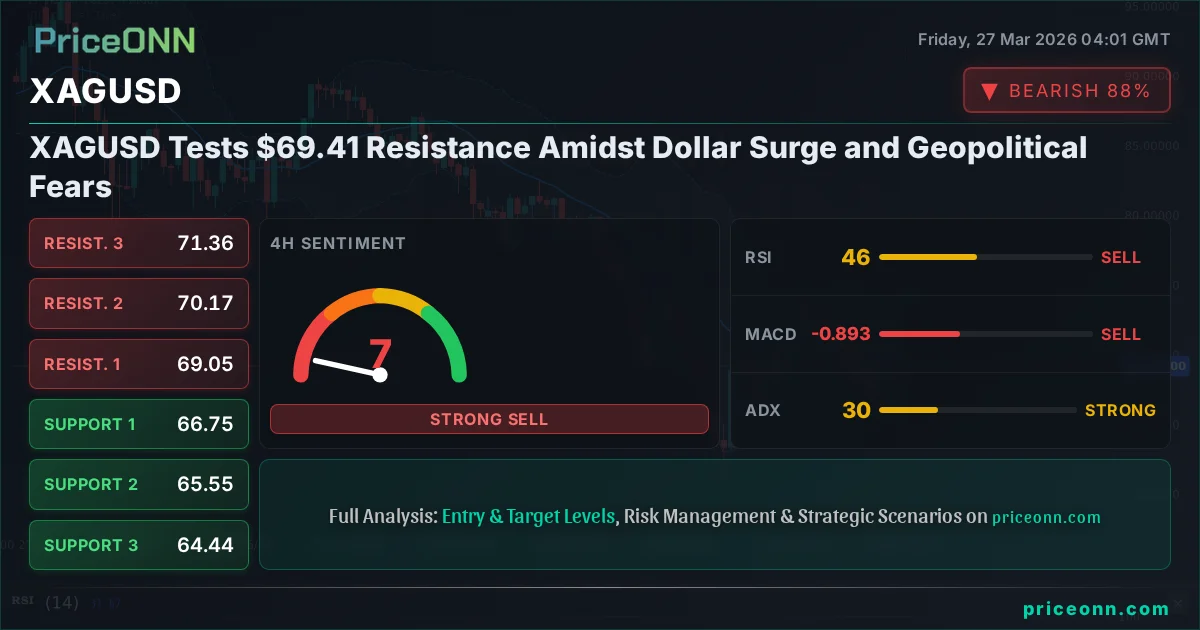
Silver Price Forecast: XAG/USD consolidates above $68.00; 100-SMA breakdown remains in play
Silver's Cautious Stance Above Key Support
The precious metal, often seen as gold's more volatile cousin, is treading water in early Asian trading. Silver (XAG/USD) is currently oscillating just above the critical $68.00 level, a tight consolidation that suggests indecision in the market. This lack of decisive movement comes as traders eye the 100-day moving average, a breakdown below which could signal further downside pressure.
Historically, silver has served as both a store of value and a hedge against economic uncertainty. While it doesn't command the same safe-haven allure as gold, its unique properties and broader industrial applications make it a compelling asset for portfolio diversification. Investors can gain exposure through physical bullion, such as coins and bars, or via financial instruments like Exchange Traded Funds designed to mirror silver's market performance.
The intricate dance of silver prices is influenced by a confluence of global factors. Geopolitical tensions or severe economic downturns can elevate silver's appeal as a haven asset, though its response is typically less pronounced than gold's. As an asset that pays no yield, silver often benefits from an environment of falling interest rates, making it more attractive relative to fixed-income investments.
The U.S. Dollar's trajectory also plays a pivotal role. Since silver is priced in dollars, a strengthening dollar tends to suppress its value, while a weakening dollar can provide a significant tailwind for price appreciation. Furthermore, the interplay between investment demand, the sheer abundance of silver compared to gold in terms of mining output, and the effectiveness of recycling programs all contribute to its price dynamics.
Beyond its monetary roles, silver's industrial significance cannot be overstated. Its exceptional electrical conductivity makes it indispensable in sectors like electronics and the rapidly expanding solar energy industry. A robust increase in industrial demand can therefore directly translate into upward pressure on prices, whereas a contraction in these sectors can lead to price erosion.
Economic powerhouses like the United States, China, and India exert considerable influence over silver's market. China and the U.S. with their vast manufacturing bases, are major consumers of silver in various industrial processes. In India, cultural demand for silver jewelry adds another significant layer to global consumption patterns, impacting price discovery.
It's also crucial to observe the relationship between silver and gold. Typically, silver prices tend to move in the same direction as gold, reflecting their shared status as precious metals. The gold-to-silver ratio, which quantifies how many ounces of silver are needed to purchase one ounce of gold, offers a valuable lens for assessing their relative valuations. A high ratio might suggest that silver is comparatively undervalued, or conversely, that gold is overvalued, prompting strategic trading decisions.
Market Ripple Effects
The current consolidation in silver prices, hovering precariously above $68.00, carries broader implications for related markets. The immediate focus remains on technical levels, particularly the 100-day moving average, which often acts as a key barometer of medium-term trend health. A sustained break below this level could trigger stop-loss orders and accelerate selling pressure, potentially impacting investor sentiment across other precious metals and risk assets.
This price action is closely watched by traders of gold (XAU/USD), as silver's movements often foreshadow or echo gold's. A significant breakdown in silver could signal weakening demand for safe-haven assets more broadly, although gold's inherent safe-haven status might offer it more resilience. The U.S. Dollar Index (DXY) is another critical counterpoint; a weakening dollar could provide a much-needed floor for silver, while a resurgent dollar would likely add to the downward pressure.
Furthermore, the industrial demand component for silver links its price action to the broader economic outlook, particularly in sectors like technology and renewable energy. A prolonged period of silver price weakness could indirectly signal concerns about industrial output or demand, potentially affecting cyclical assets and related equity markets, such as semiconductor manufacturers or solar energy companies. Investors should monitor the $68.00 support level closely; a failure to hold this could pave the way for a retest of lower psychological barriers, while a decisive bounce could signal a renewed attempt to challenge higher price resistance.
Track markets in real-time
Empower your investment decisions with AI-powered analysis, technical indicators and real-time price data.
Join Our Telegram Channel
Get breaking market news, AI analysis and trading signals delivered instantly to your Telegram.
Join Channel