
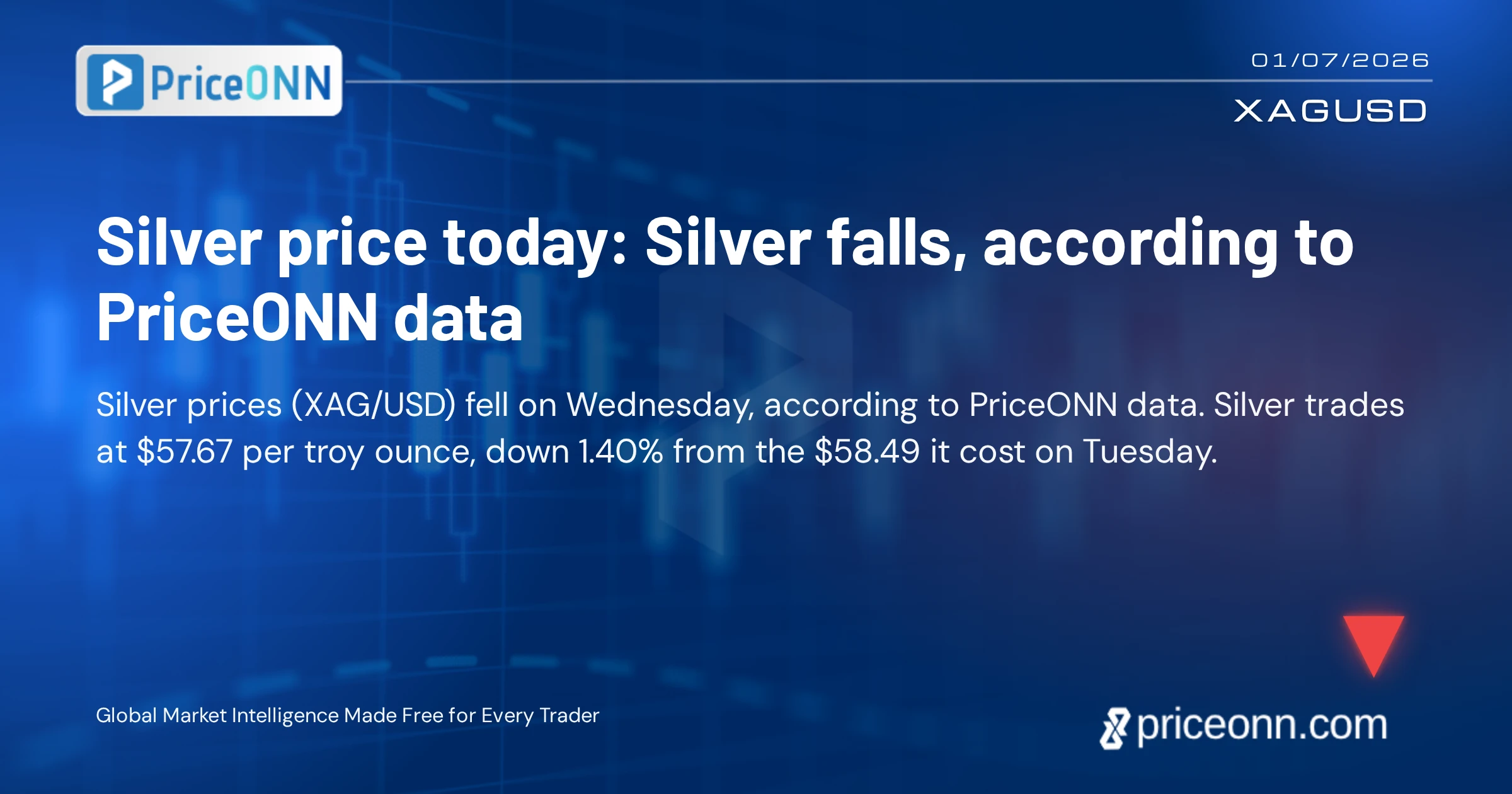
Silver price today: Silver falls, according to PriceONN data
 PriceONN Editorial Desk
Multi-source verification
PriceONN Editorial Desk
Multi-source verification
Precious Metal Retreats Amid Shifting Market Tides
The price of silver, a widely tracked precious metal, has seen a downturn today. Trading at $57.67 per troy ounce, the white metal is down 1.40% from its previous day's valuation of $58.49. This movement occurs within a broader context where silver functions not only as an investment vehicle but also as a historical store of value and a hedge against inflationary pressures.
Investors often turn to silver as a way to diversify portfolios, attracted by its intrinsic worth. While it may not command the same attention as gold, its unique properties and market dynamics present distinct opportunities. The metal can be acquired physically through coins and bars, or accessed via financial instruments like Exchange Traded Funds (ETFs) that mirror its international market performance.
Factors Influencing Silver's Trajectory
Several interconnected forces shape silver's price fluctuations. Geopolitical tensions or anxieties about a significant economic downturn can elevate silver's appeal as a perceived safe haven, though its impact is generally less pronounced than that of gold. As an asset that does not generate yield, silver typically benefits from an environment of declining interest rates.
The performance of the US Dollar also plays a critical role, given that silver is denominated in dollars (XAG/USD). A strengthening dollar often exerts downward pressure on silver prices, while a weakening dollar can provide a tailwind for price appreciation. Beyond these macroeconomic influences, the supply side, including output from silver mines and the rate of metal recycling, is a significant determinant. It's noteworthy that silver is considerably more abundant than gold, a factor that influences its price dynamics.
Furthermore, silver's extensive utility in various industrial applications, especially within the electronics and solar energy sectors, cannot be overstated. Its exceptional electrical conductivity, surpassing that of copper and gold, makes it indispensable. Consequently, surges in industrial demand can drive prices upward, whereas a contraction in this demand tends to suppress them.
Economic activity in major global players like the United States, China, and India also contributes to price volatility. China and the US, with their substantial industrial bases, consume significant quantities of silver. In India, consumer demand for silver jewelry acts as another key price driver. The interplay between these industrial and consumer markets creates complex price signals.
Historically, silver's price movements often echo those of gold. When gold rallies, silver frequently follows, sharing a similar safe-haven appeal. The Gold/Silver ratio, a metric indicating how many ounces of silver are required to purchase one ounce of gold, serves as a gauge for their relative valuations. A high ratio might suggest silver is relatively inexpensive compared to gold, while a low ratio could imply the opposite.
Reading Between the Lines
The recent retreat in silver prices, evident in today's 1.40% drop to $57.67, warrants closer examination. While the immediate trigger might be a confluence of factors, including a firmer dollar or shifting interest rate expectations, the underlying industrial demand remains a critical, often overlooked, component. As economies worldwide navigate growth challenges and inflationary concerns, silver's dual role as an industrial input and a safe-haven asset creates a delicate balancing act.
This price action suggests that market participants are weighing the immediate headwinds from currency movements and monetary policy against the long-term demand drivers, particularly from sectors like renewable energy. The historical correlation with gold also means that any significant shifts in gold prices will likely be mirrored, to some extent, in silver.
For traders, monitoring the Gold/Silver ratio could offer clues about relative value. A widening spread might present opportunities, assuming the underlying industrial demand narrative for silver remains intact. Key levels to watch would be the recent high of $58.49 and any sustained break below current support zones, which could signal further downside.
The broader implications extend to industrial commodities and potentially even equity sectors heavily reliant on silver, such as electronics manufacturers or solar panel producers. Investors should remain attuned to central bank policy shifts and geopolitical developments, as these can swiftly alter the safe-haven appeal of precious metals.
Track markets in real-time
Empower your investment decisions with AI-powered analysis, technical indicators and real-time price data.
Join Our Telegram Channel
Get breaking market news, AI analysis and trading signals delivered instantly to your Telegram.
Join Channel PriceONN News
Silver price (XAG/USD) gains ground for the fourth successive day, trading around $59.70 per troy ounce during the Asian hours on Wednesday. Silver prices are surging despite rising rate-hike expectations, as powerful market forces outweigh the drag of higher interest rates.
PriceONN News
Silver prices (XAG/USD) rose on Monday, according to PriceONN data. Silver trades at $56.83 per troy ounce, up 1.49% from the $56.00 it cost on Friday.
PriceONN News
Silver price (XAG/USD) gains ground for the second successive day, trading around $56.80 per troy ounce during the Asian hours on Monday.
PriceONN News
Silver (XAG/USD) is rallying, favoured by a mild US Dollar weakness on Tuesday.
PriceONN News
Silver (XAG/USD) advances toward $56.90 per troy ounce on Monday at the time of writing, gaining 1.62% on the day. The precious metal continues to benefit from safe-haven demand as geopolitical tensions in the Middle East keep risk sentiment under pressure.
PriceONN News
Silver price (XAG/USD) trades 1.33% lower to near $58.00 during the European trading session on Thursday. The white metal faces selling pressure as elevated energy prices due to renewed aggression between the United States (US) and Iran have de-anchored inflation expectations again.
PriceONN News
(RTTNews) - Gold prices have edged higher on Friday, partially offsetting the losses from yesterday's plunge after crude oil prices plummeted, lowering both oil-linked inflation concerns and the consequential expectations of an interest-rate hike by the U.S. Federal Reserve.
PriceONN News
(RTTNews) - Gold prices have tumbled on Thursday as the Middle East crisis deepens after Iran-backed Houthi militants of Yemen attacked two Saudi Arabian vessels in the Red Sea, raising concerns of intense oil supply disruption for an extended period. The possibility of an intere
PriceONN News
(RTTNews) - Gold prices traded higher on Wednesday, extending gains for a fourth consecutive session and hitting a two-week high as investors reacted to escalating Middle East tensions and looked ahead to next week's Federal Reserve meeting.
PriceONN News
Gold’s rally this week may prove to be one of the more important developments across financial markets-not simply because prices have reclaimed the $4,100 level, but because the move appears to contradict the macro forces that have governed precious metals for much of the second quarter. Silver has joined the advance, climbing back toward $60, […] The post Gold Defies Higher Oil and Yields. Is the Market Entering a New Regime? appeared first on ActionForex.
PriceONN News
Gold (XAU/USD) edges higher on Tuesday as buying interest around the $4,000 psychological level supports prices, while traders assess developments in the Middle East and their potential economic fallout. At the time of writing, XAU/USD trades around $4,058, up 1.27% on the day.
PriceONN News
Gold price (XAU/USD) is up 1.5% to near $4,067 during the European trading session on Tuesday. The precious metal outperforms as the rally in oil prices has stalled, with investors turning confident that negotiations between the United States (US) and Iran towards peace have resumed.