
Silver price today: Silver falls, according to PriceONN data
 PriceONN Editorial Desk
Multi-source verification
PriceONN Editorial Desk
Multi-source verification
Market Snapshot: Silver's Retreat
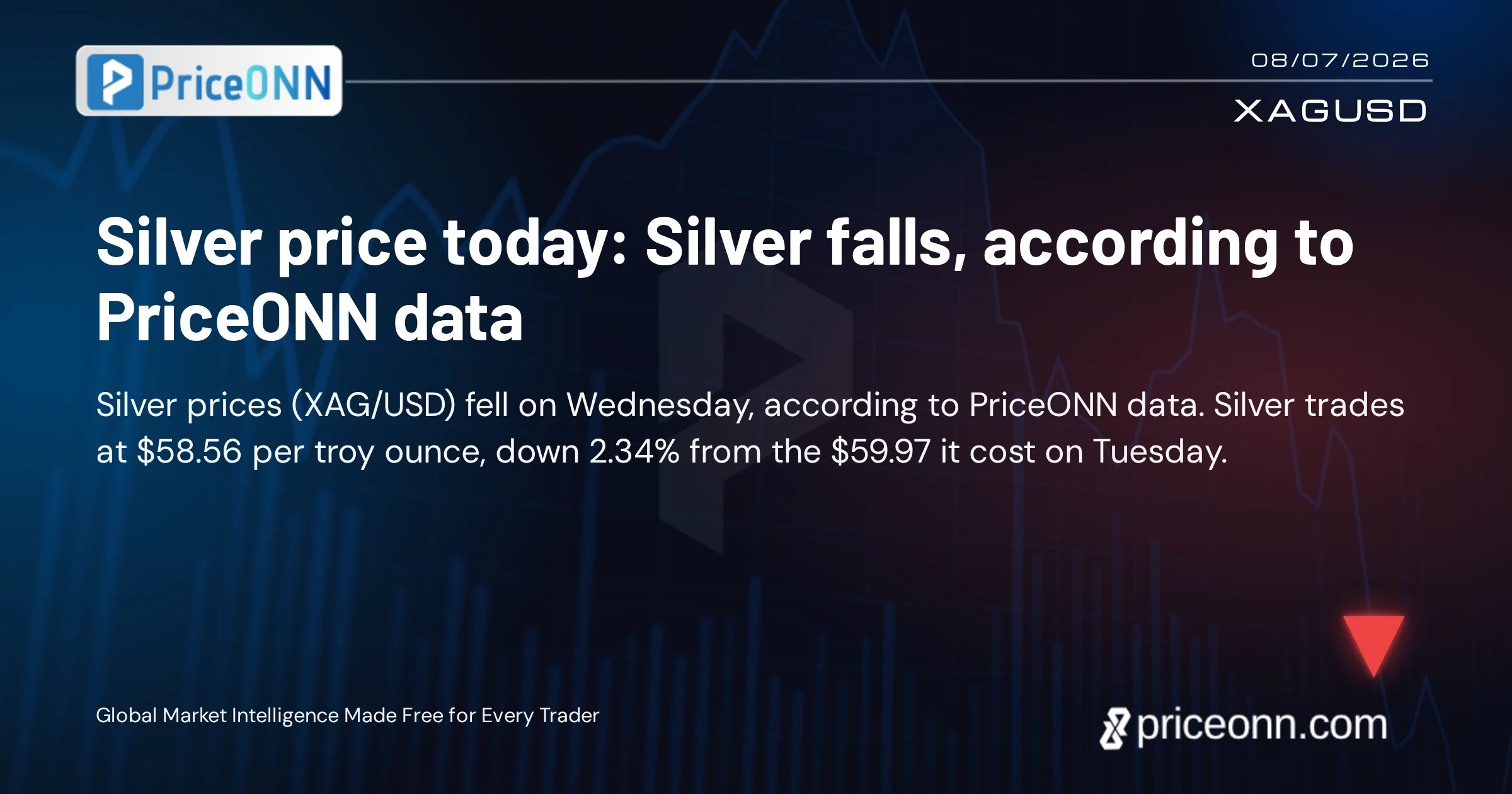
The price of silver (XAG/USD) has seen a significant dip today, shedding 2.34% of its value. As of Wednesday, the precious metal is trading hands at $58.56 per troy ounce, a clear retreat from its previous day's valuation of $59.97. This movement signals a renewed bearish sentiment in the short term for the white metal.
Silver, a metal historically revered for its dual role as a store of value and a medium of exchange, often attracts investor attention. While it may not command the same spotlight as gold, its appeal lies in its ability to offer portfolio diversification. Furthermore, its intrinsic worth and potential as a bulwark against inflationary pressures draw in a segment of the investment community. Investors have multiple avenues to gain exposure, from holding physical coins and bars to utilizing financial instruments like Exchange Traded Funds (ETFs) that mirror its global price action.
Factors Shaping Silver's Trajectory
The forces dictating silver's price are multifaceted and dynamic. Geopolitical tensions or anxieties surrounding a severe economic downturn can elevate silver's status as a safe haven, though its influence in this regard is typically less pronounced than that of gold. As an asset that generates no yield, silver typically finds favor when interest rates are on a downward trend. Its valuation is also intrinsically linked to the performance of the US Dollar; given that silver is quoted in dollars (XAG/USD), a strengthening dollar generally exerts downward pressure on its price, while a weakening dollar can provide a tailwind for price appreciation.
Beyond these macroeconomic drivers, the supply side plays a crucial role. Silver mining output, which is considerably more abundant than gold extraction, alongside rates of metal recycling, significantly influences market dynamics. The metal's extensive use across various industries, most notably in electronics and solar energy due to its superior electrical conductivity compared to copper and gold, also creates demand-side pressures. A surge in industrial consumption can drive prices upward, whereas a contraction in demand tends to push them lower.
The economic health of major global players like the United States, China, and India further contributes to silver's price fluctuations. The substantial industrial sectors in the US and especially China are significant consumers of silver, integrating it into numerous manufacturing processes. In India, consumer appetite for silver jewelry remains a key determinant of pricing. This intricate web of industrial and consumer demand, coupled with its safe-haven appeal and sensitivity to monetary policy, creates a complex pricing environment.
Reading Between the Lines
Silver's price movements often echo those of gold, reflecting their shared status as precious metals. When gold rallies, silver typically follows, driven by similar safe-haven perceptions. The relationship between the two is often quantified by the Gold/Silver ratio, which indicates how many ounces of silver are equivalent in value to one ounce of gold. Traders and analysts frequently examine this ratio to gauge relative valuations. A high ratio might suggest that silver is comparatively inexpensive or gold is expensive, prompting potential arbitrage opportunities. Conversely, a low ratio could signal that gold is undervalued relative to silver.
Portfolio Impact and Market Connections
The current downward pressure on silver prices, evidenced by today's 2.34% drop, warrants attention from investors and traders. This price action could signal a broader risk-off sentiment or specific headwinds affecting industrial commodities. Traders should monitor the $58.00 level, a psychologically significant price point that, if breached decisively, could invite further selling pressure. The interplay between silver and the US Dollar Index (DXY) remains critical; a continued strengthening of the dollar could exacerbate silver's decline, while any signs of dollar weakness might offer a reprieve.
Beyond the direct impact on silver holdings, this price movement could have ripple effects. Investors might reassess their exposure to precious metals broadly, potentially leading to correlated moves in Gold (XAU/USD). Furthermore, companies involved in silver mining, such as First Majestic Silver Corp. (AG) or Hecla Mining Company (HL), could see their stock prices pressured if this trend persists. On the industrial front, a sustained lower silver price might benefit sectors heavily reliant on its conductivity, such as electronics manufacturers, although this benefit is often marginal compared to the broader economic factors influencing their performance.
What smart money is watching involves a deeper look beyond simple price action. The options market for silver might reveal positioning biases or hedging strategies that aren't immediately apparent in spot prices. Additionally, institutional desks will be closely observing mining supply reports for any unexpected disruptions or significant increases that could alter the fundamental supply-demand balance over the medium term. They also track the velocity of investment flows into and out of silver ETFs, as these can be leading indicators of broader sentiment shifts.
Track markets in real-time
Empower your investment decisions with AI-powered analysis, technical indicators and real-time price data.
Join Our Telegram Channel
Get breaking market news, AI analysis and trading signals delivered instantly to your Telegram.
Join Channel PriceONN News
Silver price (XAG/USD) gains ground for the fourth successive day, trading around $59.70 per troy ounce during the Asian hours on Wednesday. Silver prices are surging despite rising rate-hike expectations, as powerful market forces outweigh the drag of higher interest rates.
PriceONN News
Silver prices (XAG/USD) rose on Monday, according to PriceONN data. Silver trades at $56.83 per troy ounce, up 1.49% from the $56.00 it cost on Friday.
PriceONN News
Silver price (XAG/USD) gains ground for the second successive day, trading around $56.80 per troy ounce during the Asian hours on Monday.
PriceONN News
Silver prices (XAG/USD) fell on Wednesday, according to PriceONN data. Silver trades at $58.41 per troy ounce, down 0.46% from the $58.68 it cost on Tuesday.
PriceONN News
Silver (XAG/USD) is rallying, favoured by a mild US Dollar weakness on Tuesday.
PriceONN News
Silver (XAG/USD) advances toward $56.90 per troy ounce on Monday at the time of writing, gaining 1.62% on the day. The precious metal continues to benefit from safe-haven demand as geopolitical tensions in the Middle East keep risk sentiment under pressure.
PriceONN News
Silver price (XAG/USD) trades 1.33% lower to near $58.00 during the European trading session on Thursday. The white metal faces selling pressure as elevated energy prices due to renewed aggression between the United States (US) and Iran have de-anchored inflation expectations again.
PriceONN News
(RTTNews) - Gold prices have tumbled on Thursday as the Middle East crisis deepens after Iran-backed Houthi militants of Yemen attacked two Saudi Arabian vessels in the Red Sea, raising concerns of intense oil supply disruption for an extended period. The possibility of an intere
PriceONN News
(RTTNews) - Gold prices traded higher on Wednesday, extending gains for a fourth consecutive session and hitting a two-week high as investors reacted to escalating Middle East tensions and looked ahead to next week's Federal Reserve meeting.
PriceONN News
Gold’s rally this week may prove to be one of the more important developments across financial markets-not simply because prices have reclaimed the $4,100 level, but because the move appears to contradict the macro forces that have governed precious metals for much of the second quarter. Silver has joined the advance, climbing back toward $60, […] The post Gold Defies Higher Oil and Yields. Is the Market Entering a New Regime? appeared first on ActionForex.
PriceONN News
Gold (XAU/USD) edges higher on Tuesday as buying interest around the $4,000 psychological level supports prices, while traders assess developments in the Middle East and their potential economic fallout. At the time of writing, XAU/USD trades around $4,058, up 1.27% on the day.
PriceONN News
Gold price (XAU/USD) is up 1.5% to near $4,067 during the European trading session on Tuesday. The precious metal outperforms as the rally in oil prices has stalled, with investors turning confident that negotiations between the United States (US) and Iran towards peace have resumed.