
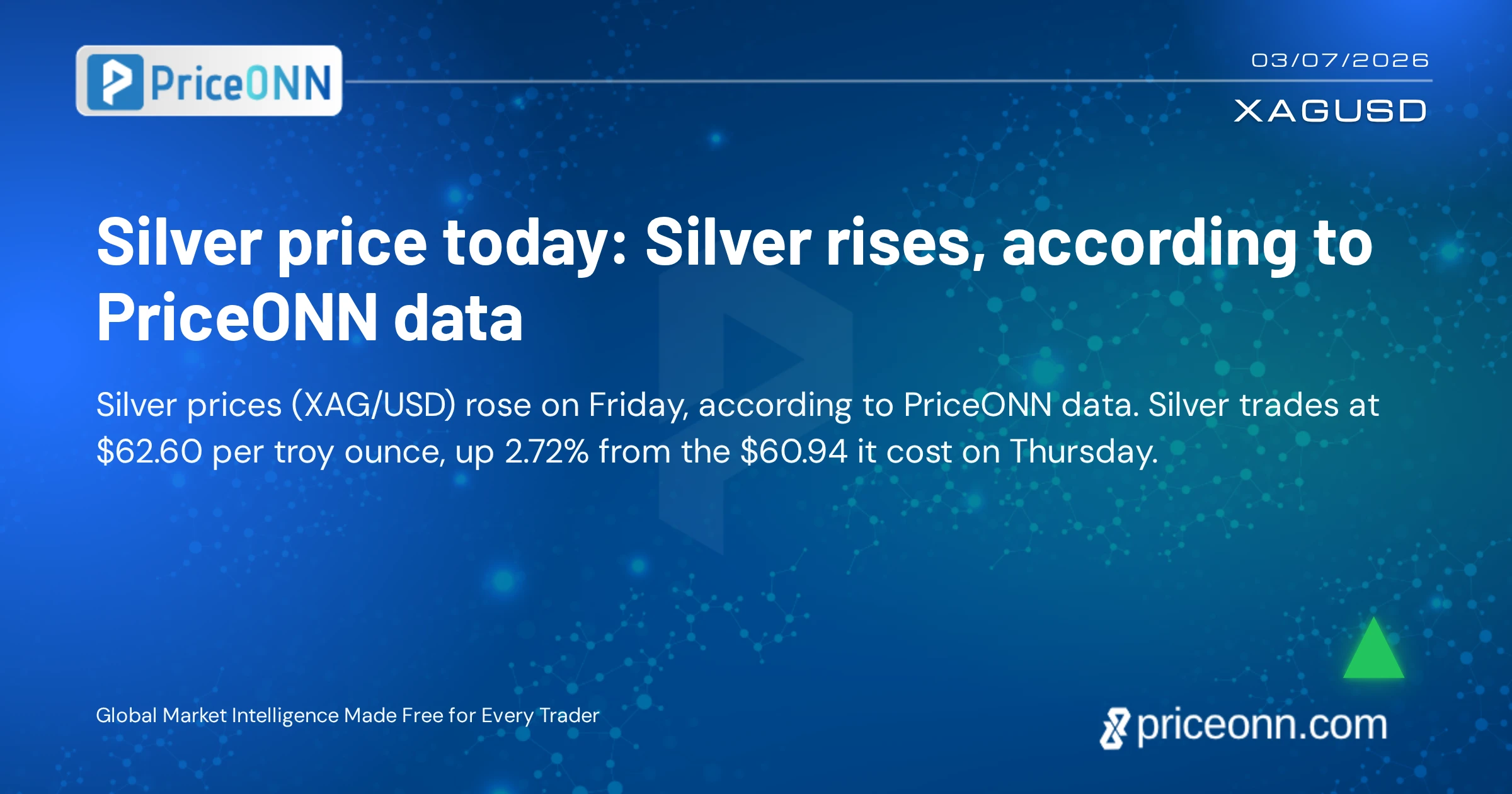
Silver price today: Silver rises, according to PriceONN data
 PriceONN Editorial Desk
Multi-source verification
PriceONN Editorial Desk
Multi-source verification
A Precious Metal's Dynamic Performance
Silver, a venerable precious metal, continues to capture investor attention, not just for its historical role as a store of value but as a dynamic trading instrument. While often overshadowed by its more famous counterpart, gold, silver presents a compelling avenue for portfolio diversification. Many traders turn to XAG/USD seeking an intrinsic value play or a potential shield against inflationary pressures.
Investment in silver manifests in multiple ways. Physical acquisition of coins and bars remains a traditional path. Alternatively, sophisticated financial instruments like Exchange Traded Funds (ETFs) offer market participants a way to track silver's price movements across global exchanges without holding the physical commodity. This accessibility broadens its appeal among a diverse investor base.
The trajectory of silver prices is influenced by a complex interplay of global economic and geopolitical forces. Its status as a safe-haven asset, though less pronounced than gold's, can drive prices higher during periods of geopolitical uncertainty or recessionary fears. As an asset that does not generate yield, silver often finds favor when interest rates are on a downward trend. Furthermore, the strength of the US Dollar plays a critical role; a robust dollar typically suppresses silver prices, while a weakening dollar tends to provide an upward tailwind.
Beyond macroeconomic factors, supply and demand dynamics are equally significant. Silver's considerably larger abundance compared to gold means mining output and recycling rates can exert substantial influence. Crucially, silver's extensive use in industrial applications, particularly in the electronics and solar energy sectors, cannot be overstated. Its superior electrical conductivity, surpassing even copper and gold, makes it indispensable. A surge in industrial demand can thus directly translate into higher silver prices, whereas a downturn in these sectors can lead to price erosion.
The economic engines of the United States, China, and India exert a considerable pull on silver prices. The substantial industrial bases in the US and especially China consume significant quantities of silver in manufacturing processes. Meanwhile, robust consumer demand for silver jewelry in India adds another layer to its price discovery. These regional economic trends, coupled with global market sentiment, shape silver's daily fluctuations.
A consistent pattern observed in the precious metals market is the tendency for silver prices to mirror gold's movements. When gold rallies, silver often follows, capitalizing on their shared perception as safe-haven assets. The Gold/Silver ratio serves as a key metric for investors assessing their relative valuations. A high ratio, indicating that many ounces of silver are needed to equate to one ounce of gold, might signal that silver is comparatively undervalued or gold is overvalued, prompting strategic adjustments in trading positions.
Reading Between the Lines
Friday's ascent in silver prices, pushing XAG/USD past the $62.60 mark, signals a renewed appetite for the precious metal. This 2.72% jump from Thursday's close at $60.94 is significant, suggesting that factors beyond simple safe-haven demand may be at play. Investors are likely weighing industrial outlooks against currency movements and broader inflation expectations.
This price action has immediate implications for related markets. The US Dollar Index (DXY), which has shown an inverse correlation with silver, warrants close observation; a continued slide in the dollar could fuel further gains for silver. Additionally, the performance of industrial commodities, particularly copper, often moves in tandem with silver due to their shared industrial utility. Equity markets, especially those in the technology and renewable energy sectors where silver is a key component, could also see ripple effects.
Traders should monitor the Gold/Silver ratio. A reading above 80 might suggest silver is lagging gold and could present a relative value opportunity. Conversely, a ratio below 70 often indicates gold is cheaper relative to silver. Key risks include unexpected hawkish shifts from major central banks, which could strengthen the dollar and pressure silver, or a sudden downturn in global manufacturing activity. Watch for any significant shifts in ETF inflows or outflows, as these can indicate institutional sentiment.
Track markets in real-time
Empower your investment decisions with AI-powered analysis, technical indicators and real-time price data.
Join Our Telegram Channel
Get breaking market news, AI analysis and trading signals delivered instantly to your Telegram.
Join Channel PriceONN News
Silver price (XAG/USD) gains ground for the fourth successive day, trading around $59.70 per troy ounce during the Asian hours on Wednesday. Silver prices are surging despite rising rate-hike expectations, as powerful market forces outweigh the drag of higher interest rates.
PriceONN News
Silver prices (XAG/USD) rose on Monday, according to PriceONN data. Silver trades at $56.83 per troy ounce, up 1.49% from the $56.00 it cost on Friday.
PriceONN News
Silver price (XAG/USD) gains ground for the second successive day, trading around $56.80 per troy ounce during the Asian hours on Monday.
PriceONN News
Silver (XAG/USD) is rallying, favoured by a mild US Dollar weakness on Tuesday.
PriceONN News
Silver (XAG/USD) advances toward $56.90 per troy ounce on Monday at the time of writing, gaining 1.62% on the day. The precious metal continues to benefit from safe-haven demand as geopolitical tensions in the Middle East keep risk sentiment under pressure.
PriceONN News
Silver price (XAG/USD) trades 1.33% lower to near $58.00 during the European trading session on Thursday. The white metal faces selling pressure as elevated energy prices due to renewed aggression between the United States (US) and Iran have de-anchored inflation expectations again.
PriceONN News
(RTTNews) - Gold prices have edged higher on Friday, partially offsetting the losses from yesterday's plunge after crude oil prices plummeted, lowering both oil-linked inflation concerns and the consequential expectations of an interest-rate hike by the U.S. Federal Reserve.
PriceONN News
(RTTNews) - Gold prices have tumbled on Thursday as the Middle East crisis deepens after Iran-backed Houthi militants of Yemen attacked two Saudi Arabian vessels in the Red Sea, raising concerns of intense oil supply disruption for an extended period. The possibility of an intere
PriceONN News
(RTTNews) - Gold prices traded higher on Wednesday, extending gains for a fourth consecutive session and hitting a two-week high as investors reacted to escalating Middle East tensions and looked ahead to next week's Federal Reserve meeting.
PriceONN News
Gold’s rally this week may prove to be one of the more important developments across financial markets-not simply because prices have reclaimed the $4,100 level, but because the move appears to contradict the macro forces that have governed precious metals for much of the second quarter. Silver has joined the advance, climbing back toward $60, […] The post Gold Defies Higher Oil and Yields. Is the Market Entering a New Regime? appeared first on ActionForex.
PriceONN News
Gold (XAU/USD) edges higher on Tuesday as buying interest around the $4,000 psychological level supports prices, while traders assess developments in the Middle East and their potential economic fallout. At the time of writing, XAU/USD trades around $4,058, up 1.27% on the day.
PriceONN News
Gold price (XAU/USD) is up 1.5% to near $4,067 during the European trading session on Tuesday. The precious metal outperforms as the rally in oil prices has stalled, with investors turning confident that negotiations between the United States (US) and Iran towards peace have resumed.