US Dollar Index rises for third straight day as safe-haven demand stretches
Dollar's Ascent Fueled by Risk Aversion
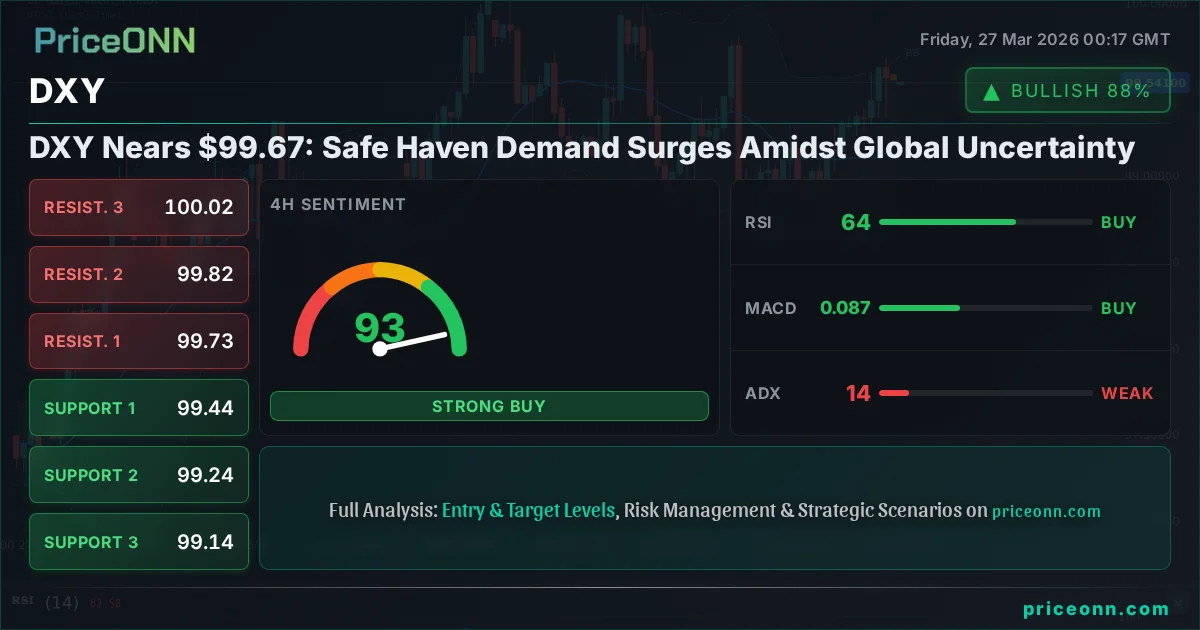
The US Dollar Index, a benchmark tracking the greenback's strength against a basket of major world currencies, continued its upward march on Thursday. For the third day running, the index saw a notable climb, pushing past intraday lows around 99.56 to flirt with the 99.90 level. This sustained rally underscores a growing appetite for perceived safety in financial markets, drawing capital away from riskier assets and into the world's preeminent reserve currency.
The US Dollar's global dominance is a well-established phenomenon. Beyond its role as the official currency of the United States, it serves as a de facto medium of exchange in numerous other nations. Its sheer volume in global trade is staggering; in 2022, it accounted for over 88% of all foreign exchange turnover, translating to an average daily transaction volume of approximately $6.6 trillion. This unparalleled liquidity and widespread acceptance cement its position as the linchpin of international finance.
Monetary Policy: The Fed's Crucial Role
The value of the US Dollar is intrinsically linked to the monetary policy decisions enacted by the Federal Reserve. Established after World War II, the Fed operates under a dual mandate: maintaining price stability, which generally means keeping inflation in check, and promoting maximum employment. The primary instrument for achieving these objectives is the adjustment of interest rates.
When inflationary pressures build and the consumer price index surpasses the Fed's target, typically around 2%, the central bank tends to raise interest rates. Higher rates make borrowing more expensive, which can cool demand and, consequently, bolster the dollar's value as investors are drawn to higher yields. Conversely, if inflation dips below the target or unemployment ticks upward significantly, the Fed might lower rates. This easing of monetary policy typically exerts downward pressure on the greenback.
In more extreme economic scenarios, the Federal Reserve possesses additional tools. It can resort to printing more dollars or implementing quantitative easing (QE). QE is an unconventional policy measure designed to inject liquidity into a faltering financial system, particularly when interbank lending freezes due to counterparty risk fears. This process involves the Fed purchasing assets, predominantly US government bonds from financial institutions, thereby increasing the money supply. Historically, QE has often been associated with a weakening dollar.
The inverse of QE is quantitative tightening (QT). Under QT, the Federal Reserve scales back its balance sheet by ceasing new bond purchases and not reinvesting the principal from maturing bonds. This reduction in the money supply typically provides support for the US Dollar.
Market Ripple Effects
The sustained strength of the US Dollar Index carries significant implications across various financial markets. As the DXY climbs, it often signals a global deleveraging trend or increased uncertainty, leading investors to shed riskier assets. This can manifest as pressure on emerging market currencies, which often struggle when global liquidity tightens and capital flows back to the perceived safety of the US.
Specifically, currency pairs like USD/JPY could see continued appreciation, as the Japanese Yen also often acts as a safe-haven asset, creating a complex dynamic. However, a strengthening dollar can make Japanese exports more expensive. Furthermore, commodities priced in dollars, such as Gold and crude oil, may face headwinds. A stronger dollar increases the cost of these commodities for holders of other currencies, potentially dampening demand and putting downward pressure on their prices.
Equity markets, particularly growth-oriented sectors and US technology stocks, can also feel the pinch. A stronger dollar can reduce the overseas earnings of US multinational corporations when translated back into dollars. Meanwhile, bond markets might react to the implicit signal of global risk aversion, potentially seeing yields stabilize or even dip as investors seek the relative safety of US Treasuries, though the Fed's monetary policy stance remains the dominant factor.
Reading Between the Lines
The current rally in the US Dollar Index is more than just a technical move; it reflects a palpable undercurrent of global economic anxiety. While the specific triggers might be varied and evolving, the consistent demand for the greenback suggests that markets are prioritizing capital preservation over speculative gains. This environment often favors assets that are perceived as stable or less volatile.
Traders and investors should closely monitor geopolitical developments and economic data releases from major economies. Any escalation of global tensions or signs of a significant economic slowdown in Europe or Asia could further bolster the dollar. Conversely, a decisive pivot in Federal Reserve policy or a clear resolution to international conflicts could lead to a reversal of this trend. The key is to watch for shifts in risk sentiment and how they are reflected in currency flows and commodity prices.
Track markets in real-time
Empower your investment decisions with AI-powered analysis, technical indicators and real-time price data.
Join Our Telegram Channel
Get breaking market news, AI analysis and trading signals delivered instantly to your Telegram.
Join Channel