
Gold Holds Firm Below $4,500 Amid Geopolitical Tensions and Dollar Strength

Gold is demonstrating notable resilience, trading just under the critical $4,500 psychological threshold during Asian market hours. This stability comes after an overnight rejection from the 100-day Simple Moving Average (SMA), suggesting underlying support even as immediate gains are capped.
Market Context
The precious metal has historically served as a cornerstone of value and a medium of exchange. In contemporary markets, beyond its aesthetic appeal for jewelry, gold is widely recognized as a premier safe-haven asset. This status means it is often sought after during periods of heightened global uncertainty and economic turbulence. Furthermore, gold is frequently viewed as a hedge against inflation and currency devaluation, benefiting from its independence from any single government or issuer.
Central banks remain significant holders of gold, often increasing their reserves to bolster economic confidence and currency strength during volatile times. In 2022, central banks collectively added approximately 1,136 tonnes of gold, valued at around $70 billion, marking the highest annual purchase on record, according to World Gold Council data. Emerging economies, including China, India, and Turkey, have been particularly active in expanding their gold holdings.
Analysis & Drivers
Gold's price dynamics are intricately linked to several key factors, most notably its inverse correlation with the US Dollar and US Treasuries, both of which are major reserve and safe-haven assets themselves. A depreciating US Dollar typically supports gold prices, as investors and central banks seek diversification. Conversely, a strengthening dollar tends to exert downward pressure on the yellow metal, as it becomes more expensive for holders of other currencies.
The precious metal also exhibits an inverse relationship with riskier assets like equities. A robust stock market rally can dampen gold prices, while sharp sell-offs in riskier markets often boost demand for gold. Geopolitical instability, fears of a recession, or significant global unrest can rapidly escalate gold prices due to its safe-haven appeal. As a non-yielding asset, gold generally performs better in an environment of lower interest rates. Conversely, rising interest rates, which increase the opportunity cost of holding gold, typically weigh on its price.
Trader Implications
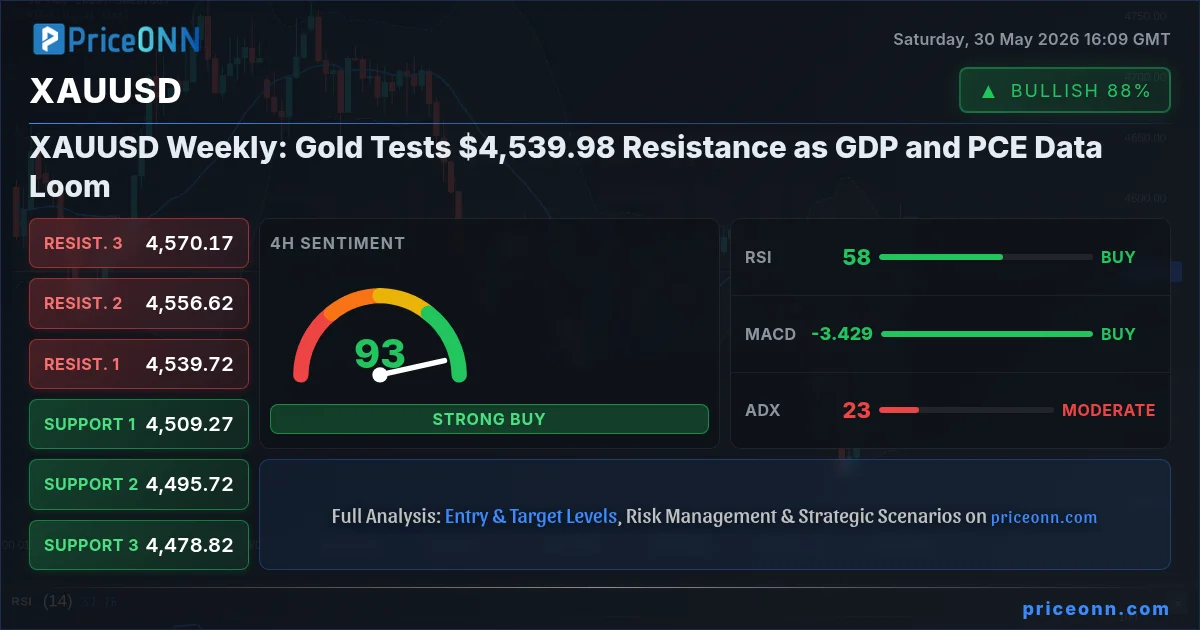
Traders are closely monitoring the interplay between geopolitical developments and the trajectory of the US Dollar. While ongoing international tensions provide a fundamental underpinning for gold's safe-haven status, a firming USD is acting as a significant headwind, preventing a decisive breakout above the $4,500 mark. Key levels to watch include the immediate resistance around $4,500 and the 100-day SMA, which currently acts as a dynamic resistance point. On the downside, support may be found near the recent lows around $4,450.
The current market sentiment suggests a cautious approach. Investors should be mindful of central bank commentary regarding monetary policy, as shifts in interest rate expectations can significantly impact gold. Furthermore, any escalation in geopolitical flashpoints could trigger a swift upward move, potentially invalidating the current bearish pressure from the dollar. A sustained move above $4,500 on increased volume would signal a potential continuation higher, while failure to do so could lead to further consolidation or a test of lower support levels.
Outlook
The immediate future for gold appears to be one of continued consolidation, contingent on the evolving geopolitical landscape and the strength of the US Dollar. While underlying safe-haven demand persists, the dollar's current bullish posture presents a significant challenge to gold's upside potential. Traders should remain vigilant for any shifts in global risk sentiment or central bank policy signals that could alter the current balance. Upcoming economic data releases from major economies, particularly the United States, will be crucial in shaping both currency and commodity markets.
Frequently Asked Questions
What is the current price trend for Gold (XAU/USD)?
Gold is currently consolidating below $4,500. While it shows resilience, it faces resistance from a strengthening US Dollar, capping immediate upside potential.
What are the main factors influencing Gold prices right now?
Key drivers include geopolitical tensions (boosting safe-haven demand) and the US Dollar's strength (acting as a headwind). Interest rate expectations and broader market risk sentiment also play significant roles.
What key levels should traders watch for Gold?
Traders should watch the $4,500 level as immediate resistance. Support is noted near recent lows around $4,450, with the 100-day SMA also acting as a technical barrier.
Track markets in real-time
Empower your investment decisions with AI-powered analysis, technical indicators and real-time price data.
Join Our Telegram Channel
Get breaking market news, AI analysis and trading signals delivered instantly to your Telegram.
Join Channel PriceONN News
Gold prices retreated to $4,504.30 per troy ounce despite ongoing geopolitical tensions and the closure of the Strait of Hormuz, suggesting a complex market dynamic beyond typical safe-haven demand. Silver, however, managed a modest gain.
PriceONN News
Gold futures broke above $4,500 per ounce on Friday, driven by increasing optimism for a de-escalation in the U.S.-Iran conflict and the potential reopening of the Strait of Hormuz. Silver also saw significant gains, reflecting a broader shift towards precious metals as geopolitical tensions ease.
PriceONN News
Gold prices experienced a significant decline on Wednesday, falling over 1% as diplomatic optimism surrounding U.S.-Iran talks grew, despite ongoing military actions. The June gold contract settled at $4,444.50.
PriceONN News
Gold prices experienced a significant downturn, shedding 2% this week to settle near $4,444.50 per ounce. This decline is attributed to evolving U.S.-Iran diplomatic efforts and concerns over potential central bank rate hikes.
PriceONN News
Gold prices are facing intense scrutiny at the critical $4500 per ounce support level, even as industrial metals like copper surge and the US dollar softens amid renewed geopolitical optimism.
PriceONN News
Gold prices surged by 1% to approximately $4,556 on Monday as market participants reacted to developing news of a potential US-Iran peace deal. The speculation weakened the US Dollar and sent oil prices tumbling.
PriceONN News
Gold prices are under intense scrutiny as they hover around the critical $4500 per ounce support level. The precious metal faces pressure from a risk-on environment, despite a weaker dollar and strength in industrial commodities like copper.
PriceONN News
Gold prices fell on Friday as concerns over crude oil inventories and the prolonged closure of the Strait of Hormuz fueled inflation anxieties, overshadowing U.S.-Iran peace talks. The June Comex Gold contract settled down 0.55% at $4,517.40.
PriceONN News
(RTTNews) - Gold prices have soared on Friday amid rising optimism about an end to the Middle East war with the chances of reopening of the Strait of Hormuz and resumption of oil and energy trade growing stronger.
PriceONN News
(RTTNews) - Gold held firm above $4,500 an ounce on Friday, the dollar headed for a small weekly loss on improved risk sentiment in markets, and oil prices slipped to a one-month low amid investor optimism that the Middle East conflict is inching toward an end and that the reopen
PriceONN News
(RTTNews) - After moving sharply lower earlier in the day, the price of gold has shown a significant turnaround over the course of the trading session on Thursday.
PriceONN News
Gold prices fell below the $4500 mark on Wednesday, extending previous losses as oil prices tumbled and geopolitical tensions between the US and Iran remained a key market driver. Investors are weighing inflation concerns against hopes of de-escalation.