
Why Did Gold Prices Jump 1% Amidst US-Iran Deal Speculation and Dollar Weakness?

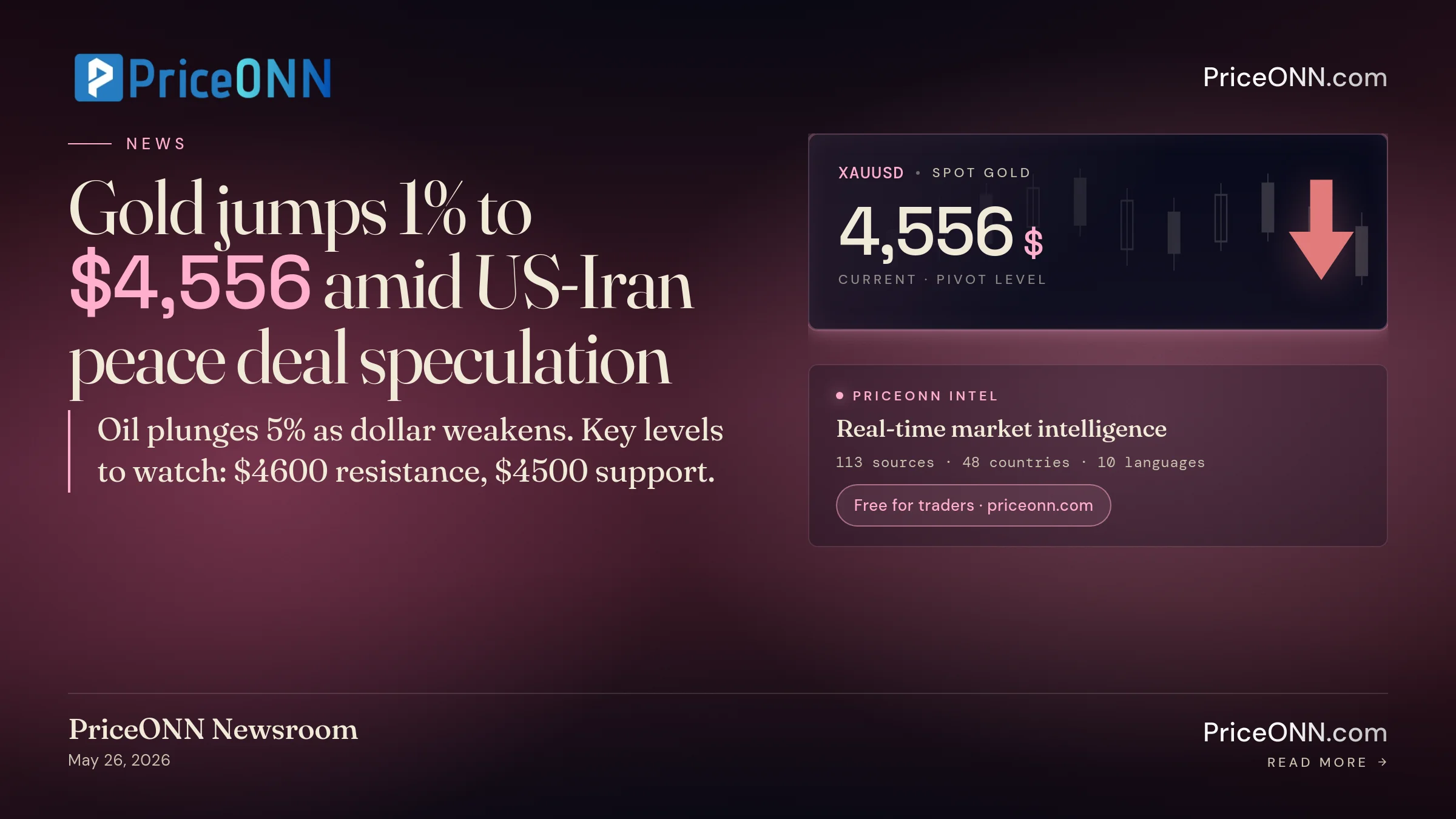
Gold prices experienced a significant rebound on Monday, climbing 1.0% to around $4,556 per ounce. This upward movement in the precious metal was largely driven by a developing narrative around potential diplomatic progress between the United States and Iran. The prospect of a de-escalation in Middle East tensions, which could lead to the reopening of the critical Strait of Hormuz shipping lane, has injected a new dynamic into global markets, impacting currency valuations and commodity prices.
Market Context: A Geopolitical Pivot's Impact
The precious metal staged a notable recovery, reversing recent downward trends as traders assessed the implications of evolving geopolitical developments. At the time of writing, XAU/USD was trading at approximately $4,556, reflecting a gain of 1.0% for the session. This price action underscores gold's sensitivity to global risk sentiment and geopolitical stability. The catalyst for this surge appears to be burgeoning hope for a diplomatic resolution to the conflict in the Middle East, specifically an agreement that could ensure the unimpeded passage through the Strait of Hormuz. This development gained traction following statements from U.S. President Donald Trump, who characterized ongoing discussions with Iran as proceeding in a "constructive and orderly fashion."
The potential terms of such an accord, as reported, suggest a comprehensive deal that might include a 60-day extension of the current ceasefire, an end to naval blockades affecting Iranian ports, and the resumption of normal traffic through the Strait of Hormuz. These developments are occurring concurrently with ongoing dialogue concerning Iran's nuclear program, adding layers of complexity to the situation.
Analysis & Drivers: Dollar Dip and Oil Plunge
The ripple effects of these potential diplomatic overtures were immediately apparent across major financial markets. Crude oil prices, which had previously benefited from supply concerns stemming from Middle East tensions, saw a substantial sell-off. West Texas Intermediate (WTI) futures, for instance, plummeted by over 5% during the trading period. This sharp decline reflects market expectations that a reduction in geopolitical risk will alleviate the supply-side pressures that have been supporting oil prices.
Simultaneously, the U.S. Dollar Index (DXY), a key gauge of the greenback's strength against a basket of major currencies, retreated, testing levels near 99.00. A weaker U.S. dollar is generally a supportive factor for gold, as the commodity is denominated in dollars. When the dollar weakens, gold becomes less expensive for holders of other currencies, potentially increasing demand. This inverse relationship is a fundamental driver for gold's price movements in response to shifts in monetary policy expectations and geopolitical sentiment.
Further adding to the nuanced picture are the cautious tones emerging from political figures. While President Trump's initial remarks suggested an imminent deal, subsequent statements indicated a more measured approach, with officials reportedly advised not to rush the process. Reports have nevertheless surfaced regarding a fundamental agreement to reopen the Strait of Hormuz, with Iran purportedly agreeing to relinquish highly enriched uranium. However, significant hurdles remain. Israeli Prime Minister Benjamin Netanyahu stressed that any definitive accord must involve the dismantling of Iran's nuclear enrichment infrastructure and the removal of all enriched nuclear material from its territory. Iran's President Masoud Pezeshkian stated on Sunday that Tehran is "ready to reassure the world that we are not seeking nuclear weapons," yet Iranian media outlets have pointed to ongoing U.S. obstruction regarding Tehran's demands for the release of frozen financial assets, highlighting the delicate nature of these negotiations.
Trader Implications: Key Levels and Risk Factors
For traders and investors, the current environment presents both opportunities and risks. The immediate upward momentum in gold suggests that market sentiment is leaning towards a risk-on appetite, driven by the prospect of reduced geopolitical friction and a weaker dollar. Key resistance levels for gold will be closely watched, with a sustained break above $4,600 potentially signaling further upside potential. Conversely, a failure to maintain upward momentum could see prices retrace towards immediate support around $4,500.
Traders should remain vigilant regarding any official statements from the U.S. and Iranian governments, as well as key stakeholders like Israel. Any indication of a breakdown in negotiations or renewed escalations could rapidly shift market sentiment back towards safe-haven assets like gold, leading to a swift reversal of current price action. The U.S. Dollar's trajectory will also be a critical barometer; a sustained decline below the 99.00 mark could provide further tailwinds for gold, while a rebound in the DXY might exert downward pressure on the precious metal.
The dramatic fall in oil prices also presents trading opportunities. Traders might look for signs of stabilization in crude oil markets, potentially indicating that the initial sell-off has overextended or that the market is pricing in a high degree of certainty regarding the Strait of Hormuz reopening. However, the volatility in oil remains high, making it susceptible to sharp reversals based on geopolitical news flow.
Outlook: Navigating Uncertainty
The outlook for gold remains closely tied to the progression of U.S.-Iran diplomatic efforts. Should a comprehensive deal materialize and lead to a sustained de-escalation of tensions and the reopening of the Strait of Hormuz, gold prices could face headwinds as safe-haven demand diminishes. However, underlying inflationary concerns and the broader economic outlook, coupled with potential shifts in central bank policies, will continue to provide a supportive backdrop for the precious metal. Traders will be closely monitoring upcoming economic data releases from major economies and statements from central bankers for further clues on market direction. The market's reaction to any confirmed details of the U.S.-Iran accord will be the primary driver in the short term, with gold likely to remain sensitive to shifts in geopolitical risk perception.
Frequently Asked Questions
What is the current price of gold and its percentage change?
As of Monday, gold (XAU/USD) is trading around $4,556, marking a 1.0% increase on the day, driven by hopes of a U.S.-Iran deal.
How are oil prices reacting to the potential US-Iran agreement?
Crude oil prices have fallen sharply, with WTI futures dropping over 5%, as the market anticipates an easing of supply concerns due to the potential reopening of the Strait of Hormuz.
What key levels should traders watch for gold in the near term?
Traders should monitor key resistance at $4,600 for further upside, while support is seen around $4,500. A sustained break above $4,600 could signal continued gains.
Track markets in real-time
Empower your investment decisions with AI-powered analysis, technical indicators and real-time price data.
Join Our Telegram Channel
Get breaking market news, AI analysis and trading signals delivered instantly to your Telegram.
Join Channel PriceONN News
(RTTNews) - Gold prices were sharply lower on Tuesday as traders waited for the Federal Reserve policy decision.
PriceONN News
(RTTNews) - Gold prices have advanced on Monday, extending the gains from Friday's session as a pause on mutual attacks by both the U.S. and Iran eased escalation tensions in the ongoing gulf crisis. Expectations of a tighter monetary policy in the U.S. diminished amid a freefall
PriceONN News
(RTTNews) - Gold prices have edged higher on Friday, partially offsetting the losses from yesterday's plunge after crude oil prices plummeted, lowering both oil-linked inflation concerns and the consequential expectations of an interest-rate hike by the U.S. Federal Reserve.
PriceONN News
(RTTNews) - Gold prices fell from a two-week high on Thursday as escalating West Asia tensions rekindled inflation fears and clouded the outlook for interest rates.
PriceONN News
Gold (XAU/USD) rallies to an over two-week high, around the $4,140-$4,141 area, during the Asian session on Wednesday amid hopes that US-Iran diplomacy could ease energy prices and temper hawkish US Federal Reserve (Fed) expectations.
PriceONN News
Gold (XAU/USD) edges higher on Tuesday as buying interest around the $4,000 psychological level supports prices, while traders assess developments in the Middle East and their potential economic fallout. At the time of writing, XAU/USD trades around $4,058, up 1.27% on the day.
PriceONN News
Gold price (XAU/USD) is up 1.5% to near $4,067 during the European trading session on Tuesday. The precious metal outperforms as the rally in oil prices has stalled, with investors turning confident that negotiations between the United States (US) and Iran towards peace have resumed.
PriceONN News
Gold (XAU/USD) regains positive traction following the previous day's two-way price moves, though it struggles to capitalize on the move and trades below the $4,050 level during the Asian session on Tuesday.
PriceONN News
Gold (XAU/USD) trades in a volatile range on Monday as markets react to conflicting headlines from the Middle East. At the time of writing, XAU/USD trades around $4,010, little changed on the day after climbing to an intra-day high of $4,040.
PriceONN News
(RTTNews) - Gold was little changed on Monday, reversing early losses as the dollar eased and risk currencies rebounded on signs of renewed diplomatic efforts between the United States and Iran.
PriceONN News
The Gold price turns negative on Wednesday, even though the last two US inflation reports showed that prices are dropping, though developments in the Middle East sent energy prices higher. At the time of writing, the XAU/USD traded at $4,034, down some 0.53%.
PriceONN News
(RTTNews) - Gold prices have tumbled on Thursday as the Middle East crisis deepens after Iran-backed Houthi militants of Yemen attacked two Saudi Arabian vessels in the Red Sea, raising concerns of intense oil supply disruption for an extended period. The possibility of an intere