USD/JPY retreats below 160.00 on the BoJ's hawkish summary ahead of Tokyo CPI

Yen Stages Comeback Amid Shifting BoJ Stance
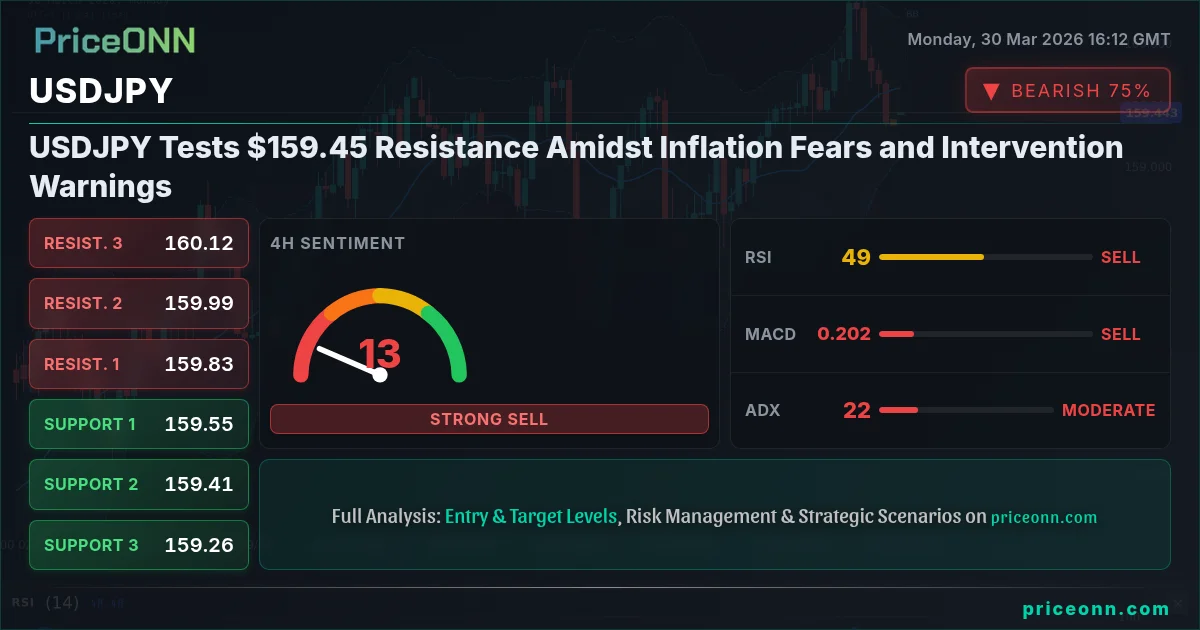
The Japanese Yen, a cornerstone of global forex markets, experienced a notable reversal on Monday. After touching a fresh year-to-date peak just above 160.50 against the US Dollar, the USD/JPY cross reversed course, dipping 0.38% to finish the session around the 159.70 level. This pullback occurred as market participants digested the implications of the Bank of Japan's latest policy meeting minutes, which suggested a potentially less accommodative future.
For years, the Yen's trajectory has been closely tied to the health of the Japanese economy, but more critically, to the monetary policy decisions emanating from the Bank of Japan (BoJ). Its status as a heavily traded currency also means its value is intrinsically linked to the interest rate differentials with major economies like the United States, and broader market risk appetite. The BoJ, tasked with managing currency stability, has not shied away from direct market intervention historically, though such actions are infrequent and often carry political sensitivities with key trading partners.
The prolonged era of ultra-loose monetary policy from 2013 through early 2024 created a significant policy divergence between the BoJ and its global counterparts. This gap directly fueled a depreciation in the Yen, as capital flowed towards higher yields elsewhere. However, recent signals from the BoJ indicating a gradual departure from this ultra-accommodative stance have begun to offer some much-needed support to the beleaguered currency.
The widening gap between Japanese and US sovereign debt yields, particularly at the 10-year maturity, has been a primary driver of the US Dollar's strength against the Yen over the past decade. This divergence was largely a consequence of the BoJ's steadfast commitment to its unconventional policies while other major central banks, notably the US Federal Reserve, moved towards normalization. The BoJ's pivotal decision in 2024 to slowly pivot away from its negative interest rate policy and yield curve control, coupled with anticipated rate cuts from other leading central banks, is now working to narrow this critical yield differential.
Traditionally, the Japanese Yen is often perceived as a safe-haven asset. This characteristic typically sees increased demand during periods of global economic uncertainty or market turmoil, as investors seek refuge in its perceived stability. Consequently, turbulent financial environments often correlate with an appreciation of the Yen's value relative to currencies perceived as higher risk.
Market Ripple Effects
The recent volatility in USD/JPY, influenced by the Bank of Japan's policy signals, carries significant implications beyond the immediate currency pair. Traders and investors will be closely monitoring this dynamic for potential impacts across a range of interconnected markets. The narrowing yield differential between Japan and the US could exert downward pressure on the US Dollar Index (DXY), particularly if the Federal Reserve signals a more aggressive easing path than previously anticipated.
Furthermore, shifts in the Yen's valuation can influence Japanese equity markets. A stronger Yen typically makes Japanese exports more expensive, potentially dampening the performance of export-oriented companies listed on the Nikkei 225. Conversely, any sustained Yen weakness could provide a tailwind for these firms. The safe-haven appeal of the Yen means its fluctuations can also serve as a barometer for global risk sentiment. A sudden strengthening of the Yen might indicate rising global anxieties, potentially leading to broader risk-off sentiment in equity markets and a move away from riskier assets.
The Bank of Japan's policy evolution is a critical development that could ripple into global bond markets. As Japanese yields potentially rise in anticipation of further policy normalization, this could attract capital back to Japan, influencing global bond flows and potentially affecting yields in other major economies. Investors should therefore watch the interplay between the Yen, the US Dollar, Japanese equities, and global bond yields for a comprehensive view of market sentiment.
Track markets in real-time
Empower your investment decisions with AI-powered analysis, technical indicators and real-time price data.
Join Our Telegram Channel
Get breaking market news, AI analysis and trading signals delivered instantly to your Telegram.
Join Channel