
Why Did the Australian Dollar Slip After Weakening Manufacturing Data?

The Australian Dollar (AUD) experienced downward pressure following the release of preliminary manufacturing data for March, which indicated a slowdown in the sector's expansion. The S&P Global Manufacturing Purchasing Managers' Index (PMI) edged down to 50.1, a slight decrease from February's reading of 51.0. This figure hovers precariously close to the 50-point threshold, which delineates the boundary between economic expansion and contraction, suggesting that while the sector remains in growth territory, its momentum has considerably waned.
Market Context
The manufacturing sector's performance is a key barometer for economic health, reflecting trends in production, new orders, and employment. A reading of 50.1 indicates that growth has slowed but has not yet turned negative. However, its proximity to the contractionary zone means that any further deterioration could signal broader economic headwinds. This development comes as the Reserve Bank of Australia (RBA) continues to navigate domestic inflation targets, which ideally lie between 2% and 3%. The RBA's monetary policy decisions, including interest rate adjustments, are critical drivers for the AUD, alongside global economic sentiment and commodity prices, given Australia's significant export base.
Analysis & Drivers
The slight decline in Australia's manufacturing PMI suggests that domestic industrial activity is facing increasing challenges. While not a definitive sign of recession, a sustained trend near the 50-point mark warrants attention. This data point, when viewed alongside other economic indicators, can influence market expectations regarding the RBA's future policy actions. A weaker economic outlook might lead to speculation of a more dovish stance from the central bank, potentially capping gains for the Australian Dollar. Furthermore, global economic conditions and demand from major trading partners, particularly China, play a pivotal role in Australia's export-driven economy. Any signs of slowing global growth or reduced demand for commodities could further dampen the outlook for Australian manufacturing and, by extension, the AUD.
Trader Implications
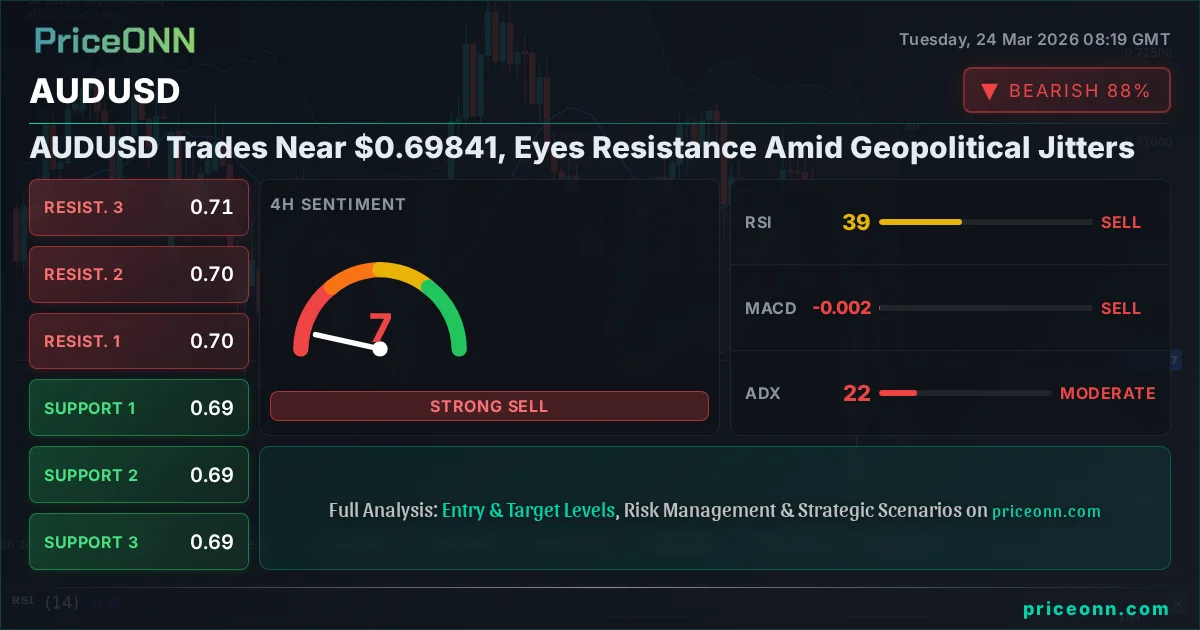
Traders monitoring the Australian Dollar should pay close attention to the manufacturing PMI and other leading economic indicators. The 50.1 print suggests that the AUD may face resistance from further appreciation in the short term, especially if upcoming data points also indicate cooling economic activity. Key levels to watch for AUD/USD include the 0.6500 support and potential resistance around 0.6650. A decisive break below 0.6500 could signal a deeper correction, while a sustained move above 0.6650 might indicate renewed bullish sentiment. Traders should also consider the RBA's forward guidance and inflation data, as these will heavily influence interest rate expectations and, consequently, the currency's trajectory.
Outlook
The immediate outlook for the Australian Dollar will likely be shaped by further economic data releases from Australia and its major trading partners. The cooling manufacturing sentiment suggests a cautious approach for the AUD, with potential for volatility. Investors will be watching for any signs of a rebound in manufacturing or other sectors to gauge the broader economic resilience. Upcoming inflation figures and central bank commentary will be crucial in determining the RBA's next moves, impacting the currency's direction in the coming weeks.
Frequently Asked Questions
What does the 50.1 PMI reading mean for Australia's economy?
A PMI reading of 50.1 indicates that Australia's manufacturing sector is still experiencing growth, but the expansion has slowed significantly. It is just above the 50-point threshold, suggesting that the sector is vulnerable to entering contraction if conditions worsen.
How does this affect the Australian Dollar (AUD)?
The weakening manufacturing data can put downward pressure on the AUD as it suggests potential economic slowdown. This might lead traders to anticipate a more cautious stance from the Reserve Bank of Australia, making the currency less attractive. Key support for AUD/USD is seen around 0.6500.
What should traders watch next for the Australian Dollar?
Traders should monitor upcoming Australian inflation data and commentary from the Reserve Bank of Australia for clues on future monetary policy. Additionally, global commodity prices and economic health in China will remain significant drivers for the AUD.
Track markets in real-time
Empower your investment decisions with AI-powered analysis, technical indicators and real-time price data.
Join Our Telegram Channel
Get breaking market news, AI analysis and trading signals delivered instantly to your Telegram.
Join Channel


PriceONN