
Why Did Gold Slip Below $2,300 Amid Shifting Global Tensions?
Gold (XAU/USD) experienced a notable downturn on Thursday, breaking a two-day streak of gains and dipping below the $2,300 per ounce level. This decline occurred as market participants navigated a complex interplay of geopolitical uncertainties and evolving interest rate expectations, which ultimately overshadowed gold's traditional safe-haven appeal.
Market Context
The precious metal has been sensitive to shifts in global sentiment, particularly concerning developments in the Middle East. Tensions surrounding potential US-Iran negotiations have kept markets on edge, creating a backdrop of uncertainty. However, the primary driver for gold's recent pullback appears to stem from a renewed hawkish tilt in global interest rate outlooks. This shift is largely attributed to an inflation shock originating from the energy markets, which has prompted central banks to signal a more protracted stance on interest rate policy than previously anticipated. This environment, where higher rates can increase the opportunity cost of holding non-yielding assets like gold, has led to a reassessment of its attractiveness.
Analysis & Drivers
Gold's role as a safe haven is being tested by a dual set of pressures. On one hand, geopolitical friction, such as that potentially involving US-Iran relations, typically bolsters demand for gold as investors seek to preserve capital amidst instability. Historically, gold's intrinsic value, independent of any single government or financial institution, has made it a reliable store of wealth. This is underscored by significant central bank activity; in 2022 alone, central banks acquired approximately 1,136 tonnes of gold, a record worth roughly $70 billion, according to industry data. Emerging economies, notably China, India, and Turkey, have been particularly aggressive in expanding their reserves, signaling a long-term strategic importance for the metal.
On the other hand, the prospect of persistently higher interest rates globally acts as a significant headwind. Gold typically exhibits an inverse relationship with the US Dollar and US Treasuries, and a strong correlation with rising yields on these assets can diminish gold's appeal. When interest rates climb, the return offered by interest-bearing assets becomes more attractive relative to gold, which offers no yield. This dynamic is amplified when inflation, potentially exacerbated by energy price shocks, forces central banks to maintain restrictive monetary policies for longer. The market is currently weighing the safe-haven bid from geopolitical events against the restrictive economic backdrop posed by hawkish monetary policy.
Trader Implications
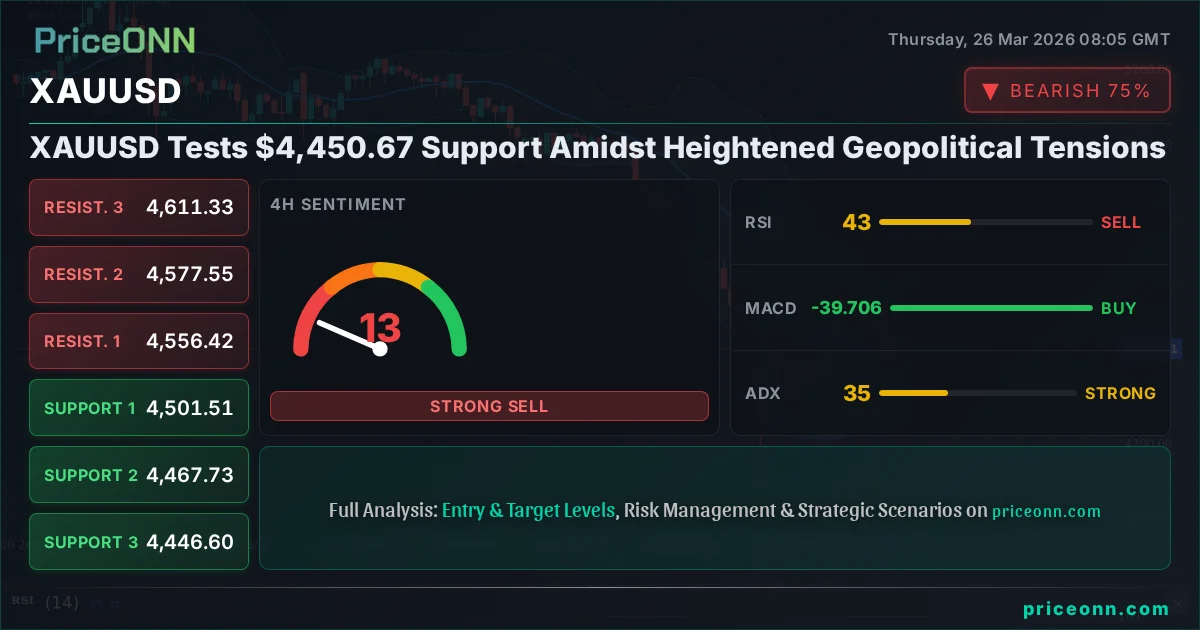
Traders are closely monitoring key price levels for gold. A sustained break below the $2,300 psychological mark could signal further downside pressure, with the next significant support potentially emerging around the $2,250 area. Conversely, any de-escalation in geopolitical tensions or dovish signals from major central banks could reignite buying interest, with resistance likely to be encountered near the recent highs around $2,350 and potentially towards $2,400. Volatility is expected to remain elevated as markets digest conflicting economic and geopolitical data. Key indicators to watch include US inflation prints, central bank commentary on interest rates, and developments in the Middle East.
Outlook
The near-term outlook for gold remains uncertain, caught between geopolitical risk premiums and the restrictive implications of a hawkish global interest rate environment. While central bank demand provides a structural floor, short-term price action will likely be dictated by the ebb and flow of geopolitical news and the evolving narrative around inflation and monetary policy. A decisive shift towards rate cuts could see gold regain its upward momentum, but persistent inflation or escalating global tensions could also provide support, albeit potentially at lower price points if interest rate differentials widen significantly. Traders should remain vigilant for shifts in market sentiment and be prepared for continued price swings.
Frequently Asked Questions
What is the current price of gold and what caused the recent drop?
Gold (XAU/USD) recently fell below $2,300 per ounce. This decline was driven by a combination of geopolitical uncertainties, particularly concerning US-Iran relations, and renewed hawkish sentiment from central banks regarding interest rates, fueled by an energy-driven inflation shock.
How have central bank gold purchases influenced the market?
Central banks are significant buyers of gold, with record purchases of approximately 1,136 tonnes in 2022. This consistent demand, especially from emerging economies, provides a structural support level for gold prices, reinforcing its role as a reserve asset.
What are the key levels traders should watch for gold in the short term?
Traders should monitor the $2,300 level as immediate support. A break below could target $2,250. Resistance is seen near recent highs around $2,350, with a move towards $2,400 possible on renewed bullish sentiment.
Track markets in real-time
Empower your investment decisions with AI-powered analysis, technical indicators and real-time price data.
Join Our Telegram Channel
Get breaking market news, AI analysis and trading signals delivered instantly to your Telegram.
Join Channel
PriceONN