
Why Did WTI Crude Oil Stall Near $91 After a Brief Rally?

West Texas Intermediate (WTI) crude oil prices are exhibiting a pause in their upward momentum, trading around the $90.50 level during Thursday's Asian session. After a brief rally, the benchmark U.S. crude contract is consolidating, caught between mixed geopolitical signals and a market reassessment of global supply dynamics. This three-day trading range suggests a temporary equilibrium, with traders awaiting clearer direction.
Market Context
The WTI benchmark has been confined to a narrow band for three consecutive days, indicating a standoff between potential supply disruptions and hopes for de-escalation in key geopolitical regions. Despite a recent push back above $91.00, the intraday uptick lacks strong bullish conviction. Key technical indicators suggest resistance building, particularly around the 200-hour Exponential Moving Average (EMA), which bulls are seeking to overcome. The market is digesting a complex interplay of factors, including the potential for a renewed surge in demand versus easing supply tensions.
Analysis & Drivers
Several factors are contributing to WTI's current indecision. Geopolitical developments in the Middle East remain a primary wildcard, capable of introducing significant supply risk premiums. However, any perceived de-escalation can quickly temper these premiums, leading to price retracements. The decisions of OPEC and its allies (OPEC+) regarding production quotas continue to be a significant influence; any indication of output adjustments could shift market sentiment. Furthermore, the strength of the U.S. dollar plays a pivotal role. A stronger dollar typically exerts downward pressure on oil prices as it makes the commodity more expensive for holders of other currencies, while a weaker dollar can provide support. Weekly U.S. crude inventory reports from the American Petroleum Institute (API) and the Energy Information Administration (EIA) are also closely watched. A significant drop in inventories, such as one indicating increased demand or unexpected supply constraints, could provide the catalyst for a breakout, while rising inventories could weigh on prices.
Trader Implications
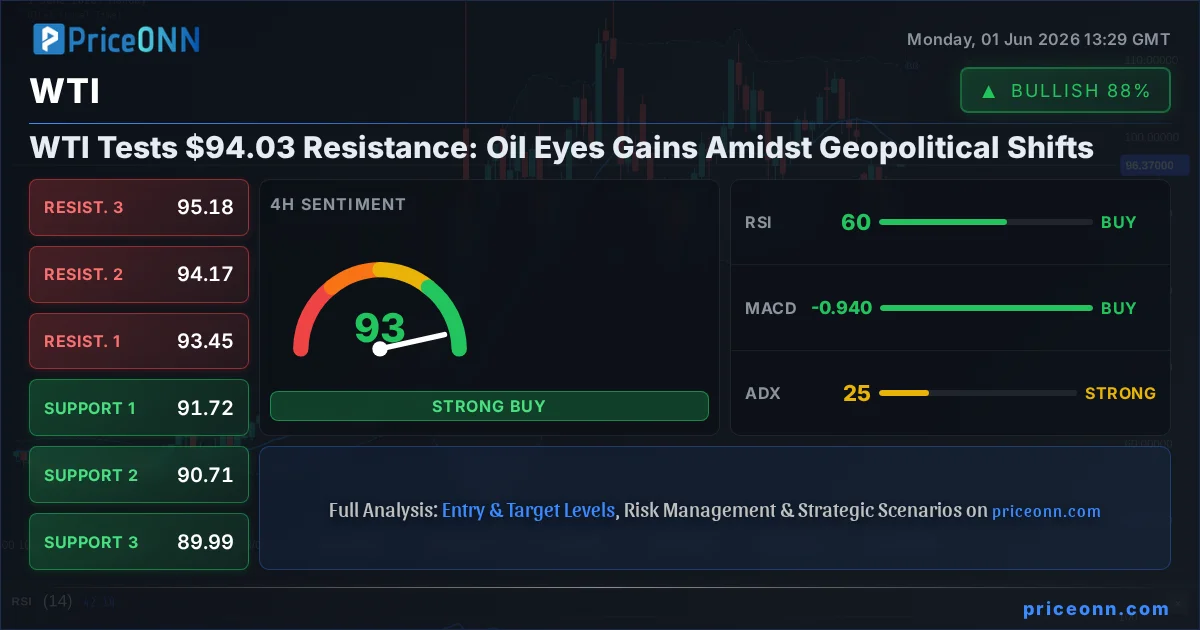
Traders are advised to monitor the $91.00-$92.00 range as a critical area for a potential breakout. A sustained move above the 200-hour EMA and the upper bounds of the current range could signal a resumption of the bullish trend, with immediate targets potentially reaching towards $93.50 and then the $95.00 resistance. Conversely, a failure to overcome these levels could lead to a pullback. Key support levels to watch on the downside are $90.00, followed by the psychological $89.00 mark. A decisive break below $88.50 could signal a more significant correction, potentially revisiting lower levels around $87.00. The market sentiment appears cautiously optimistic, but conviction remains low, suggesting that a clear catalyst is needed to drive prices decisively in either direction.
Outlook
The immediate outlook for WTI crude oil hinges on its ability to break through immediate technical resistance and the unfolding geopolitical landscape. While consolidation around the $90.50 mark suggests underlying support, the lack of conviction above $91.00 points to significant overhead supply. Upcoming inventory data and any new developments from the Middle East will be crucial in determining the next directional move. Traders should remain vigilant for shifts in supply expectations and demand signals.
Frequently Asked Questions
What is the immediate resistance level for WTI crude oil?
The immediate resistance for WTI crude oil is forming around the $91.00-$92.00 range, with the 200-hour EMA also acting as a technical hurdle. A sustained break above this zone is needed for further upward momentum.
What are the key support levels to watch for WTI?
Key support levels for WTI crude oil are the $90.00 psychological mark, followed by $89.00. A break below $88.50 could indicate a more substantial price decline.
What could drive WTI prices higher in the near term?
A significant catalyst for higher WTI prices would be a clear de-escalation of geopolitical tensions in the Middle East, coupled with strong weekly inventory drawdowns, indicating robust demand or unexpected supply constraints.
Track markets in real-time
Empower your investment decisions with AI-powered analysis, technical indicators and real-time price data.
Join Our Telegram Channel
Get breaking market news, AI analysis and trading signals delivered instantly to your Telegram.
Join Channel PriceONN News
Crude oil prices experienced a significant drop, with WTI futures falling over 1.8% to $87.25, as optimism grew for a U.S.-Iran deal potentially reopening the Strait of Hormuz.
PriceONN News
(RTTNews) - Crude oil prices have tumbled on Friday as expectations of the U.S. and Iran signing a Memorandum of Understanding run high. The MoU would allow for immediate reopening of the Strait of Hormuz and pave the way for the resumption of oil and energy trade.
PriceONN News
Crude oil futures experienced a dramatic intraday reversal on Thursday, soaring overnight on geopolitical fears only to pull back significantly as reports of a potential diplomatic understanding between the U.S. and Iran emerged.
PriceONN News
Global oil prices are treading water after a significant 5% slump, as market sentiment grapples with cautious optimism over Middle East de-escalation efforts versus lingering geopolitical uncertainties. Brent crude hovers near $104.72 and WTI near $98.07.
PriceONN News
Crude oil prices experienced a sharp decline, with WTI futures for July delivery falling 5.66% to $98.26. This drop is largely attributed to renewed diplomatic efforts aimed at de-escalating the U.S.-Iran conflict and easing tensions around the Strait of Hormuz.
PriceONN News
Crude oil prices experienced a significant downturn as market sentiment shifted towards optimism about a potential US-Iran Memorandum of Understanding that could reopen the Strait of Hormuz. WTI futures fell nearly 2% on the news.
PriceONN News
Crude oil futures experienced a dramatic intraday reversal, soaring to $92.52 before pulling back significantly on Thursday. The volatile session was driven by shifting geopolitical narratives and U.S. inventory data.
PriceONN News
(RTTNews) - Crude oil futures skyrocketed overnight but have shown a significant pullback over the course of the trading day on Thursday.
PriceONN News
(RTTNews) - Extending the losses from yesterday's session, crude oil prices have gone into freefall on Wednesday as investor expectations on a potential U.S.-Iran agreement continue to rise despite the U.S. refusing to ease its demands.
PriceONN News
(RTTNews) - Crude oil prices have tumbled on Tuesday as optimism about a U.S.-Iran peace deal that could lead to reopening of the Strait of Hormuz soon grows despite reports of fresh U.S. strikes on Iran yesterday.
PriceONN News
(RTTNews) - After surging early in the day, crude oil prices have tumbled over the course of the trading session on Thursday. With the downturn, crude oil is extending the losses from the two previous sessions, as investors watch the developments in U.S.-Iran peace talks.
PriceONN News
WTI Crude Oil futures experienced a sharp decline of over 5.6%, falling to $98.26 per barrel as diplomatic efforts between the U.S. and Iran gained significant momentum, easing supply disruption fears.