
Why is the US Dollar Gaining Ground as Middle East Tensions Rise?

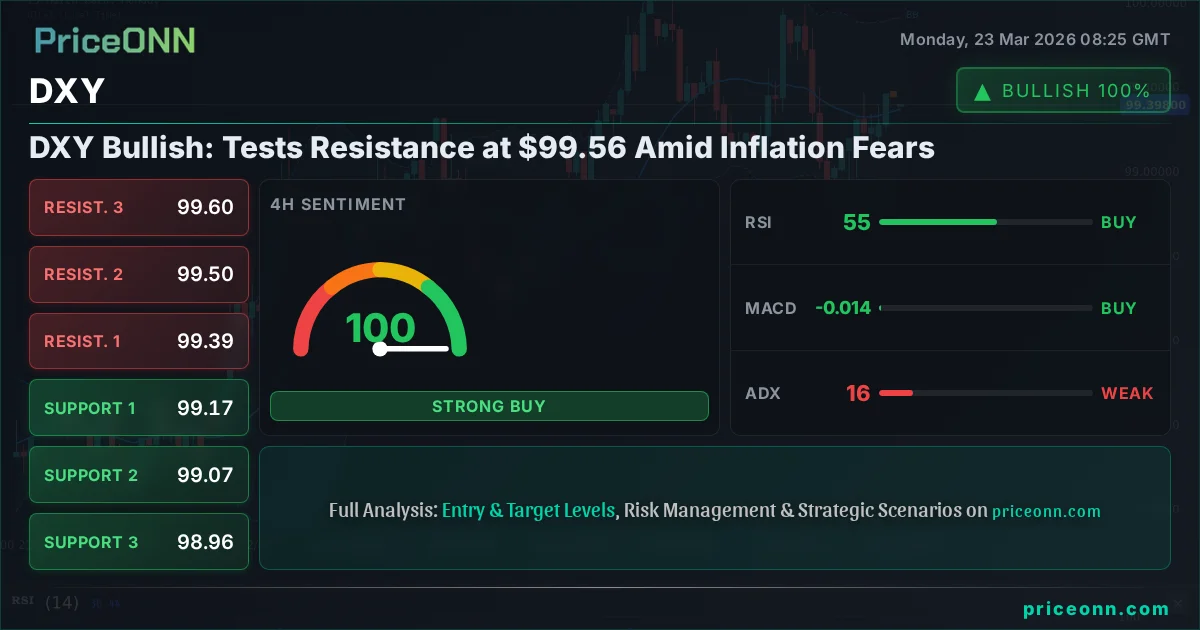
The US Dollar Index (DXY) is showing resilience, consolidating above the 99.50 level as the new trading week commences. While lacking significant follow-through momentum beyond Friday's highs, the Greenback is finding underlying support from a palpable increase in geopolitical uncertainty stemming from the Middle East. This risk-off sentiment is leading investors to seek traditional safe-haven assets, bolstering demand for the USD at the expense of risk-sensitive currencies.
Market Context
The DXY, a benchmark for the US Dollar's performance against a basket of six major currencies, is currently trading around the 99.65 region, marking a modest gain of 0.15% on the day. This consolidation occurs against a backdrop of escalating tensions in the Middle East, which has triggered a shift in market sentiment towards caution. Early in the Asian trading session on Monday, the AUD/USD pair experienced selling pressure, dipping towards the 0.7000 handle. This weakness in the Australian Dollar is a direct consequence of the heightened geopolitical risks, which are driving capital away from growth-oriented economies and into perceived safe havens like the US Dollar.
Analysis & Drivers
The primary driver for the US Dollar's current strength is the escalating geopolitical situation in the Middle East. In times of global uncertainty, investors typically flock to assets perceived as safe, and the US Dollar has historically played this role due to the sheer depth and liquidity of US financial markets and its status as the world's primary reserve currency. The US Dollar accounts for over 88% of all global foreign exchange turnover, underscoring its dominant position.
Beyond safe-haven flows, the US Dollar's value is fundamentally influenced by the monetary policy of the Federal Reserve. The Fed's dual mandate of controlling inflation and fostering full employment dictates its approach to interest rates. When inflation pressures are high, the Fed typically raises interest rates, making the dollar more attractive to investors seeking higher yields. Conversely, lower interest rates or quantitative easing measures tend to weaken the dollar. While current market focus is on geopolitical events, any upcoming signals from the Fed regarding future policy direction will be crucial for the dollar's longer-term trajectory.
The Australian Dollar, on the other hand, is sensitive to global risk appetite and commodity prices. As a major exporter of raw materials like iron ore, the AUD often moves in tandem with global industrial demand. Furthermore, the economic health of China, Australia's largest trading partner, significantly impacts the AUD. The current risk-off environment, coupled with potential disruptions to global trade routes due to Middle East instability, directly weighs on currencies like the AUD, which are more sensitive to global economic growth and trade flows.
Trader Implications
Traders should monitor the ongoing developments in the Middle East closely, as any further escalation could extend the demand for the US Dollar. Key levels to watch for the DXY include immediate resistance around 100.00 and support at 99.50. For those trading the AUD/USD, a break below 0.7000 could signal further downside, with the next significant support level potentially being 0.6950. Conversely, a de-escalation of tensions would likely see a reversal of safe-haven flows, putting pressure on the USD and potentially lifting currencies like the AUD.
The Federal Reserve's monetary policy remains a critical factor. Traders should pay attention to any statements or economic data releases that might influence expectations for US interest rates. A more hawkish stance from the Fed would typically support the dollar, while dovish signals could lead to its depreciation. The interplay between geopolitical risk and central bank policy will dictate short-term price action.
Outlook
The immediate outlook for the US Dollar appears cautiously positive, primarily supported by ongoing geopolitical concerns. However, sustained strength will likely depend on the longevity of these tensions and any concrete policy shifts from major central banks. Should the Middle East situation stabilize, the focus could quickly shift back to economic fundamentals and monetary policy divergence, potentially leading to a reassessment of the dollar's current gains. Traders should remain vigilant for both geopolitical catalysts and economic data that could alter market sentiment.
Frequently Asked Questions
What is causing the US Dollar Index (DXY) to consolidate above 99.50?
The DXY is consolidating above 99.50 primarily due to escalating geopolitical tensions in the Middle East, which are driving investors towards safe-haven assets. This demand is counteracting other potential pressures on the dollar.
How are Middle East tensions impacting the Australian Dollar?
Escalating Middle East tensions are increasing global risk aversion, causing the Australian Dollar (AUD) to weaken. The AUD/USD pair has seen selling pressure, falling towards 0.7000 as investors move away from riskier, growth-sensitive currencies.
What key levels should traders watch for the US Dollar and Australian Dollar?
Traders should watch for the DXY to potentially test resistance near 100.00 or find support around 99.50. For AUD/USD, a break below 0.7000 could lead to a test of 0.6950, while a de-escalation of tensions might see it rally back.
Track markets in real-time
Empower your investment decisions with AI-powered analysis, technical indicators and real-time price data.
Join Our Telegram Channel
Get breaking market news, AI analysis and trading signals delivered instantly to your Telegram.
Join Channel

PriceONN