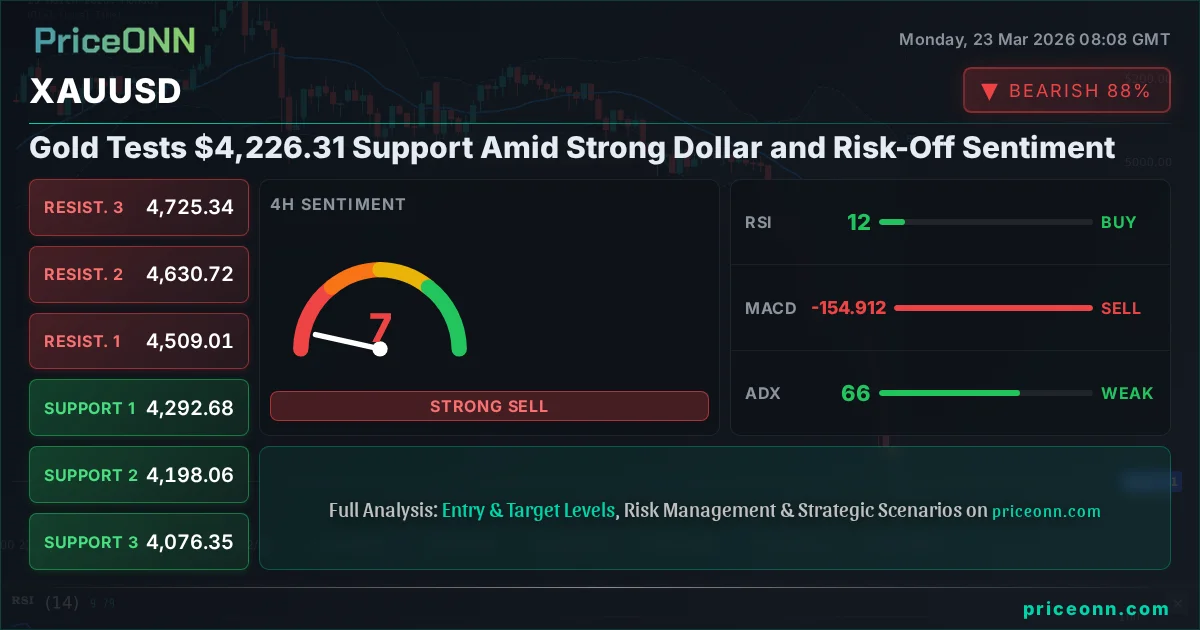
Forex Today: Middle East crisis deepens, Gold plunges to fresh 2026-low
Geopolitical Tremors Shake Currency Markets
Uncertainty emanating from the Middle East has dramatically reshaped currency dynamics, with the US Dollar emerging as the clear winner in Monday's trading. The greenback strengthened considerably against a basket of major currencies, notably demonstrating its power by posting the largest gains against the Australian Dollar. This sharp appreciation reflects a classic flight to safety, as global investors shed riskier assets in favor of perceived havens.
The concept of investor sentiment, often categorized as 'risk-on' or 'risk-off', is crucial for understanding these market movements. A 'risk-on' environment typically sees investors feeling optimistic, leading them to embrace assets with higher potential returns but also greater volatility. During such periods, equity markets often climb, most commodities (with the notable exception of gold) tend to appreciate due to expectations of robust economic activity, and currencies of commodity-exporting nations typically strengthen. Cryptocurrencies have also historically performed well in these optimistic phases.
Conversely, a 'risk-off' scenario unfolds when apprehension about the future takes hold. Investors then prioritize capital preservation, shifting towards less volatile assets. This typically results in a rally for government bonds, particularly those issued by major economies. Gold, a traditional safe haven, often shines during these times. Furthermore, currencies like the Japanese Yen and the Swiss Franc, alongside the aforementioned US Dollar, tend to attract significant inflows as investors seek refuge from turmoil.
The fortunes of currencies such as the Australian Dollar (AUD), Canadian Dollar (CAD), and New Zealand Dollar (NZD), as well as emerging market currencies like the South African Rand (ZAR), are closely tied to the 'risk-on' sentiment. Their economies heavily depend on commodity exports, and the prices of these raw materials typically rise when global economic activity is expected to accelerate. This increased demand for resources fuels the appreciation of these currencies.
The safe-haven status of the US Dollar is underpinned by its role as the world's primary reserve currency and the perceived safety of U.S. Treasury debt. In times of crisis, demand for these U.S. government bonds increases, driven by the belief that the world's largest economy is unlikely to default. The Japanese Yen benefits from demand for Japanese government bonds, many of which are held domestically by investors less likely to divest them during downturns. The Swiss Franc's appeal is bolstered by Switzerland's stringent banking secrecy laws, which offer investors enhanced protection for their capital.
Reading Between the Lines
The immediate aftermath of escalating geopolitical tensions invariably sparks a predictable market reaction: a swift retreat from riskier ventures and a scramble for perceived safety. Today's price action, particularly the US Dollar's broad-based strength and the precipitous drop in gold prices, underscores this well-trodden path. The plunge in gold, often seen as the ultimate safe haven, to its lowest point in 2026 is a stark indicator of the depth of current investor anxiety. This suggests that while gold can act as a hedge, in a scenario where the very stability of global trade routes or major economic powers is questioned, the liquidity and backing of the US Dollar and its associated debt instruments become paramount.
This shift in sentiment has direct implications for several key markets. Firstly, the strength in the USD puts pressure on emerging market currencies and could increase the cost of dollar-denominated debt for developing nations. Secondly, the dramatic fall in Gold prices, despite the heightened global uncertainty, presents a complex picture. It might indicate that other safe havens are currently preferred, or it could signal an unwinding of positions by institutional investors needing liquidity. Thirdly, the performance of commodity currencies like the AUD and CAD, which have weakened significantly against the dollar, points to a broad-based risk aversion that dampens demand for raw materials.
Traders should be closely monitoring geopolitical developments for any signs of de-escalation or, conversely, further escalation. Key levels to watch on the USD Index (DXY) would be any sustained push above recent highs, signaling continued risk aversion. For gold, a failure to reclaim the $2000 per ounce level could signal further downside. The market's reaction to upcoming economic data will also be critical in determining whether this risk-off move has legs or if it's a temporary overreaction.
Track markets in real-time
Empower your investment decisions with AI-powered analysis, technical indicators and real-time price data.
Join Our Telegram Channel
Get breaking market news, AI analysis and trading signals delivered instantly to your Telegram.
Join Channel