
Will Economic Slack Temper RBNZ's Response to Oil Price Shocks?

New Zealand's monetary policymakers are closely monitoring the nation's economic capacity as they prepare to address the inflationary pressures arising from elevated global oil prices. Reserve Bank of New Zealand (RBNZ) Chief Economist Paul Conway has highlighted that the presence of lingering economic slack will significantly shape the central bank's response strategy.
This suggests that the RBNZ might opt for a more calibrated approach to monetary policy tightening, rather than an immediate, aggressive stance, in an effort to balance inflation control with economic stability. The RBNZ's primary mandate is to maintain inflation within the target band of 1% to 3%, with a focus on the 2% midpoint. To achieve this, interest rates serve as the primary tool.
Market Context and the Kiwi Dollar
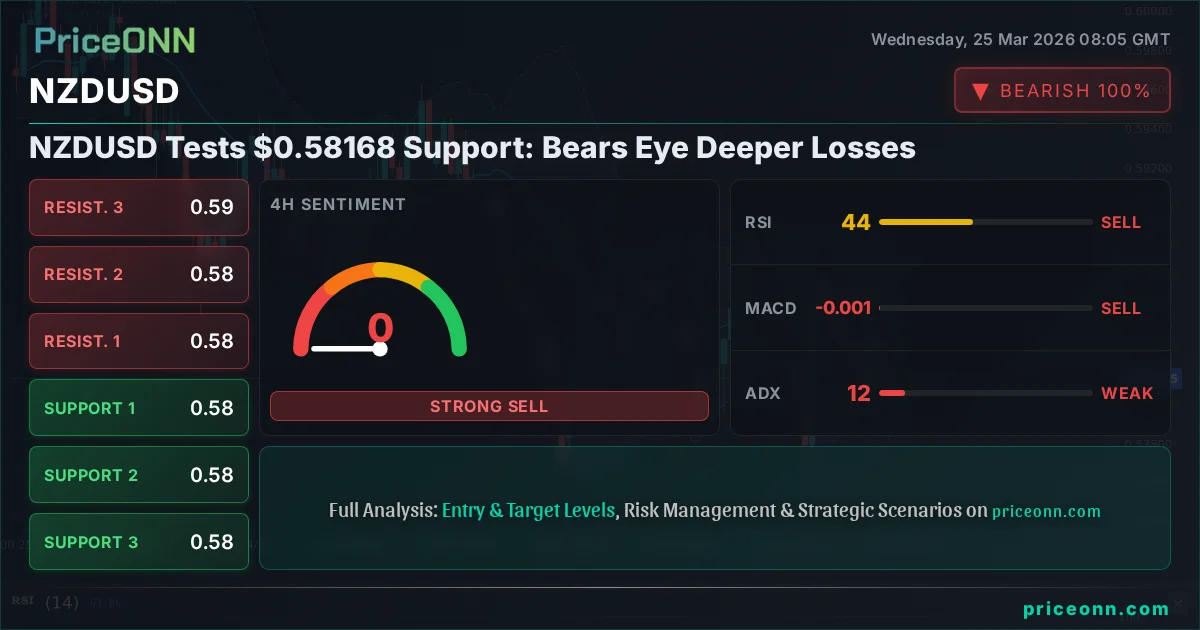
The New Zealand Dollar (NZD), often referred to as the Kiwi, is a key currency in global forex markets. Its value is closely tied to the health of the domestic economy and the RBNZ's policy decisions. However, external factors play a crucial role in its valuation. China, New Zealand's largest trading partner, significantly influences the Kiwi's performance; any economic slowdown in China can reduce demand for New Zealand's exports, weakening the currency.
Furthermore, the performance of the dairy sector, a cornerstone of New Zealand's export revenue, directly impacts the nation's income. Fluctuations in global dairy prices have a tangible effect on the NZD. A rise in dairy prices typically boosts the economy and strengthens the currency.
Analysis of Inflationary Drivers
The current economic environment presents a complex challenge for the RBNZ. While global oil price shocks can be inflationary, the presence of economic slack implies that demand-pull inflationary pressures may be subdued. This slack can absorb some of the cost-push inflation stemming from higher energy costs, potentially mitigating the need for drastic interest rate hikes.
Analysts note that the RBNZ's decision-making process will likely involve carefully weighing the immediate impact of oil prices against the broader domestic economic conditions. If inflation proves to be transitory and driven primarily by supply-side factors like oil, a less interventionist monetary policy might be favored. Conversely, if evidence emerges of broader demand-driven inflation taking hold, the RBNZ would be compelled to act more decisively.
Trader Implications and Key Levels
For forex traders, the RBNZ's stance on economic slack and oil prices presents a nuanced trading landscape for the New Zealand Dollar. The market will be keenly watching for any signals that suggest a divergence from the expected policy path. Key levels to monitor for the NZD/USD pair include immediate resistance around the 0.6150 level and support near 0.6000.
- Watch for RBNZ communication: Speeches and statements from RBNZ officials will be crucial for gauging the bank's sentiment.
- Monitor oil price trends: Continued upward pressure on crude oil could force the RBNZ's hand, while stabilization might allow for a more patient approach.
- Track dairy commodity prices: Significant movements in dairy prices can independently influence the NZD, adding another layer of complexity.
Traders should be prepared for potential volatility, especially if economic data releases contradict the narrative of significant economic slack. A sustained move above 0.6200 could signal renewed bullish sentiment, while a break below 0.5950 might indicate growing concerns about the domestic economy or global risk aversion.
Outlook for the New Zealand Dollar
Looking ahead, the RBNZ's ability to navigate these competing economic forces will be critical for the New Zealand Dollar's trajectory. If the central bank can successfully manage inflation without stifling economic growth, the Kiwi could find a stable footing. However, any misstep or unexpected surge in inflation could lead to significant currency depreciation. The market sentiment will likely remain cautious, with traders seeking confirmation of the RBNZ's intended policy path in the coming weeks.
Frequently Asked Questions
What is the RBNZ's inflation target?
The Reserve Bank of New Zealand aims to keep inflation within a medium-term range of 1% to 3%, with a preferred midpoint of 2%.
How might economic slack affect the RBNZ's response to oil prices?
Lingering economic slack suggests that the economy is not operating at full capacity, potentially allowing it to absorb some of the inflationary impact from higher oil prices without necessitating aggressive interest rate hikes by the RBNZ.
What are key trading levels for NZD/USD to watch?
Traders should monitor resistance around 0.6150 and support near 0.6000. A sustained move above 0.6200 or a break below 0.5950 could indicate a shift in market sentiment.
Track markets in real-time
Empower your investment decisions with AI-powered analysis, technical indicators and real-time price data.
Join Our Telegram Channel
Get breaking market news, AI analysis and trading signals delivered instantly to your Telegram.
Join Channel



PriceONN