
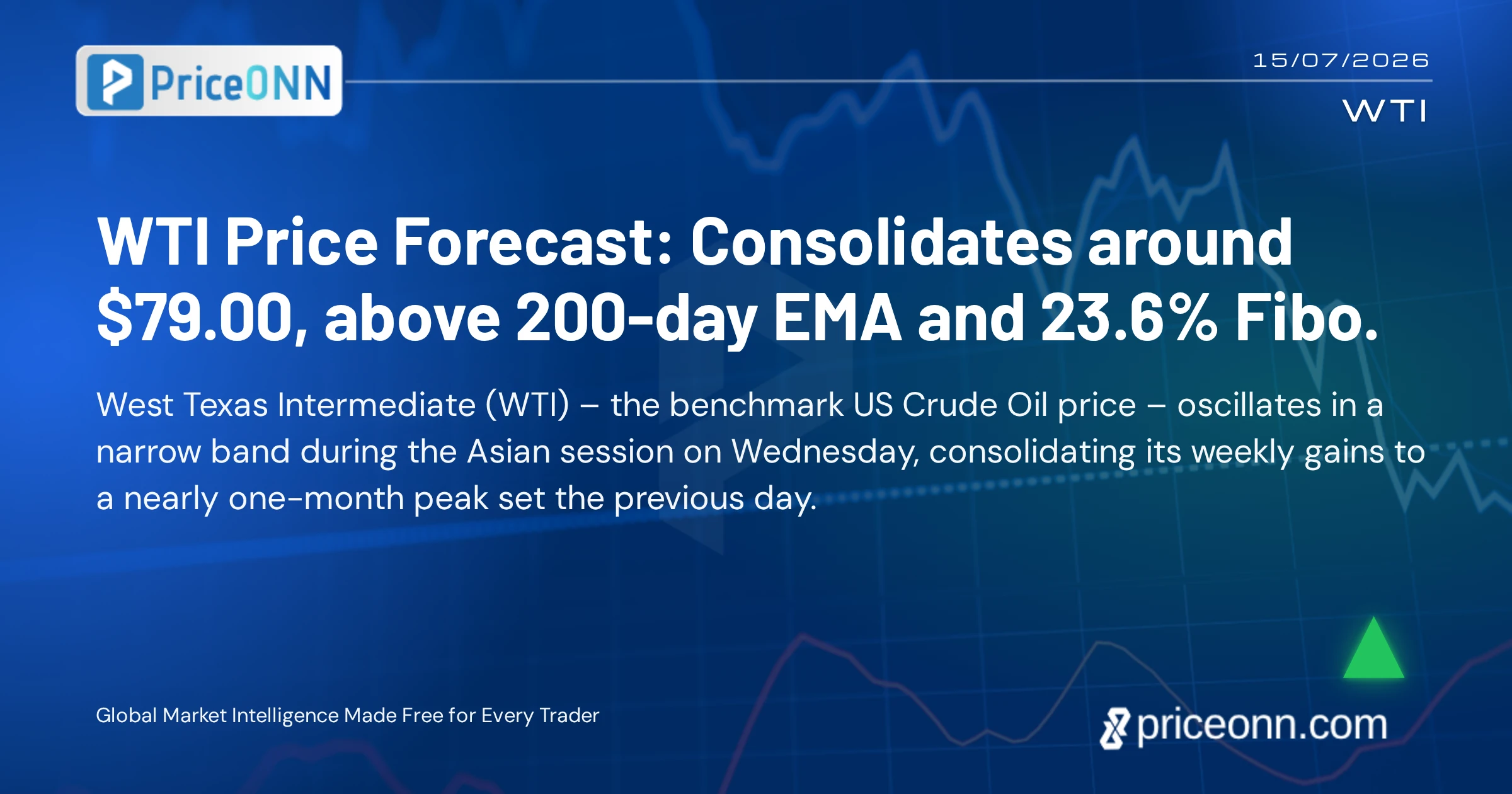
WTI Price Forecast: Consolidates around $79.00, above 200-day EMA and 23.6% Fibo.
 PriceONN Editorial Desk
Multi-source verification
PriceONN Editorial Desk
Multi-source verification
Crude Oil's Benchmark Navigates Choppy Waters
The price of West Texas Intermediate (WTI), a pivotal benchmark for the global oil market, is currently exhibiting remarkable stability. During Wednesday's Asian trading session, the commodity has settled into a narrow band, consolidating recent gains that propelled it to a high not seen in nearly a month. This consolidation occurs just above the significant technical thresholds of the 200-day exponential moving average (EMA) and the 23.6% Fibonacci retracement level, signaling underlying strength.
WTI, a light and sweet crude oil sourced within the United States, stands as one of the primary global benchmarks alongside Brent and Dubai grades. Its low gravity and minimal sulfur content contribute to its status as a high-quality, easily refined product. Distribution primarily flows through the Cushing hub in Oklahoma, famously dubbed "The Pipeline Crossroads of the World." Media outlets frequently cite WTI prices, underscoring its market influence.
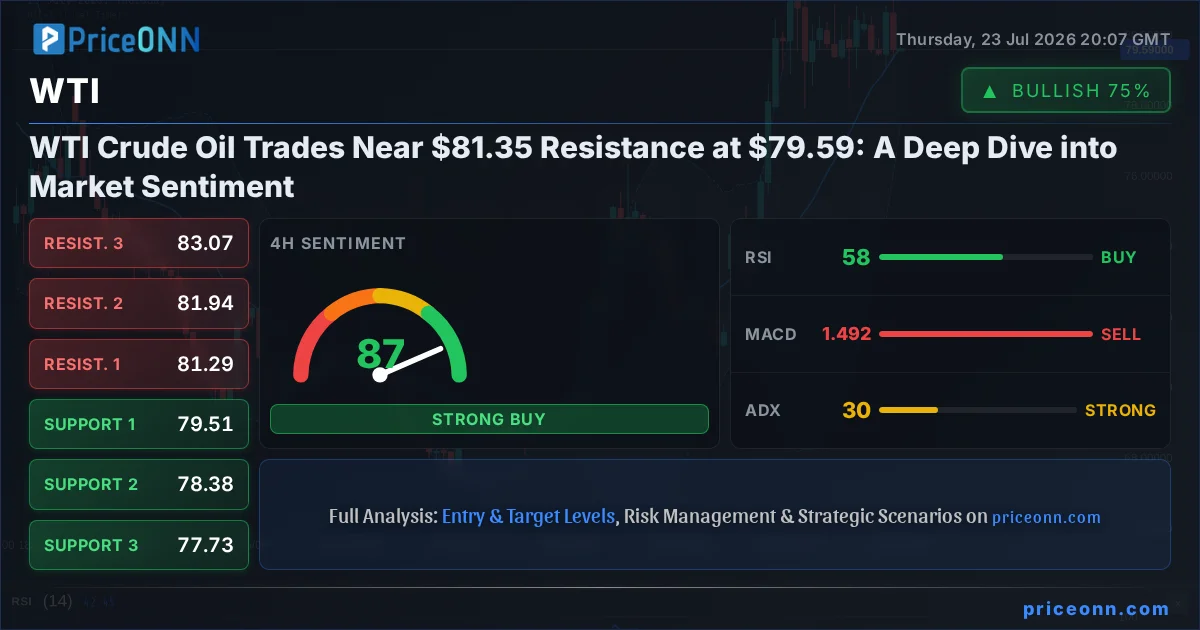
Fundamental Forces Shaping Oil's Trajectory
The intricate dance of supply and demand fundamentally dictates WTI's price movements. Broader economic health plays a crucial role; robust global growth typically fuels increased energy consumption, thereby boosting demand. Conversely, economic downturns can dampen this demand. Geopolitical events, including political instability, armed conflicts, and international sanctions, possess the power to disrupt supply chains, leading to significant price volatility.
Furthermore, the strategic decisions made by OPEC, the Organization of the Petroleum Exporting Countries, exert considerable influence. This cartel of major oil-producing nations, along with its expanded OPEC+ group which includes key non-OPEC allies like Russia, frequently adjusts production quotas. When OPEC opts to curtail output, it can constrict global supply, often driving prices upward. An increase in production, however, tends to have the opposite effect, potentially easing price pressures.
The prevailing strength of the U.S. Dollar also casts a long shadow over WTI pricing. Given that crude oil transactions are predominantly denominated in dollars, a weaker dollar can render oil more accessible and thus more attractive to international buyers, potentially increasing demand and prices. The inverse holds true for a strengthening dollar, which can make oil more expensive.
Inventory Data and Market Signals
Critical weekly reports from the American Petroleum Institute (API) and the Energy Information Administration (EIA) offer vital insights into fluctuating supply and demand dynamics. These inventory figures can directly impact WTI's price trajectory. A reported decrease in stockpiles may signal heightened demand, potentially pushing oil prices higher. Conversely, an accumulation of inventories could suggest an oversupply, leading to downward price pressure.
The API releases its data every Tuesday, followed by the EIA the subsequent day. While their findings generally align closely, often within 1% of each other about 75% of the time, the EIA's figures are typically regarded with greater authority due to its status as a government agency. These regular updates provide traders and analysts with crucial data points to interpret market sentiment and anticipate price action.
Reading Between the Lines
The current consolidation of WTI crude oil around the $79.00 level, while holding above the 200-day EMA and the 23.6% Fibonacci retracement, suggests a market in a holding pattern. Traders are likely weighing recent geopolitical developments and upcoming OPEC+ meeting murmurs against current demand signals and inventory levels. The resilience shown above these technical levels is a positive sign for bulls, indicating that the previous rally's momentum has not yet dissipated.
However, the narrow trading range points to a lack of strong conviction in either direction. The market appears to be awaiting a clearer catalyst, perhaps a more definitive statement from OPEC+ on production targets or a significant shift in global economic outlook. For traders, the $79.00 level now acts as a crucial pivot. A sustained break below this could invite further selling pressure, potentially targeting the next support zone. Conversely, a decisive push above recent highs could signal a resumption of the uptrend, with eyes potentially turning towards the psychologically important $80.00 mark.
The interplay between the U.S. Dollar's trajectory and any emerging inflation data will also be critical. A weaker dollar coupled with persistent inflation concerns could provide a tailwind for oil prices, while a stronger dollar or signs of cooling inflation might dampen enthusiasm. The upcoming inventory reports will be closely watched for any surprises that could break the current stalemate. Market participants should remain attuned to shifts in risk appetite across broader financial markets, as oil often correlates with overall sentiment towards riskier assets.
Track markets in real-time
Empower your investment decisions with AI-powered analysis, technical indicators and real-time price data.
Join Our Telegram Channel
Get breaking market news, AI analysis and trading signals delivered instantly to your Telegram.
Join Channel PriceONN News
India is on track to export the highest volume of refined petroleum products in months as refining margins have jumped with the re-escalation of the Middle East conflict. India is estimated to ship as many as 1.55 million barrels per day (bpd) of light and middle distillates in July, per data by commodity analysts Kpler cited by Reuters columnist Clyde Russell. The July volumes would be nearly double the fuel export volumes of just 866,000 bpd in May, when the Strait of Hormuz crisis hit crude...
PriceONN News
Since Middle East hostilities reignited, oil prices have soared higher, although they remain below the highs witnessed during April 2026. This can be blamed on U.S. strikes against Iran, with Tehran and Washington disrupting traffic in the Strait of Hormuz, through which a fifth of global hydrocarbon supplies are shipped. This has sparked greater demand for Brazil’s high-quality oil grades, notably from Asia, because there is no need for shipments to pass through contested waters. This will...
PriceONN News
Crude oil inventories in the United States saw an increase of 2.0 million barrels during the week ending July 17, according to new data from the U.S. Energy Information Administration (EIA) released on Wednesday. The increase brings commercial stockpiles to 411.7 million barrels, according to government data, which are now 6% below the five-year average for this time of year. The EIA’s data release follows API’s figures that were released a day earlier, which reported that crude oil inventories...
PriceONN News
Kazakhstan should, in theory, be one of the major beneficiaries of Russia’s growing isolation from global energy markets. Its crude is unsanctioned and European refiners need alternatives to Russian barrels. Yet instead of gaining a clear geopolitical advantage, Kazakhstan has found itself exposed to many of the same risks as its northern neighbour: attacks on export infrastructure, disruptions inside Russia and repeated operational failures at its own largest fields. The roots of that...
PriceONN News
Brent crude has broken back above $100 a barrel for the first time in nearly two months as escalating attacks on commercial shipping in the Red Sea deepen concerns that the Middle East supply crisis is spreading beyond the Strait of Hormuz. As of mid-morning Thursday, front-month Brent for September delivery was trading at $100.69 a barrel, up more than 7% on the day after touching an intraday high of $101.01. WTI was also sharply higher, with the entire Brent forward curve moving higher as...
PriceONN News
The war in the Middle East has diminished the negotiating power that key regional LNG exporters Qatar and the United Arab Emirates (UAE) have enjoyed for years. Importers of LNG from Europe to Asia plan to negotiate better terms in future long-term deals and ask for lower prices and higher contract flexibility, industry executives at LNG importing companies have told Reuters. For years, Qatar and the UAE commanded significant negotiating power, tied to their reliability as LNG suppliers. The...
PriceONN News
The European Union will exempt Greek Dynagas from the latest sanctions package for Russia after pressure from the Greek government, which said the package would harm the country’s economy. The package, set to be voted on today, includes a ban on LNG shipments to third countries and a total ban on LNG purchases by EU entities. However, with several EU member states now complaining about the adverse effects of these sanctions on their economies, Brussels has been placed in a position to negotiate...
PriceONN News
At least two tankers have turned away from the Bab el-Mandeb Strait after Yemen’s Houthis said they have struck two Saudi tankers in the chokepoint in the latest Middle East war escalation, saying they had violated the naval blockade that the Yemeni forces declared earlier this week. According to reports, one of the tankers was loaded with Saudi crude for India and the other was carrying oil to China. “While it’s only two vessels so far, it suggests owners and operators are taking the threat...
PriceONN News
The regional price of natural gas produced in the Permian, the top U.S. oil basin, was negative for most of the first half of the year. Rising associated gas output from oil-targeting wells has had nowhere to go. Producers had to either flare the gas, within allowed limits, or pay to get rid of what many Permian players see as an undesirable by-product of the valuable crude. For years, the key constraint to local gas prices has been the insufficient pipeline takeaway capacity, which hasn’t...
PriceONN News
Renewed Houthi blockade of Saudi Red Sea ports threatens up to 4 million bpd of redirected Saudi crude exports, adding fresh supply risks as the Strait of Hormuz remains effectively disrupted The latest reignition of hostilities between the United States and Iran led to a spike in oil prices that, contrary to some observers’ expectations proved to be temporary. After jumping, prices once again moved lower, driven by hope for peace. Yet the recent announcement by Yemen’s Houthis that they would...
PriceONN News
Japan’s day-ahead spot electricity prices surged on Wednesday to the highest level in three and a half years as soaring fuel costs, heat waves, and a weakening Japanese currency have combined to push power prices higher this summer. Data from the Japan Electric Power Exchange showed that nationwide day-ahead spot price surged to $0.15 (24.78 Japanese yen) per kilowatt-hour (kWh) on Wednesday, Bloomberg reports. The price has surged by 24% so far this week and hit on Wednesday the highest level...
PriceONN News
China produced a record amount of crude oil last year, at 216 million tons, with natural gas production also rising substantially, the National Energy Administration reported today. Together, the oil and gas output of China in terms of oil equivalent rose to 420 million tons-a record high. Natural gas alone rose by 10 billion cubic meters last year. The annual growth rate was unchanged for the ninth year in a row, the NEA said. Chinese oil and gas companies also boosted their reserves, with new...