
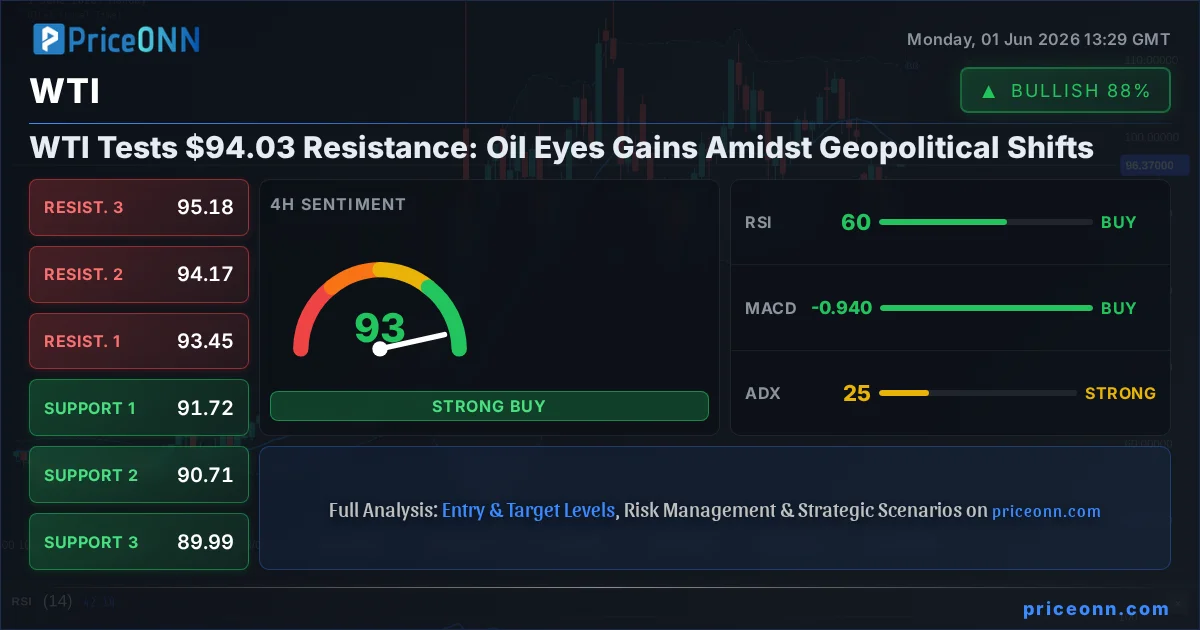
WTI rallies as Qatar’s Kaabi expects oil price to surge to $150/barrel amid Iran conflicts
 PriceONN Editorial Desk
Multi-source verification
PriceONN Editorial Desk
Multi-source verification

Understanding WTI Crude Oil
West Texas Intermediate (WTI) crude oil serves as a critical benchmark in the global energy market. Traded on the NYMEX exchange, WTI is categorized as a 'light, sweet' crude due to its low density and sulfur content, making it ideal for refining into gasoline and other high-value products. Its strategic location, sourced primarily in the United States and distributed through the Cushing, Oklahoma hub, often referred to as 'The Pipeline Crossroads of the World', solidifies its importance in price discovery and risk management.
The price of WTI, like any commodity, is fundamentally determined by the interplay of supply and demand. Strong global economic growth typically translates to increased demand for energy, driving WTI prices higher. Conversely, economic slowdowns can dampen demand and exert downward pressure. Geopolitical events, including conflicts, political instability, and sanctions imposed on oil-producing nations, can significantly disrupt supply chains, leading to price volatility. Furthermore, decisions made by the Organization of the Petroleum Exporting Countries (OPEC) regarding production levels exert considerable influence on WTI prices.
The strength of the US dollar also plays a crucial role. As crude oil is predominantly priced in US dollars, a weaker dollar can make oil more attractive to buyers holding other currencies, potentially boosting demand and prices. Conversely, a stronger dollar can have the opposite effect.
Inventory Reports and OPEC's Influence
Weekly inventory reports from the American Petroleum Institute (API) and the Energy Information Administration (EIA) provide valuable insights into the supply and demand dynamics of crude oil. These reports track changes in crude oil inventories, with a decline often signaling increased demand and potentially higher prices. Conversely, an increase in inventories may suggest weaker demand or oversupply, potentially leading to price declines. While both reports offer similar data, with results typically aligning within a 1% range approximately 75% of the time, the EIA data, as a government source, is often regarded as the more authoritative.
OPEC's role in shaping global oil supply cannot be overstated. This cartel, comprised of 12 major oil-producing nations, convenes bi-annually to establish production quotas for its members. Decisions to curtail production can lead to tighter supply and higher prices, while increased output can have the opposite effect. The extended group known as OPEC+, which includes Russia and other non-OPEC members, further amplifies this influence, accounting for a substantial portion of global oil production.
Recent comments from Qatar's Energy Minister, Saad al-Kaabi, projecting a potential surge to $150 per barrel amid escalating geopolitical tensions involving Iran, have added further fuel to the bullish sentiment surrounding WTI. These anxieties, coupled with existing supply concerns, continue to support upward price momentum.
Track markets in real-time
Empower your investment decisions with AI-powered analysis, technical indicators and real-time price data.
Join Our Telegram Channel
Get breaking market news, AI analysis and trading signals delivered instantly to your Telegram.
Join Channel PriceONN News
Crude oil prices experienced a significant drop, with WTI futures falling over 1.8% to $87.25, as optimism grew for a U.S.-Iran deal potentially reopening the Strait of Hormuz.
PriceONN News
(RTTNews) - Crude oil prices have tumbled on Friday as expectations of the U.S. and Iran signing a Memorandum of Understanding run high. The MoU would allow for immediate reopening of the Strait of Hormuz and pave the way for the resumption of oil and energy trade.
PriceONN News
Crude oil futures experienced a dramatic intraday reversal on Thursday, soaring overnight on geopolitical fears only to pull back significantly as reports of a potential diplomatic understanding between the U.S. and Iran emerged.
PriceONN News
Global oil prices are treading water after a significant 5% slump, as market sentiment grapples with cautious optimism over Middle East de-escalation efforts versus lingering geopolitical uncertainties. Brent crude hovers near $104.72 and WTI near $98.07.
PriceONN News
Crude oil prices experienced a sharp decline, with WTI futures for July delivery falling 5.66% to $98.26. This drop is largely attributed to renewed diplomatic efforts aimed at de-escalating the U.S.-Iran conflict and easing tensions around the Strait of Hormuz.
PriceONN News
WTI crude oil: ⬇️ Sell WTI crude oil reversed from resistance zone Likely to fall to support level 95.00 WTI crude oil recently reversed from the resistance zone between the pivotal resistance level 105.00 (which has been reversing the price from the start of April) and the upper daily Bollinger Band. The downward reversal from […] The post WTI Crude Oil Wave Analysis appeared first on ActionForex.
PriceONN News
Crude oil prices experienced a significant downturn as market sentiment shifted towards optimism about a potential US-Iran Memorandum of Understanding that could reopen the Strait of Hormuz. WTI futures fell nearly 2% on the news.
PriceONN News
Crude oil futures experienced a dramatic intraday reversal, soaring to $92.52 before pulling back significantly on Thursday. The volatile session was driven by shifting geopolitical narratives and U.S. inventory data.
PriceONN News
Crude oil futures experienced a dramatic reversal, soaring overnight to $92.52 before plummeting nearly 6% to $89 a barrel. This volatility was driven by escalating US-Iran tensions followed by reports of a potential preliminary diplomatic understanding.
PriceONN News
(RTTNews) - Crude oil futures skyrocketed overnight but have shown a significant pullback over the course of the trading day on Thursday.
PriceONN News
(RTTNews) - Extending the losses from yesterday's session, crude oil prices have gone into freefall on Wednesday as investor expectations on a potential U.S.-Iran agreement continue to rise despite the U.S. refusing to ease its demands.
PriceONN News
(RTTNews) - Crude oil prices have tumbled on Tuesday as optimism about a U.S.-Iran peace deal that could lead to reopening of the Strait of Hormuz soon grows despite reports of fresh U.S. strikes on Iran yesterday.