

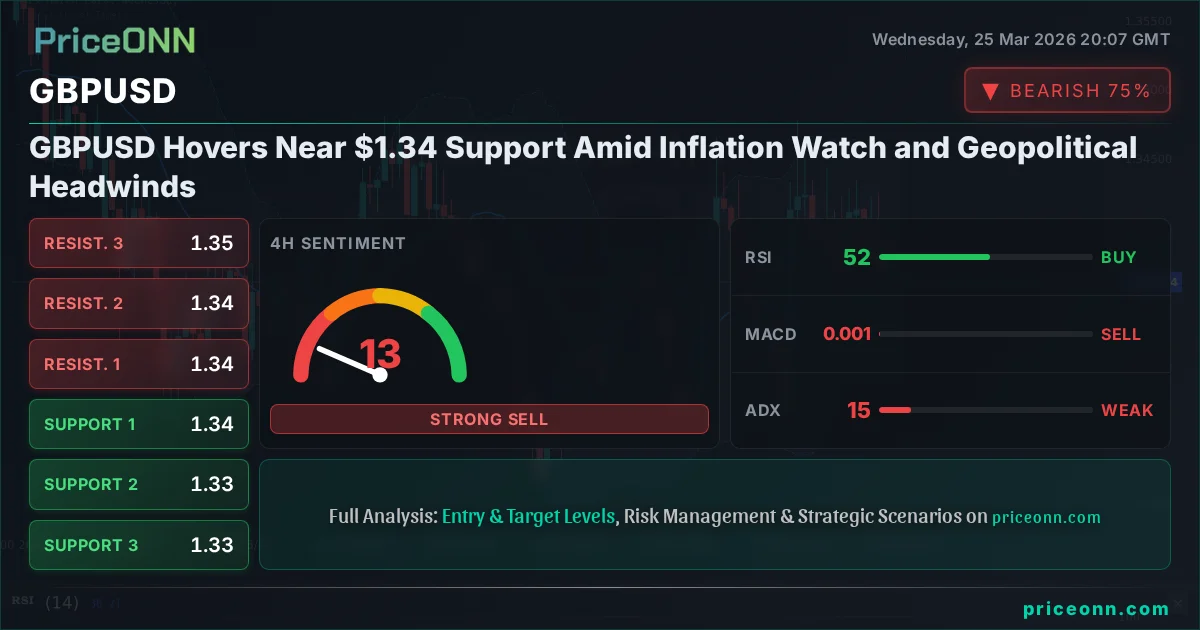
GBPUSD Analysis: Testing the $1.34 Line in the Sand
The GBPUSD pair is currently finding itself at a pivotal juncture, hovering precariously near the $1.34 level. This isn't just another trading session; it's a critical moment where upcoming economic data releases, particularly UK inflation figures, are set to clash with persistent geopolitical tensions and a strengthening US Dollar. Having tracked GBPUSD through the recent market volatility, it's clear that $1.34 is more than just a price point - it’s a psychological and technical line that could dictate the pair's trajectory in the short to medium term. The market is holding its breath, caught between the potential for a dovish surprise from the Bank of England and the ongoing safe-haven demand for the dollar, exacerbated by global uncertainties.
- GBPUSD is currently trading around $1.34, testing significant support levels.
- Upcoming UK inflation data for February is crucial, with expectations pointing to persistent price pressures.
- Geopolitical tensions are fueling safe-haven demand for the USD, adding pressure on GBPUSD.
- The DXY is showing strength, currently trading around 99.41, which typically correlates with downward pressure on GBPUSD.
The narrative surrounding GBPUSD has become increasingly complex. On one hand, the British Pound faces headwinds from domestic economic concerns and potential policy divergence from the Bank of England, which some analysts believe might be leaning towards a more cautious, if not dovish, stance compared to the Federal Reserve. On the other hand, the US Dollar continues to draw strength from its safe-haven appeal amidst escalating global risks, particularly in the Middle East, and the prospect of higher-for-longer interest rates in the US. This confluence of factors creates a challenging environment for sterling, pushing it towards key support levels that, if breached, could signal a deeper correction.
The Dollar's Resilience and Its Impact
The Dollar Index (DXY), currently trading around 99.41, serves as a constant reminder of the greenback's underlying strength. A rising DXY usually spells trouble for major currency pairs like GBPUSD, as it implies capital is flowing into perceived safe-haven assets. This strength is not arbitrary; it's underpinned by a combination of factors. Geopolitical risks, such as the ongoing Middle East tensions, naturally boost demand for the dollar as a global reserve currency. Furthermore, the Federal Reserve's monetary policy stance, coupled with robust US economic data in certain sectors, suggests that interest rate cuts might be further down the line than initially anticipated. This scenario typically leads to higher yields for US Treasury bonds, making dollar-denominated assets more attractive and thus supporting the DXY. For GBPUSD, this means that any positive news from the UK economy needs to be significantly strong to counteract the persistent upward pressure on the dollar.
Focus on UK Inflation: A Potential Catalyst
The upcoming release of the UK's February inflation data is arguably the most significant domestic event on the horizon for GBPUSD traders. Consensus forecasts suggest that inflation might remain stubbornly high, potentially above the Bank of England's target. Persistent inflation would put the BoE in a difficult position, potentially forcing them to maintain a hawkish stance or at least delay any anticipated interest rate cuts. This could provide some support for the Pound, as higher interest rates generally attract foreign investment seeking better yields. However, the flip side is that sustained high inflation also signals underlying economic stress, which could dampen growth prospects and weigh on the currency in the longer run. The market's reaction will likely depend on the degree of deviation from forecasts and the accompanying commentary from the Office for National Statistics (ONS).
Critical Point: February UK inflation data is due Wednesday. Consensus points to persistent price pressures. If actual figures come in significantly higher than the forecast of 3%, it could strengthen GBP in the short term as the Bank of England might be forced to maintain a hawkish stance. Conversely, any signs of cooling inflation could pressure the Pound if it fuels dovish BoE expectations.
Technical Picture: $1.34 Support in Focus
From a technical standpoint, GBPUSD is currently teetering on the edge of a crucial support zone. The 1-hour chart shows a general downtrend with a Power score of 98%, indicating strong bearish momentum in the very short term. Key support levels identified are $1.33539, $1.33427, and $1.33273. The RSI(14) at 42.37 suggests room for further downside before hitting oversold territory, while the MACD remains in negative territory, reinforcing the bearish sentiment on this timeframe. The Stochastic Oscillator's %K line below the %D line further supports a bearish signal. However, the ADX at 13.75 indicates a weak trend, suggesting that the current downward move might be losing steam or is part of a broader consolidation rather than a strong trend continuation.
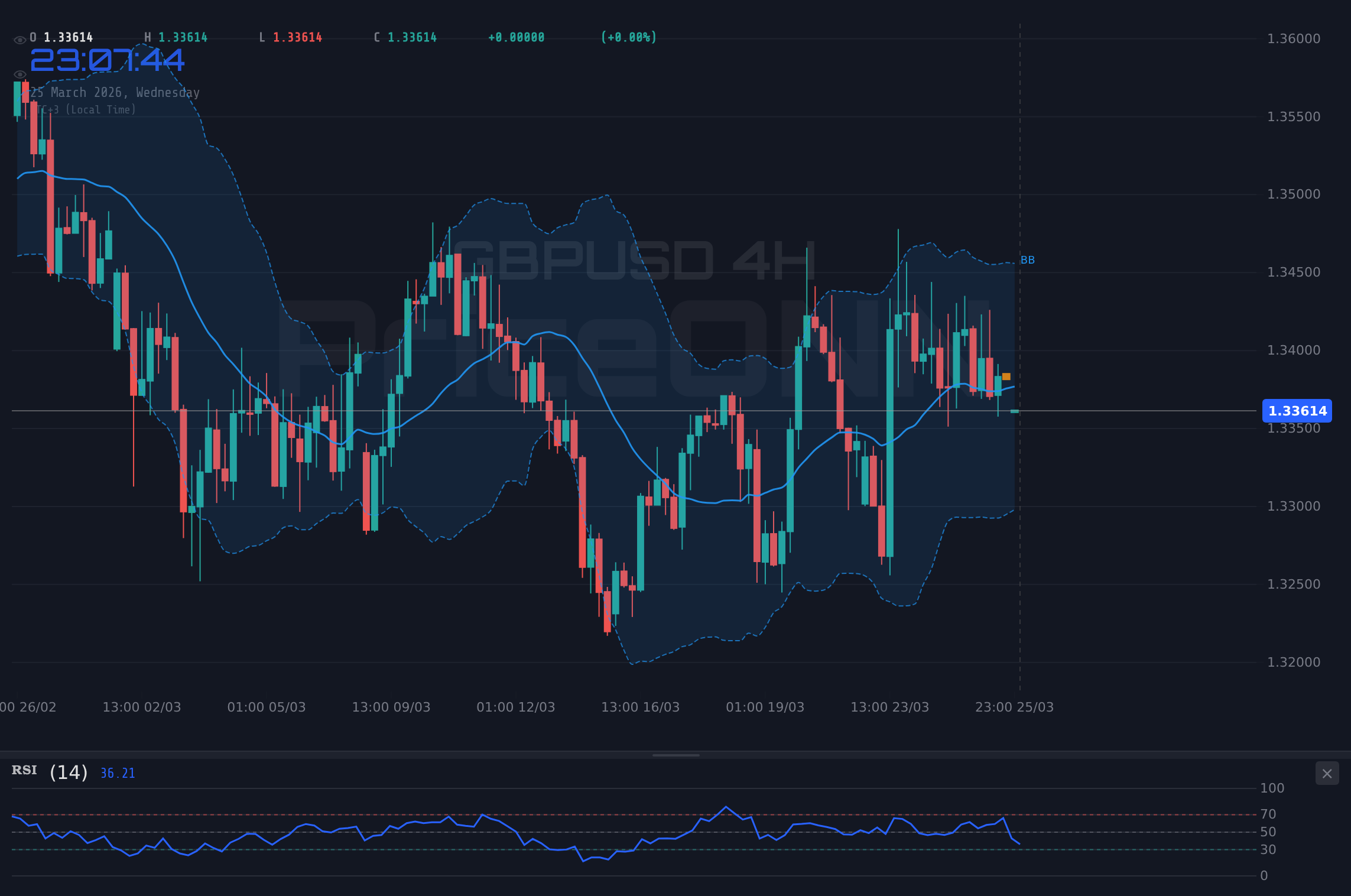
Looking at the 4-hour timeframe, the picture becomes slightly more nuanced. The trend is classified as neutral with a Power score of 50%, suggesting a balance between buyers and sellers. Support levels are seen at $1.33506, $1.33305, and $1.32928, while resistance lies at $1.34084, $1.34461, and $1.34662. The RSI(14) is at 51.7, hovering around the neutral zone and showing a slight upward inclination, which could hint at a potential short-term rebound. The MACD, however, remains in negative momentum, below its signal line, and the Stochastic Oscillator (%K
The daily chart presents a more significant picture for longer-term traders. Here, the trend is again classified as neutral (Power 50%), but the ADX at 28.9 indicates a strong downtrend in play. Support levels are established at $1.33604, $1.33094, and $1.32676, with resistance found at $1.34532, $1.3495, and $1.3546. The RSI(14) is at 46.79, trending downwards and indicating further downside potential. The MACD has positive momentum but is below its signal line, suggesting a potential shift. However, the Stochastic Oscillator shows a bullish signal with %K above %D, currently at 70.09 / 56.2. This divergence between the RSI's bearish lean and the Stochastic's bullish signal highlights the current indecision in the market. The presence of strong downtrend indicators like ADX at 28.9, coupled with the price hovering near critical support, suggests that any upward movement might be met with selling pressure unless significant fundamental shifts occur.
Geopolitical Ripples and Risk Sentiment
The ongoing geopolitical tensions in the Middle East cannot be overstated in their influence on currency markets, particularly for a pair like GBPUSD which is sensitive to global risk sentiment. Escalating conflicts and uncertainty tend to drive capital towards perceived safe-haven assets such as the US Dollar and, to some extent, gold and Swiss Franc. This dynamic directly impacts GBPUSD by increasing demand for the dollar, thereby pushing the pair lower. Recent news indicates that Middle East tensions are not only affecting oil prices but also creating broader market jitters, with recession odds surging past 45% according to some Wall Street economists. This heightened risk aversion often leads to a deleveraging effect across riskier assets and currencies, potentially leaving the British Pound vulnerable.
The correlation between GBPUSD and broader market sentiment is crucial. When risk appetite diminishes, as suggested by the rising recession odds and Middle East concerns, investors tend to shy away from currencies perceived as higher-risk. While the British Pound has its own fundamental drivers, it often gets caught in the crossfire of global risk-off sentiment, especially when the US Dollar is strengthening. The current market environment, characterized by elevated oil prices and supply chain concerns, further complicates the outlook, potentially leading to stagflationary pressures that could impact both the UK and US economies differently, but often favouring the dollar in times of stress.
Economic Calendar: What's Next for GBPUSD?
Looking ahead, the economic calendar is packed with events that could significantly move GBPUSD. The most immediate focus remains on the UK's February inflation data, due Wednesday. As mentioned, consensus expects inflation to remain elevated. A reading significantly above forecast could offer temporary relief to the Pound, but the market's reaction will be heavily scrutinized for signs of sustained strength. Following this, upcoming high-impact events include US data releases such as the revised GDP figures and, crucially, the Non-Farm Payrolls (NFP) report. Strong NFP numbers could reinforce the Fed's hawkish bias, potentially strengthening the dollar further and pushing GBPUSD lower. Conversely, weaker-than-expected employment data might fuel bets on earlier Fed rate cuts, which could provide some respite for sterling.
The interplay between central bank policies is also a key factor. While the Federal Reserve is signaling a data-dependent approach to rate cuts, the Bank of England faces a similar dilemma but with potentially different domestic economic constraints. Any hints from BoE officials regarding their outlook on inflation and growth will be closely monitored. Traders will be looking for any signs of divergence in monetary policy between the Fed and the BoE, as this is often a primary driver of major currency pair movements. The market is currently pricing in a certain path for interest rates, and any data that deviates from these expectations could trigger significant volatility.
The current GBPUSD setup near $1.34 highlights the tension between domestic UK data and global USD strength. Patience is key. Look for confirmation: a clear break below $1.3350 on the 4-hour chart, supported by strong US Dollar momentum (e.g., DXY above 99.50), would strengthen the bearish case. Conversely, a sustained move above $1.3450, especially if accompanied by better-than-expected UK inflation or dovish Fed signals, could signal a reversal.
Navigating the Current Market Sentiment
The prevailing market sentiment appears to be one of cautious risk aversion. The surge in recession odds and the ongoing geopolitical instability contribute to an environment where investors are less inclined to take on significant currency risk. This typically translates into a preference for established safe-haven currencies, with the US Dollar often being the primary beneficiary. For GBPUSD, this means that even if UK economic data shows some resilience, the broader risk sentiment could cap any upside potential. The ability of the Pound to strengthen significantly will likely depend on a clear de-escalation of geopolitical tensions and a strong, consistent flow of positive domestic economic news that can outweigh the dollar's safe-haven appeal.
The 1H General Signal for GBPUSD is 'SELL' (3 Buy, 5 Sell, 0 Neutral), reinforcing the short-term bearish bias. However, the 4H chart shows a neutral trend with a 'SELL' signal (2 Buy, 6 Sell, 0 Neutral), and the 1D chart also leans bearish with a 'SELL' signal (2 Buy, 6 Sell, 0 Neutral). This consistent bearish leaning across multiple timeframes, especially on the daily chart where ADX indicates a strong downtrend, suggests that the path of least resistance for GBPUSD might be downwards, at least until key support levels break or a significant shift in market sentiment occurs. The critical support at $1.33604 on the daily chart, followed by $1.33094 and $1.32676, will be closely watched.
Pro Analysis: Correlating with Global Markets
The correlation between GBPUSD and the DXY is vital. With DXY at 99.41 and showing upward momentum, it reinforces the bearish outlook for GBPUSD. If DXY breaks above 99.50, expect increased pressure on cable. Conversely, a sustained drop in DXY below 99.00 could signal a reprieve for GBPUSD. Similarly, the performance of major stock indices like the S&P 500 (currently at 6594.15, showing a slight daily dip) and Nasdaq (at 24165.76, also slightly down) provides context. A broader risk-off move in equities, driven by geopolitical fears or recession odds, would likely weigh on GBPUSD, while a recovery in stocks might offer some relief.
The Path Forward: What Traders Should Watch
For traders looking to navigate this complex environment, the key is to remain disciplined and wait for clear signals. The $1.34 level represents a critical support zone. A decisive break below this psychological level, particularly with confirming volume and sustained dollar strength, could open the door for a move towards the next support at $1.33506 on the 4-hour chart. On the flip side, any signs of a bottom forming around $1.3350-$1.3400, coupled with positive news flow from the UK or a weakening dollar, could lead to a bounce. Resistance levels at $1.34084 and $1.34461 on the 4-hour chart would be the initial targets for any potential upside reversal. The upcoming economic data releases, especially the UK inflation figures and US employment numbers, will be crucial in determining the short-term direction.
Ultimately, the GBPUSD pair is caught in a tug-of-war between domestic economic considerations and the overwhelming influence of global macroeconomic trends and geopolitical risks. While the technicals currently lean bearish, particularly on the daily chart, the upcoming data releases hold the potential to shift the narrative. Traders should exercise caution, manage their risk effectively, and wait for a clear breakout or breakdown confirmation before committing to a significant position. The market is providing opportunities, but patience and a data-driven approach will be essential to capitalize on them.
Key Levels to Monitor: Support at $1.3350-$1.3400; Resistance at $1.3450-$1.3500. A close below $1.3350 on the 4H chart, confirmed by rising DXY, favors shorts targeting $1.3300. A sustained hold above $1.3400, with receding geopolitical fears, could target $1.3450 and above.
Frequently Asked Questions: GBPUSD Analysis
What happens if GBPUSD breaks below the $1.3350 support level?
A confirmed break below $1.3350 on the 4-hour chart, especially with a rising DXY above 99.50, would strengthen the bearish case. This scenario could trigger a move towards the next support at $1.33094, potentially extending to $1.32676 if market sentiment remains risk-averse.
Should I consider buying GBPUSD at current levels around $1.34 given the daily chart's bearish signals?
Buying at $1.34 requires caution due to the bearish signals on the daily chart, including an RSI at 46.79 and ADX at 28.9. A high-probability setup would involve waiting for confirmation of a bounce, such as holding above $1.3350 with a clear shift in US Dollar sentiment or positive UK data, targeting resistance at $1.34532.
Is the RSI at 46.79 on the daily chart a sell signal for GBPUSD?
An RSI of 46.79 on the daily chart is trending downwards, indicating bearish momentum. While not yet oversold, it suggests that sellers have the upper hand. This reading aligns with the overall downtrend signal from the ADX (28.9) and supports a cautious approach, leaning towards potential further downside unless key resistance levels are breached.
How will the upcoming UK inflation data affect GBPUSD this week?
If UK February inflation data comes in significantly higher than the forecast of 3%, it could temporarily boost GBPUSD as the Bank of England might maintain a hawkish stance. However, persistent high inflation could also signal economic weakness, and the market's reaction will depend on whether it outweighs the impact of a strengthening US Dollar driven by global risks.
Bearish Scenario: Testing Lower Support
65% ProbabilityNeutral Scenario: Consolidation Around $1.34
25% ProbabilityBullish Scenario: Rebound from Support
10% ProbabilityTrack markets in real-time
AI-powered analysis, technical indicators and real-time price data.
Join Our Telegram Channel
Breaking market news, AI analysis and trading signals instantly.
Join Channel