AUD/JPY Price Forecast: Softens below 111.00, but mildly bullish tone prevails

Yen's Undercurrents Amid Shifting Global Tides
The Japanese Yen, a major player in global foreign exchange markets, often finds its value dictated by the health of Japan's economy. Yet, its trajectory is also heavily influenced by the Bank of Japan's monetary policy decisions, the interest rate gap between Japanese and U.S. government debt, and broader investor risk appetite. The BoJ holds a mandate for currency management, making its actions a critical barometer for the Yen. While direct market interventions are infrequent due to political sensitivities with major trading partners, the central bank's policy choices are paramount.
For a decade leading up to 2024, the Bank of Japan's commitment to an exceptionally accommodative monetary stance created a significant policy divergence with other global central banks. This led to a widening spread between 10-year U.S. and Japanese bond yields, a scenario that historically favored the U.S. Dollar over its Japanese counterpart. However, recent shifts, including the BoJ's gradual move away from its ultra-loose framework and interest rate adjustments by other major economies, are beginning to narrow this yield differential.
The Yen's reputation as a safe-haven asset is a key characteristic. During periods of heightened market uncertainty or global financial stress, investors often flock to the Japanese Yen. This perceived reliability and stability can drive demand for the currency, strengthening its value against those perceived as riskier investments. Consequently, turbulent geopolitical climates or economic downturns globally tend to bolster the Yen.
AUD/JPY Faces Pressure from Data and Geopolitics
The AUD/JPY exchange rate experienced a softening trend, slipping below the significant 111.00 psychological level and testing lows near 110.85 during Wednesday's early European trading session. This downward pressure on the Australian Dollar (AUD) against the Japanese Yen (JPY) stems from a confluence of factors, most notably cooler-than-anticipated inflation figures released from Australia.
Recent data revealed that Australia's Consumer Price Index (CPI) did not meet market expectations, suggesting a potential moderation in inflationary pressures within the Australian economy. This softer inflation print can dampen the outlook for future interest rate hikes by the Reserve Bank of Australia, making the AUD less attractive to yield-seeking investors.
Compounding the pressure on the AUD/JPY pair is lingering uncertainty surrounding geopolitical developments, specifically tensions between the United States and Iran. Such global risk events often bolster demand for safe-haven assets like the Japanese Yen, while simultaneously pressuring risk-sensitive currencies such as the Australian Dollar. The interplay of these domestic economic indicators and international geopolitical risks creates a challenging environment for the AUD/JPY cross.
Market Ripple Effects
The recent dip in the AUD/JPY pair, driven by softer Australian inflation and global risk aversion, carries broader implications for several financial instruments. The Australian Dollar itself is now under scrutiny, with traders watching closely for any further deterioration that could signal a deeper correction. This could impact other AUD crosses, such as AUD/USD, which might also face headwinds if the broader weakness in the Aussie persists.
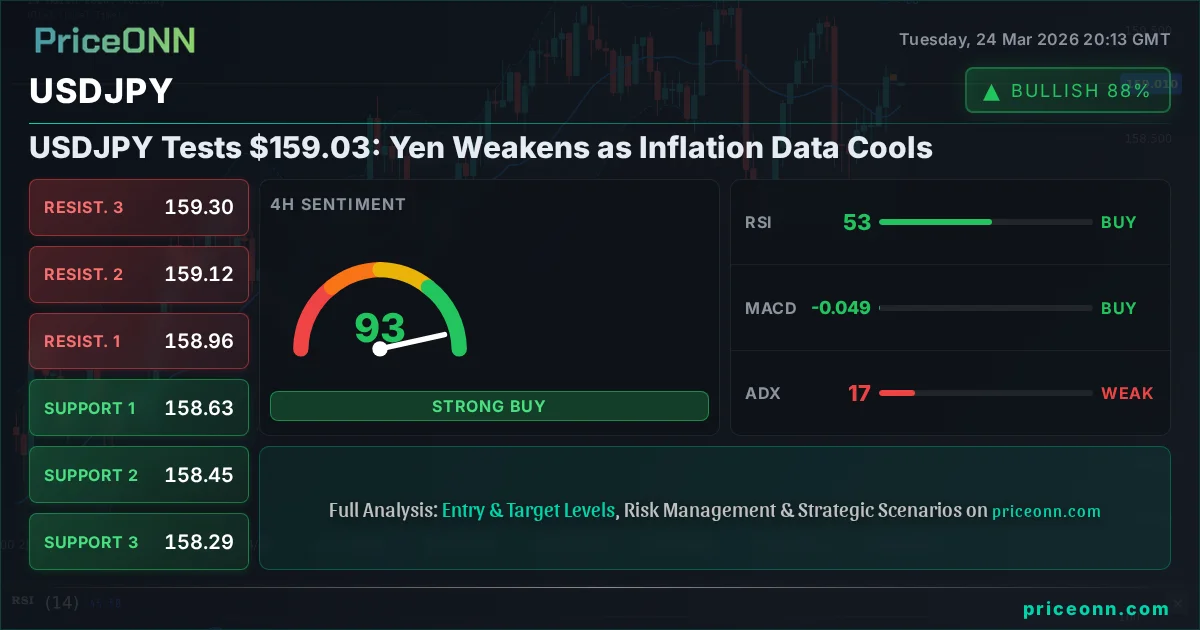
Conversely, the Japanese Yen benefits from this flight to safety. The uptick in demand for JPY could see it strengthen against other riskier currencies, potentially impacting pairs like USD/JPY. A stronger Yen might also indirectly affect Japanese equity markets, although the relationship is complex and influenced by export performance.
Furthermore, the underlying theme of moderating inflation in Australia could influence expectations for the Reserve Bank of Australia's future monetary policy. If this trend continues, it might lead to a reassessment of interest rate differentials, potentially affecting medium-term bond yields and influencing capital flows. Investors will be closely monitoring upcoming economic data from both Australia and Japan, as well as any significant developments in global geopolitical hotspots, to gauge the next directional move for AUD/JPY and related assets.
Track markets in real-time
Empower your investment decisions with AI-powered analysis, technical indicators and real-time price data.
Join Our Telegram Channel
Get breaking market news, AI analysis and trading signals delivered instantly to your Telegram.
Join Channel