
Is NZD/USD Headed for 0.5800 as Geopolitical Fears Recede?


The NZD/USD currency pair experienced a notable decline in early Wednesday trading, falling to approximately 0.5830. This downward pressure is largely attributed to a surge in geopolitical tensions in the Middle East, which is prompting investors to seek the perceived safety of the US Dollar (USD) and move away from riskier assets.
Market Context
The New Zealand Dollar has been under pressure as global uncertainty escalates. The pair saw a significant dip during Asian trading hours, extending losses from previous sessions. While domestic factors for the Kiwi include China's economic health and dairy prices, the immediate driver for the NZD/USD's weakness appears to be a global 'risk-off' sentiment. This sentiment favors the US Dollar as a safe-haven asset, pushing the NZD lower. Conversely, reports of improving diplomatic efforts in the Middle East have led to a slight retracement in USD/INR, with the pair moving back towards 94.30 after hitting a record high of 94.75. This suggests that while geopolitical fears are a major catalyst, any signs of de-escalation could shift market sentiment rapidly.
Analysis & Drivers
The interplay between geopolitical events and currency markets is starkly evident. The ongoing conflict in the Middle East has historically driven capital towards the US Dollar, increasing its demand as investors prioritize capital preservation. This dynamic directly impacts pairs like NZD/USD, where a stronger dollar inherently pushes the exchange rate lower. Market data shows that the USD has been broadly bid as a result of these tensions. The Reserve Bank of New Zealand (RBNZ) aims to keep inflation between 1% and 3%, and its monetary policy decisions are crucial. However, in the current environment, global risk sentiment appears to be overshadowing domestic economic considerations. For the Indian Rupee, crude oil prices are a significant import cost factor. Any potential easing of Middle East tensions could lead to a stabilization or even a decrease in oil prices, providing relief to the INR and potentially driving USD/INR lower. Foreign capital inflows into India, both FDI and FII, are also key determinants of the Rupee's strength, and a more stable global outlook would likely encourage such investments.
Trader Implications
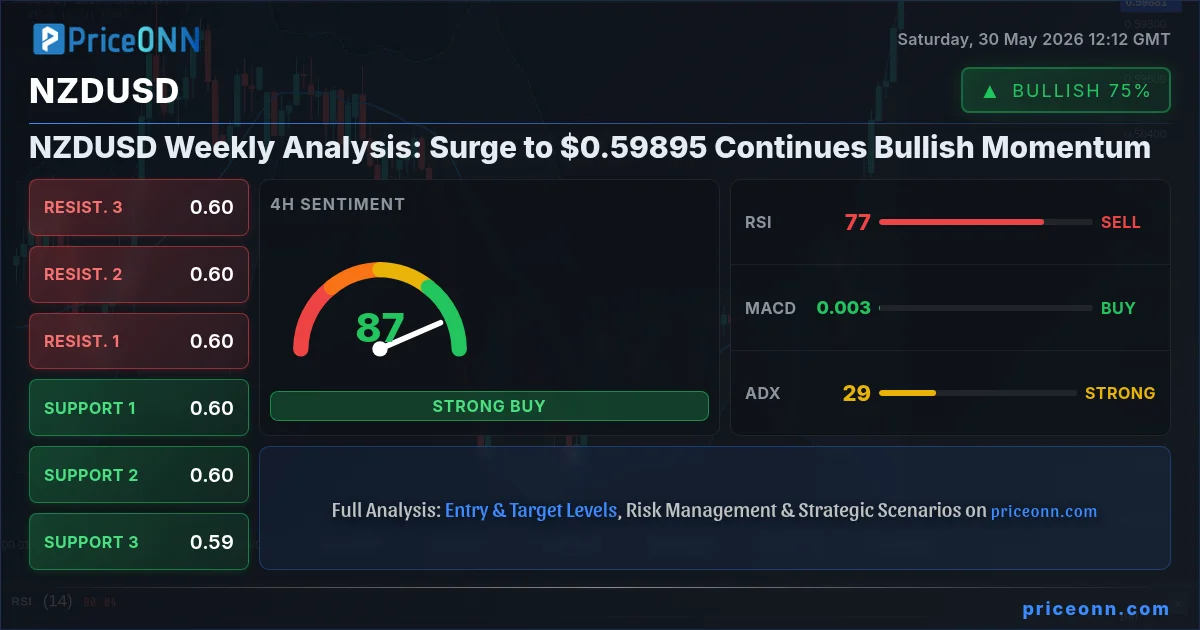
Traders should closely monitor the geopolitical landscape for any significant developments. A sustained increase in Middle East tensions could see NZD/USD testing lower support levels, potentially aiming for the 0.5800 mark. Key resistance for the pair is likely to be found around the 0.5850 level, which it recently breached. For USD/INR, a continued de-escalation in the Middle East could lead to further retracement, with the previous high of 94.75 acting as a significant psychological barrier. Traders should also be aware of upcoming economic data releases from both New Zealand and the United States, as these could provide additional directional impetus. A break below 0.5800 on NZD/USD would signal a stronger bearish sentiment, while a sustained push above 0.5850 could indicate a shift towards risk appetite. For USD/INR, a fall below 94.00 would be a significant bearish signal for the dollar against the rupee.
Outlook
The immediate outlook for NZD/USD remains cautious, heavily dependent on the trajectory of geopolitical events. Should diplomatic efforts succeed in easing tensions, we could see a reversal of the safe-haven demand for the USD, potentially allowing the NZD to recover lost ground. However, persistent uncertainty will likely keep the pair under pressure, with a retest of the 0.5800 level being a distinct possibility in the short term. The Reserve Bank of New Zealand's stance on monetary policy will become more relevant if global risks subside.
Frequently Asked Questions
What is the current trading level for NZD/USD?
The NZD/USD pair is currently trading around the 0.5830 level, showing weakness due to increased geopolitical uncertainty and a demand for the US Dollar as a safe-haven asset.
What are the key factors influencing NZD/USD?
The primary drivers for NZD/USD currently are geopolitical tensions in the Middle East, which boost the US Dollar, and broader market sentiment towards risk assets. Domestic factors like China's economy and dairy prices also play a role but are secondary to global risk appetite.
What is the outlook for NZD/USD if Middle East tensions de-escalate?
If geopolitical tensions in the Middle East de-escalate, the safe-haven demand for the US Dollar could decrease, potentially allowing NZD/USD to rebound. A move back above 0.5850 would be an initial sign of recovery.
Track markets in real-time
Empower your investment decisions with AI-powered analysis, technical indicators and real-time price data.
Join Our Telegram Channel
Get breaking market news, AI analysis and trading signals delivered instantly to your Telegram.
Join Channel PriceONN News
USDJPY has returned to the area of previous interventions. The ECB is moving towards a rate hike in June. The US dollar retreated on Friday amid new record highs for stock indices and rumours of amendments to the US-Iran agreement. However, tit-for-tat exchanges between the adversaries pushed the dollar index back into the support zone […] The post Yen Braces for a New Storm appeared first on ActionForex.
PriceONN News
Markets are pricing in a potential de-escalation in the US-Iran conflict, leading to a significant drop in crude oil prices and a weakening US Dollar as diplomatic efforts appear to be gaining traction.
PriceONN News
The USD/JPY pair is flirting with the 160 level as stalled US-Iran negotiations and hawkish Federal Reserve rhetoric fuel inflation concerns. Traders are closely watching upcoming US Non-Farm Payrolls and Eurozone CPI data.
PriceONN News
EUR/USD stalled below 1.1660 as the US Dollar defied expectations, refusing to weaken despite reports of a US-Iran ceasefire extension. Market participants remain cautious, awaiting concrete confirmation and assessing lingering inflationary pressures.
PriceONN News
EUR/USD closed at 1.1640, showing resilience amid mixed signals. Easing US-Iran tensions initially pressured the dollar, but persistent inflation concerns and political ratification hurdles are keeping the greenback surprisingly steady.
PriceONN News
The EUR/USD faces headwinds as core US PCE inflation unexpectedly rose to 3.3% year-over-year, reinforcing a 'higher for longer' interest rate narrative. Meanwhile, a US-Iran ceasefire extension boosted global risk appetite, potentially drawing capital away from safe-haven currencies.
PriceONN News
EUR/USD stabilized around 1.1640 as reports of a US-Iran ceasefire extension and potential Strait of Hormuz reopening eased inflation fears. However, the US Dollar's resilience suggests lingering caution among forex traders.
PriceONN News
The US Dollar experienced a notable decline last week as markets priced in a potential diplomatic resolution to the US-Iran conflict, leading to a drop in oil prices and Treasury yields. This shift in sentiment suggests a move away from stagflation fears towards a more stable economic outlook.
PriceONN News
USD/CAD faces pressure as Canada's economy shows signs of stalling, with Q1 GDP contracting 0.1% and domestic demand weakening. This comes as trade negotiations and geopolitical shifts add layers of uncertainty.
PriceONN News
AUD/USD’s late break of 0.7183 resistance suggests that pullback from 0.7277 has already completed at 0.7076, after defending 55 D EMA. Initial bias is back on the upside this week for retesting 0.7277 high first. Firm break there will resume larger up trend. For now, risk will stay on the upside as long as 0.7076 […] The post AUD/USD Weekly Report appeared first on ActionForex.
PriceONN News
USD/CAD is showing signs of potential upward movement as Canada's economy grapples with a significant slowdown, marked by weak domestic demand and stalled investment, while trade negotiations loom large.
PriceONN News
USD/JPY is testing the critical 160 level as stalled US-Iran negotiations and hawkish Federal Reserve rhetoric fuel inflation concerns and a potential for further rate hikes. Traders are closely watching upcoming US Non-Farm Payrolls and Eurozone CPI data for direction.