
AUD/USD Price Forecast: Hawkish remarks from RBA’s Hunter lift Australian Dollar
 PriceONN Editorial Desk
Multi-source verification
PriceONN Editorial Desk
Multi-source verification

Aussie Dollar Ascends on Central Bank Signals
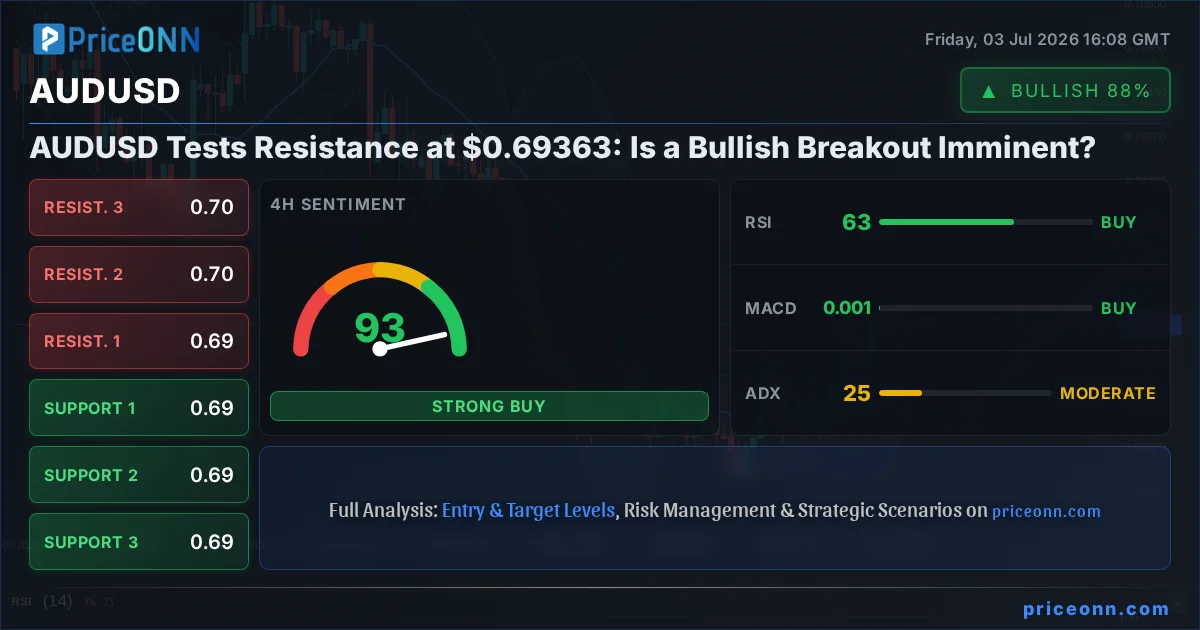
The Australian Dollar posted a modest gain of 0.23% against the US Dollar, reaching approximately 0.6943 in Wednesday's Asian trading hours. This upward movement appears to be influenced by assertive remarks from a Reserve Bank of Australia (RBA) policymaker, suggesting a firmer stance on monetary policy.
Recent trading data reveals the AUD performing strongly against several major currency counterparts, with its most significant appreciation noted against the Japanese Yen. This broad strength underscores the currency's current momentum in the interbank market.
Key Domestic and International Drivers for the AUD
Several interconnected factors continuously shape the trajectory of the Australian Dollar. At its core, the monetary policy decisions enacted by the Reserve Bank of Australia, particularly concerning interest rate settings, are paramount. The RBA's mandate is to maintain price stability, typically targeting an inflation rate between 2% and 3%, by adjusting benchmark lending rates. When Australia's interest rates are comparatively higher than those of other leading economies, the AUD tends to find support. Conversely, a lower rate environment often weighs on the currency.
Beyond domestic interest rates, the RBA possesses tools like quantitative easing and tightening, which influence credit availability and, consequently, the currency's value. Expansionary measures like quantitative easing typically exert downward pressure on the AUD, while contractionary policies, or quantitative tightening, tend to bolster it.
Australia's significant economic ties with China, its principal trading partner, create a direct channel for influence. A thriving Chinese economy translates to increased demand for Australian raw materials, goods, and services, thereby boosting demand for the AUD and driving its value higher. Economic slowdowns or unexpected data in China can thus have a palpable effect on the Australian Dollar's performance.
The price of Iron Ore, Australia's single largest export commodity, also plays a critical role. Valued at approximately $118 billion annually in 2021, with China as the primary buyer, fluctuations in iron ore prices directly impact the nation's export revenue. An uptrend in iron ore prices generally correlates with an appreciation of the AUD, as increased export earnings boost overall demand for the currency. The inverse relationship holds true when iron ore prices decline.
Furthermore, Australia's Trade Balance, the net difference between its export earnings and import expenditures, serves as another key indicator. A robust positive balance, signifying that export revenues exceed import costs, strengthens the AUD. This occurs as foreign entities require more Australian Dollars to purchase the nation's sought-after exports.
Market sentiment, characterized by investor appetite for risk (risk-on) versus a preference for safety (risk-off), also contributes to AUD dynamics. Periods of heightened risk appetite typically favor the Australian Dollar, while a flight to safety can lead to its depreciation.
Market Ripple Effects
The recent hawkish undertones from RBA official Hunter, while not a formal policy shift, inject a degree of uncertainty into the immediate outlook for the AUD/USD pair. Traders will be scrutinizing subsequent communications for confirmation of any sustained hawkish tilt. This development could have knock-on effects for other commodity-linked currencies such as the Canadian Dollar and the New Zealand Dollar, as they often move in tandem with the AUD due to similar economic sensitivities.
Additionally, a stronger Australian Dollar could present headwinds for Australian equities, particularly those sectors heavily reliant on exports or with significant foreign currency debt. Conversely, it might offer some relief on imported inflation for Australian consumers. Investors are also watching the performance of the US Dollar Index (DXY) closely, as the currency's strength or weakness against a basket of major currencies provides broader context for the AUD/USD's movements.
The interplay between commodity prices, particularly Iron Ore, and the currency remains a critical watchpoint. Any significant shifts in the demand from China or supply disruptions could rapidly alter the AUD's fortunes, irrespective of central bank rhetoric.
Track markets in real-time
Empower your investment decisions with AI-powered analysis, technical indicators and real-time price data.
Join Our Telegram Channel
Get breaking market news, AI analysis and trading signals delivered instantly to your Telegram.
Join Channel PriceONN News
The US Dollar Index (DXY), which measures the value of the US Dollar (USD) against six major currencies, is holding gains for the second consecutive day and trading around 101.10 during the Asian session on Wednesday.
PriceONN News
AUD/NZD declines after three days of gains, trading around 1.2170 during the Asian hours on Wednesday. The currency cross falls nearly 0.25% as the New Zealand Dollar (NZD) gains ground following the release of the interest rate decision by the Reserve Bank of New Zealand (RBNZ).
PriceONN News
There is a certain honesty to a currency with nothing to say for itself, and the Swiss Franc spent Tuesday doing exactly that. With not one Swiss data release on the calendar this week, the Franc has no story of its own, leaving USD/CHF to drift on whatever the Dollar side of the tape serves up.
PriceONN News
EUR/USD trades in a narrow range on Tuesday as traders await greater clarity on the Federal Reserve's (Fed) and European Central Bank's (ECB) interest rate paths. At the time of writing, EUR/USD is trading around 1.1436, little changed on the day.
PriceONN News
USD/JPY is holding near 161.84 on Tuesday, with the yen close to 40-year lows. Pressure on the Japanese currency remains as market participants continue to bet against it, with no visible currency interventions from Japanese authorities having materialised. At the same time, investors are closely monitoring potential action from Tokyo. Japanese Finance Minister Satsuki Katayama […] The post Yen Still Under Pressure: Markets Await Action from Authorities appeared first on ActionForex.
PriceONN News
The EUR/USD pair trades marginally lower at around 1.1433 during the European trading session on Tuesday.
PriceONN News
The Indian Rupee (INR) holds onto Monday’s losses against the US Dollar (USD) in the opening session on Tuesday.
PriceONN News
NZD/USD inches lower for the second successive day, trading around 0.5700 during the Asian hours on Tuesday. The currency pair depreciates as the US Dollar (USD) holds ground, which could be attributed to the renewed geopolitical tensions in the Strait of Hormuz.
PriceONN News
Sterling’s rally has been about more than better sentiment toward the UK. It has been driven by the disappearance of one of the market’s biggest bearish trades. As political uncertainty faded following the resolution of Labour’s leadership transition, investors who had built sizeable short Sterling positions found themselves on the wrong side of the market. […] The post GBP/CHF Nears Trend-Reversal Zone as Political Risk Fades and Sterling Shorts Unwind appeared first on ActionForex.
PriceONN News
The GBPJPY pair has decisively broken to a new high, thereby confirming the prevailing bullish trend. This development underscores the presence of a bullish sequence that favors continued upside momentum. In the short term, the rally from the May 1, 2026 low is unfolding as a clear five‑wave advance. From that low, wave ((i)) concluded […] The post GBPJPY Elliott Wave Outlook: Break to New High Confirms Bullish Trend appeared first on ActionForex.
PriceONN News
GBP/USD continues its winning streak for the ninth consecutive day, trading around 1.3390 during the Asian hours on Tuesday.
PriceONN News
The Japanese Yen (JPY) has resumed its broader downtrend against the US Dollar (USD) on Monday following a mild relief last week.