
British Pound gains as easing Fed hike bets weigh on US Dollar
 PriceONN Editorial Desk
Multi-source verification
PriceONN Editorial Desk
Multi-source verification
Sterling's Quiet Ascent Amidst Global Currency Currents
The British Pound, a currency with roots stretching back to 886 AD, is currently experiencing a significant upward trend. This oldest of world currencies, the official tender of the United Kingdom, holds a formidable position in global finance. Recent data from 2022 reveals it as the fourth most actively traded currency worldwide, commanding approximately 12% of all foreign exchange transactions and averaging a colossal $630 billion daily.
Its most prominent trading partners are the US Dollar, in a pairing colloquially known as 'Cable' which represents 11% of FX volume, and the Japanese Yen, dubbed the 'Dragon' by market participants, accounting for 3%. The Euro also features, with EUR/GBP representing 2% of daily trades. Overseeing the Sterling's stability is the Bank of England (BoE), whose monetary policy decisions are paramount to its valuation.
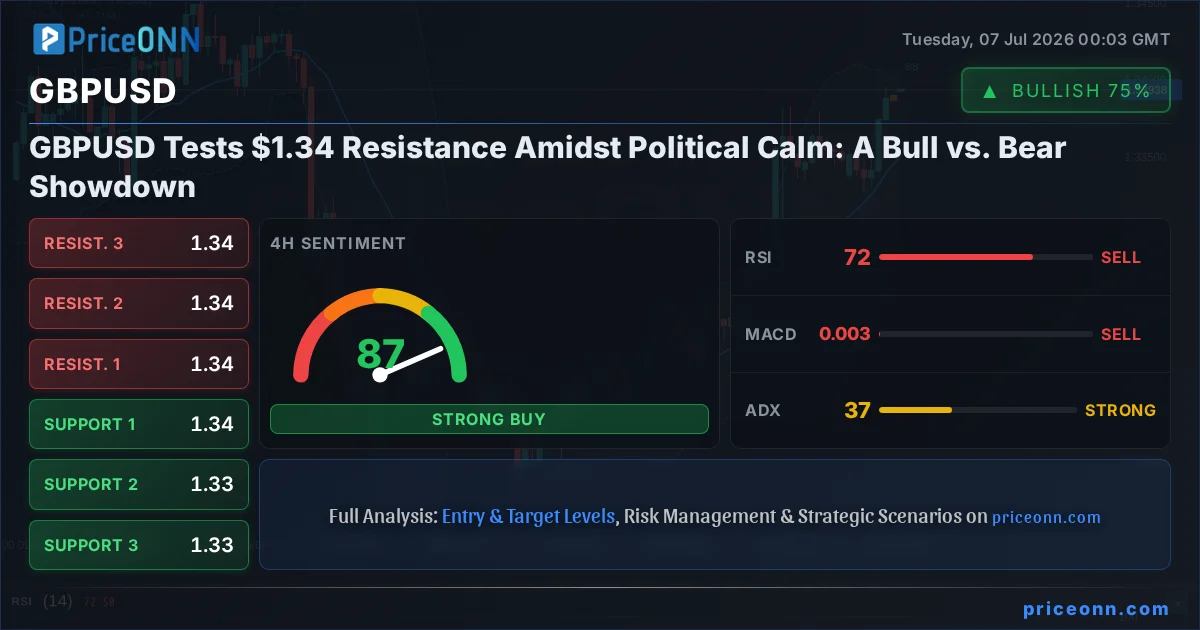
The BoE's mandate centers on achieving a stable inflation rate, ideally hovering around 2%. To manage inflation, the central bank wields interest rates as its primary instrument. When inflationary pressures mount, the BoE typically raises interest rates. This action increases the cost of borrowing, aiming to cool down economic activity. Paradoxically, higher interest rates often bolster the Sterling, as they enhance the UK's appeal to international investors seeking yield on their capital.
Conversely, a sustained period of low inflation can signal a deceleration in economic growth. In such circumstances, the BoE may opt to lower interest rates. This makes credit cheaper, theoretically stimulating business investment and fostering economic expansion. Economic data releases serve as crucial barometers for the health of the UK economy and can directly sway the Sterling's trajectory. Key indicators like Gross Domestic Product (GDP) figures, Purchasing Managers' Indexes (PMIs) for both manufacturing and services sectors, and employment statistics all play a vital role in shaping market sentiment towards GBP.
A robust domestic economy inherently supports Sterling. It not only attracts a greater influx of foreign capital but also provides the Monetary Policy Committee with greater latitude to implement interest rate hikes, thereby directly strengthening the currency. Weak economic data, however, typically precipitates a decline in the Pound Sterling. Another critical data point influencing GBP is the Trade Balance, which quantifies the disparity between a nation's export revenues and its import expenditures over a specific period. A favorable net trade balance, driven by strong demand for a country's exports from global buyers, provides a direct boost to its currency. Conversely, a persistent deficit tends to weaken it.
Reading Between the Lines
The recent uptick in the British Pound against the US Dollar is not merely a function of bilateral dynamics; it’s deeply intertwined with shifting global monetary policy expectations. The market's perception of the US Federal Reserve's future rate path has cooled considerably, with fewer bets now placed on aggressive hikes. This recalibration has diminished the allure of the dollar, creating an opening for currencies like Sterling to assert their strength.
This development suggests a potential rotation in capital flows. As the premium offered by dollar-denominated assets diminishes relative to expectations, investors may be seeking higher yields or greater stability elsewhere. The UK economy, despite its own challenges, appears to be benefiting from this re-evaluation. Furthermore, the Bank of England's own stance on interest rates, while perhaps less hawkish than previously anticipated, still presents a more attractive yield environment compared to a US that is signaling a potential pause or slower pace of tightening.
Traders should closely monitor upcoming inflation data from both the UK and the US. Any surprises on the downside for US inflation could further weaken the dollar, while positive UK inflation prints might embolden the BoE, potentially leading to further Sterling appreciation. Beyond direct interest rate differentials, market sentiment towards global growth and geopolitical stability will also play a crucial role. The interplay between the US Dollar Index (DXY), which measures the dollar's strength against a basket of major currencies, and GBP/USD will be a key indicator of broader risk appetite. Additionally, movements in European sovereign bond yields could offer clues about relative economic strength and risk perception across the Atlantic.
Track markets in real-time
Empower your investment decisions with AI-powered analysis, technical indicators and real-time price data.
Join Our Telegram Channel
Get breaking market news, AI analysis and trading signals delivered instantly to your Telegram.
Join Channel PriceONN News
There is a certain honesty to a currency with nothing to say for itself, and the Swiss Franc spent Tuesday doing exactly that. With not one Swiss data release on the calendar this week, the Franc has no story of its own, leaving USD/CHF to drift on whatever the Dollar side of the tape serves up.
PriceONN News
USD/JPY is holding near 161.84 on Tuesday, with the yen close to 40-year lows. Pressure on the Japanese currency remains as market participants continue to bet against it, with no visible currency interventions from Japanese authorities having materialised. At the same time, investors are closely monitoring potential action from Tokyo. Japanese Finance Minister Satsuki Katayama […] The post Yen Still Under Pressure: Markets Await Action from Authorities appeared first on ActionForex.
PriceONN News
The EUR/USD pair trades marginally lower at around 1.1433 during the European trading session on Tuesday.
PriceONN News
The GBP/USD pair struggles to capitalize on last week's strong move higher and oscillates in a narrow band, around the 1.3350 area during the Asian session on Monday.
PriceONN News
The Kiwi Dollar clears the 0.5700 figure on Friday, clings to gains of over 0.22% against the Greenback after hitting a daily low of 0.5689. At the time of writing, the NZD/USD trades at 0.5709.
PriceONN News
The Australian Dollar (AUD) trades 0.23% higher to near 0.6943 against the US Dollar (USD) during the Asian trading session on Wednesday.
PriceONN News
The US Dollar Index (DXY), which measures the value of the US Dollar (USD) against six major currencies, is holding gains for the second consecutive day and trading around 101.10 during the Asian session on Wednesday.
PriceONN News
AUD/NZD declines after three days of gains, trading around 1.2170 during the Asian hours on Wednesday. The currency cross falls nearly 0.25% as the New Zealand Dollar (NZD) gains ground following the release of the interest rate decision by the Reserve Bank of New Zealand (RBNZ).
PriceONN News
EUR/USD trades in a narrow range on Tuesday as traders await greater clarity on the Federal Reserve's (Fed) and European Central Bank's (ECB) interest rate paths. At the time of writing, EUR/USD is trading around 1.1436, little changed on the day.
PriceONN News
Gold is attempting to break its medium-term trend, with the latest US labour market data acting as the main catalyst. The US employment report released on 2 July came in noticeably weaker than expected, with the pace of hiring slowing to its lowest level in several months. This may have dampened expectations of a near-term […] The post Gold Resumes Its Advance Following the US Labour Market Report appeared first on ActionForex.
PriceONN News
The Indian Rupee (INR) holds onto Monday’s losses against the US Dollar (USD) in the opening session on Tuesday.
PriceONN News
NZD/USD inches lower for the second successive day, trading around 0.5700 during the Asian hours on Tuesday. The currency pair depreciates as the US Dollar (USD) holds ground, which could be attributed to the renewed geopolitical tensions in the Strait of Hormuz.