
British Pound flat lines around mid-1.3300s vs USD amid Iran tensions
 PriceONN Editorial Desk
Multi-source verification
PriceONN Editorial Desk
Multi-source verification
Sterling's Sideways Drift Amidst Global Uncertainty
The British Pound, a currency with a lineage tracing back to 886 AD, is currently experiencing a period of consolidation. Trading has settled around the 1.3350 level versus the US Dollar during early Monday trading in Asia. This pause follows a notable upward movement in the preceding week, suggesting market participants are adopting a wait-and-see approach.
Globally, the Pound Sterling ranks as the fourth most actively traded currency, commanding approximately 12% of all foreign exchange transactions. Daily volumes, based on 2022 figures, average a substantial $630 billion. Its most prominent trading relationships include the GBP/USD pair, colloquially known as 'Cable', which alone represents 11% of FX turnover. The GBP/JPY ('Dragon') and EUR/GBP pairs also hold significant, albeit smaller, shares.
The Bank of England (BoE) stands as the ultimate arbiter of Sterling's value. Its monetary policy decisions, particularly those concerning interest rates, are the primary drivers. The central bank's mandate revolves around achieving 'price stability', defined as an inflation rate hovering near 2%. Adjustments to the base interest rate serve as the principal instrument to manage inflationary pressures.
When inflation accelerates beyond the target, the BoE typically tightens monetary conditions by increasing interest rates. This action makes borrowing more costly for individuals and corporations, aiming to cool down demand. Conversely, a rate hike generally bolsters the Sterling, as higher yields attract foreign capital seeking better returns. Such a scenario positions the UK as a more appealing destination for international investment.
Conversely, a dip in inflation below the 2% target signals a potential economic slowdown. In such circumstances, the BoE may opt to lower interest rates, thereby reducing the cost of credit. This policy aims to incentivize borrowing and investment, stimulating economic expansion. The release of key economic data plays a crucial role in shaping these decisions and, consequently, the Pound's trajectory.
Indicators like Gross Domestic Product (GDP) figures, Purchasing Managers' Indexes (PMIs) for both manufacturing and services sectors, and employment statistics are closely scrutinized. A robust economic performance generally supports the Sterling. Not only does it enhance the UK's attractiveness to foreign investors, but it also provides the BoE with room to implement rate hikes, directly supporting the currency. Weak economic data, however, tends to exert downward pressure on Sterling.
Another critical economic gauge for the Pound is the Trade Balance. This metric quantifies the disparity between a nation's export earnings and its import expenditures over a specified period. A favorable net Trade Balance, indicating that a country exports more than it imports, typically strengthens its currency due to increased demand from international buyers. A negative balance, conversely, tends to weaken the currency.
Reading Between the Lines
The current lull in GBP/USD action, occurring against a backdrop of heightened geopolitical tensions, presents a complex trading environment. While last week saw a bullish surge for the pair, the inability to build on that momentum suggests underlying caution. Traders are likely weighing the potential impact of international conflicts on global economic stability and risk appetite.
This situation has ripple effects across several key markets. The US Dollar Index (DXY), a benchmark for the greenback's strength against major peers, will be closely watched. Any escalation of geopolitical risks could lead to a 'flight to safety', benefiting the DXY. Simultaneously, European currencies like the Euro (EUR) and the Swiss Franc (CHF) could face pressure if the geopolitical situation directly impacts the continent.
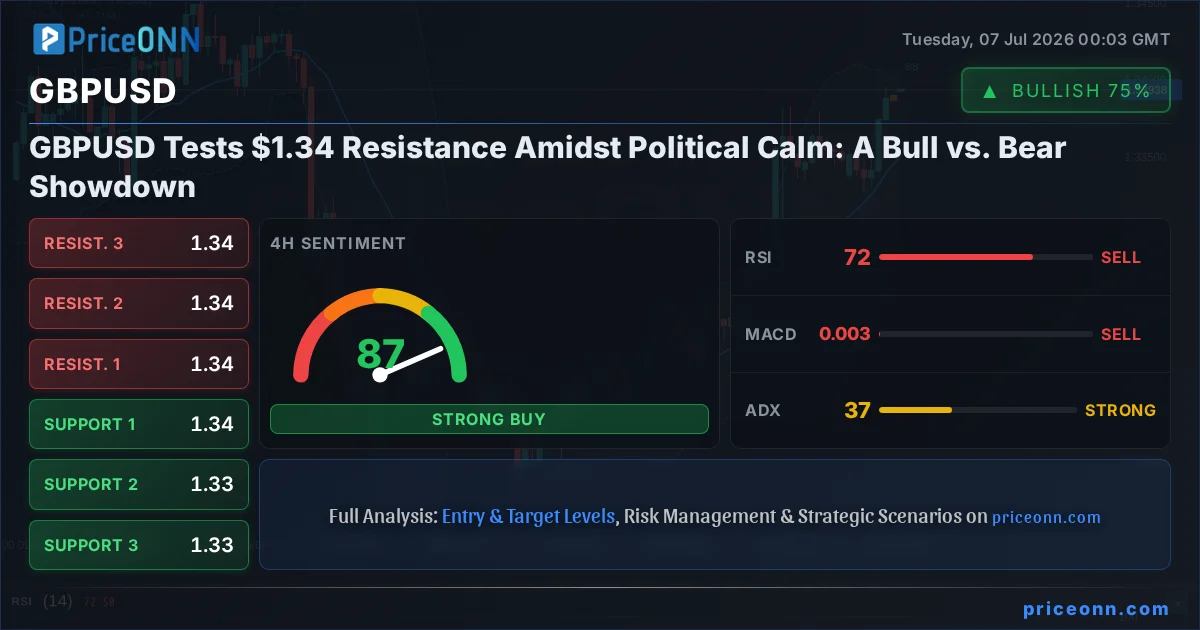
Market participants should monitor upcoming economic data from both the UK and the US. Inflation prints, employment figures, and central bank commentary will be critical. The Bank of England's stance on inflation versus growth concerns will be paramount for Sterling's direction. For USD, the Federal Reserve's reaction function to any global economic shock will dictate its path. Key levels to watch for GBP/USD include the 1.3300 support and the recent highs around 1.3400. A decisive break above the latter could signal renewed bullish conviction, while a fall below the former might indicate a return to broader dollar strength.
Track markets in real-time
Empower your investment decisions with AI-powered analysis, technical indicators and real-time price data.
Join Our Telegram Channel
Get breaking market news, AI analysis and trading signals delivered instantly to your Telegram.
Join Channel PriceONN News
The US Dollar (USD) appreciates against the Japanese Yen (JPY) for the fourth consecutive day on Wednesday, fuelled by the resumption of hostilities in the Middle East and dovish comments from Bank of Japan (BoJ) officials.
PriceONN News
The US Dollar Index (DXY), which measures the value of the US Dollar (USD) against six major currencies, is holding gains for the second consecutive day and trading around 101.10 during the Asian session on Wednesday.
PriceONN News
NZD/USD inches lower for the second successive day, trading around 0.5700 during the Asian hours on Tuesday. The currency pair depreciates as the US Dollar (USD) holds ground, which could be attributed to the renewed geopolitical tensions in the Strait of Hormuz.
PriceONN News
Sterling’s rally has been about more than better sentiment toward the UK. It has been driven by the disappearance of one of the market’s biggest bearish trades. As political uncertainty faded following the resolution of Labour’s leadership transition, investors who had built sizeable short Sterling positions found themselves on the wrong side of the market. […] The post GBP/CHF Nears Trend-Reversal Zone as Political Risk Fades and Sterling Shorts Unwind appeared first on ActionForex.
PriceONN News
GBP/USD continues its winning streak for the ninth consecutive day, trading around 1.3390 during the Asian hours on Tuesday.
PriceONN News
USD/CAD gains ground for the second consecutive day, trading around 1.4210 during the Asian hours on Monday. The upside of the pair could be restrained as the commodity-linked Canadian Dollar (CAD) could receive support from higher oil prices.
PriceONN News
The Euro (EUR) trades 0.1% higher to near 185.20 against the Japanese Yen (JPY) during the European trading session on Wednesday.
PriceONN News
Gold (XAU/USD) maintains its bid tone heading into the European session on Wednesday and, for now, seems to have snapped a two-day losing streak to sub-$4,100 levels, or the weekly trough touched the previous day.
PriceONN News
The Australian Dollar (AUD) trades 0.23% higher to near 0.6943 against the US Dollar (USD) during the Asian trading session on Wednesday.
PriceONN News
AUD/NZD declines after three days of gains, trading around 1.2170 during the Asian hours on Wednesday. The currency cross falls nearly 0.25% as the New Zealand Dollar (NZD) gains ground following the release of the interest rate decision by the Reserve Bank of New Zealand (RBNZ).
PriceONN News
There is a certain honesty to a currency with nothing to say for itself, and the Swiss Franc spent Tuesday doing exactly that. With not one Swiss data release on the calendar this week, the Franc has no story of its own, leaving USD/CHF to drift on whatever the Dollar side of the tape serves up.
PriceONN News
EUR/USD trades in a narrow range on Tuesday as traders await greater clarity on the Federal Reserve's (Fed) and European Central Bank's (ECB) interest rate paths. At the time of writing, EUR/USD is trading around 1.1436, little changed on the day.