
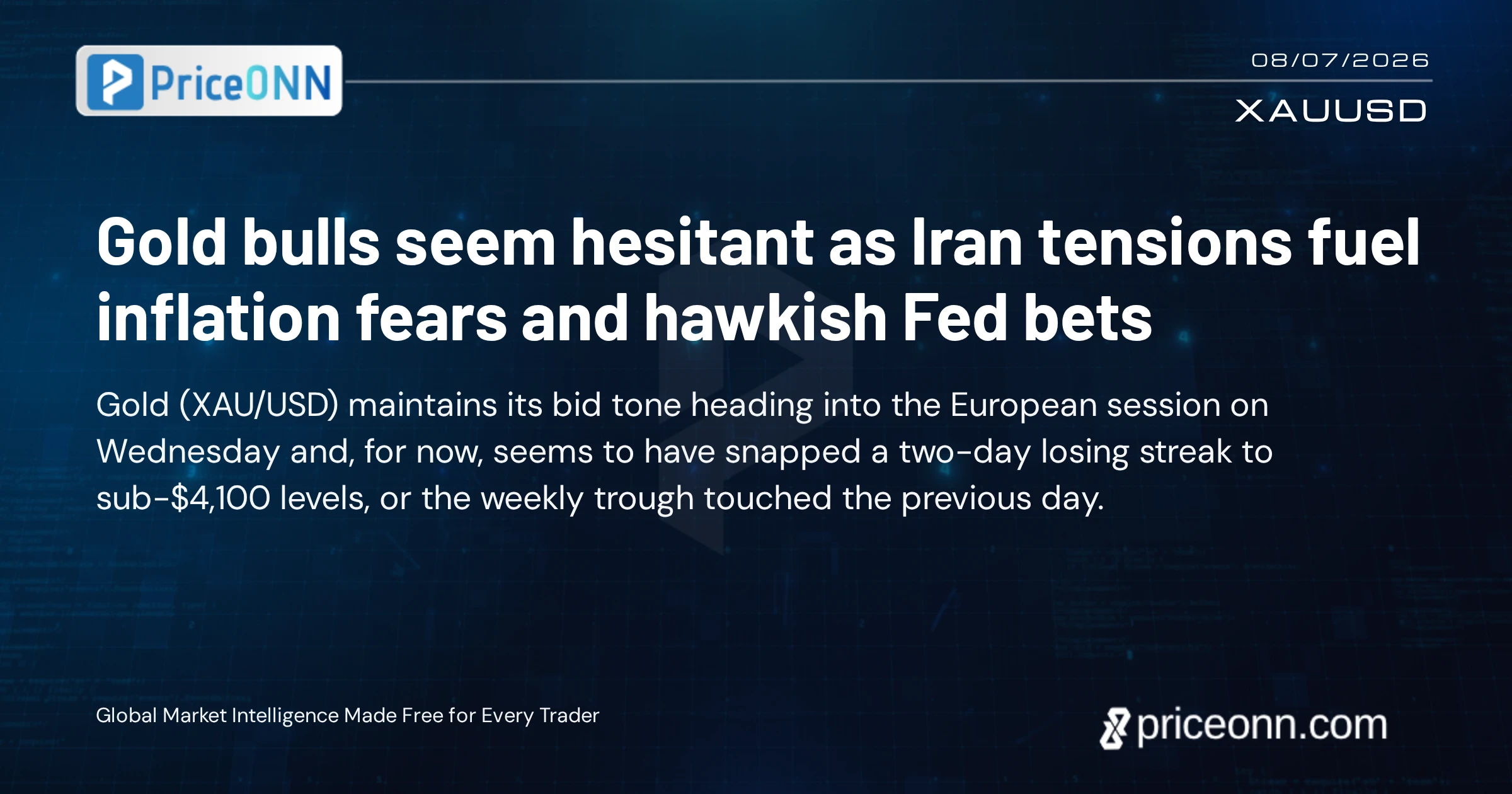
Gold bulls seem hesitant as Iran tensions fuel inflation fears and hawkish Fed bets
 PriceONN Editorial Desk
Multi-source verification
PriceONN Editorial Desk
Multi-source verification
Gold's Enduring Appeal in Volatile Times
For millennia, gold has stood as a bastion of value, transcending its role as mere adornment to become a fundamental pillar of global finance. Its enduring allure stems from a dual identity: a trusted safe-haven asset for navigating economic uncertainty and a potent hedge against the corrosive effects of inflation. Unlike fiat currencies, gold's value is not tethered to the policies or stability of any single government, granting it a unique independence.
This intrinsic stability makes it a cornerstone of reserve management for central banks worldwide. In 2022, these institutions collectively amassed a staggering 1,136 tonnes of gold, a record-breaking acquisition valued at approximately $70 billion, according to the World Gold Council. This massive influx, driven significantly by emerging economies like China, India, and Turkey, signals a strategic diversification aimed at bolstering currency strength and enhancing national solvency perceptions.
The interplay between gold, the US Dollar, and Treasury yields creates a dynamic market. Typically, a weakening dollar bolsters gold prices, as dollar-denominated assets become less attractive. Conversely, a strengthening dollar can temper gold's ascent. Similarly, gold often exhibits an inverse relationship with riskier assets like equities. When stock markets surge, gold may falter, but a sharp sell-off in equities can trigger a flight to safety, benefiting the yellow metal.
Decoding Gold's Price Drivers
The yellow metal's price trajectory is influenced by a confluence of factors, with geopolitical instability and recession fears acting as significant catalysts. Such events typically ignite demand for gold's safe-haven properties, leading to rapid price escalations. However, the cost of capital, represented by interest rates, plays a crucial role. As an asset that generates no yield, gold typically thrives in an environment of lower interest rates. Conversely, rising borrowing costs tend to exert downward pressure on its price.
Despite these various influences, the behavior of the US Dollar (USD) remains a paramount determinant for XAU/USD. The pricing mechanism itself means that a robust dollar inherently restrains gold's upward momentum, while dollar weakness provides fertile ground for gold prices to climb. Current market sentiment appears to be grappling with these competing forces, creating a complex trading environment.
Market Ripple Effects
The current tug-of-war in gold markets, influenced by geopolitical anxieties and central bank actions, has broader implications for several key financial instruments and asset classes. Traders are closely monitoring the interplay between inflation expectations, the trajectory of US interest rates, and the safe-haven demand for gold.
The US Dollar Index (DXY) is a critical bellwether. Should geopolitical tensions escalate and inflation fears intensify, a weaker dollar could emerge, providing a tailwind for gold. Conversely, persistent hawkish rhetoric from the Federal Reserve, aimed at combating inflation, could strengthen the dollar and cap gold gains. This dynamic also impacts US Treasury yields. Rising yields, often a consequence of anticipated rate hikes, increase the opportunity cost of holding non-yielding gold, potentially leading to price declines.
Furthermore, the sentiment surrounding gold often correlates with broader risk appetite in financial markets. A sustained increase in gold prices, driven by safe-haven flows, could signal a decline in investor confidence in riskier assets like tech stocks. Conversely, a cooling of geopolitical fears and a rebound in risk assets might see gold prices retreat. Investors are therefore watching for signs of a general shift in market sentiment, which could cascade across these interconnected markets.
Trader Takeaways
The recent hesitation in gold's price action, despite underlying inflationary pressures and geopolitical unease, presents a nuanced outlook for traders. While the metal has historically benefited from such conditions, the specter of continued aggressive monetary tightening by major central banks, particularly the US Federal Reserve, is acting as a significant countervailing force.
Market participants are weighing the safe-haven appeal against the rising opportunity cost of holding a non-yielding asset. The critical question revolves around whether geopolitical risks will ultimately overwhelm hawkish central bank narratives. Traders should closely watch the $2,050 per ounce level, a significant psychological and technical juncture. A decisive break below this could signal a more pronounced correction, while sustained defense might indicate underlying strength.
The divergence between emerging market central banks' accumulation of gold and developed market central banks' focus on inflation control creates a fascinating backdrop. This suggests differing risk perceptions and strategic priorities globally. Keep an eye on currency fluctuations, particularly the USD/JPY pair, which can sometimes act as an indirect indicator of global risk sentiment and capital flows. The tension between inflation hedges and the cost of capital is likely to define gold's path in the near term.
Track markets in real-time
Empower your investment decisions with AI-powered analysis, technical indicators and real-time price data.
Join Our Telegram Channel
Get breaking market news, AI analysis and trading signals delivered instantly to your Telegram.
Join Channel PriceONN News
Gold is attempting to break its medium-term trend, with the latest US labour market data acting as the main catalyst. The US employment report released on 2 July came in noticeably weaker than expected, with the pace of hiring slowing to its lowest level in several months. This may have dampened expectations of a near-term […] The post Gold Resumes Its Advance Following the US Labour Market Report appeared first on ActionForex.
PriceONN News
The US Dollar (USD) appreciates against the Japanese Yen (JPY) for the fourth consecutive day on Wednesday, fuelled by the resumption of hostilities in the Middle East and dovish comments from Bank of Japan (BoJ) officials.
PriceONN News
The US Dollar Index (DXY), which measures the value of the US Dollar (USD) against six major currencies, is holding gains for the second consecutive day and trading around 101.10 during the Asian session on Wednesday.
PriceONN News
NZD/USD inches lower for the second successive day, trading around 0.5700 during the Asian hours on Tuesday. The currency pair depreciates as the US Dollar (USD) holds ground, which could be attributed to the renewed geopolitical tensions in the Strait of Hormuz.
PriceONN News
GBP/USD continues its winning streak for the ninth consecutive day, trading around 1.3390 during the Asian hours on Tuesday.
PriceONN News
European Central Bank (ECB) Governing Council member Emmanuel Moulin said at the Rencontres Economiques conference in Aix-en-Provence on Saturday that the central bank is in a “good position” after raising interest rates in its June policy meeting, with inflation easing alongside the slump in oil pr
PriceONN News
Last week’s post-US NFP rebound has given NZD/USD some breathing room, but it has done little to convince traders that the recent downtrend has run its course. With the Reserve Bank of New Zealand set to announce its policy decision this week, the Kiwi now faces a catalyst that could determine whether the recovery develops […] The post NZD/USD Bears Await RBNZ Verdict After Relief Rally appeared first on ActionForex.
PriceONN News
The Euro (EUR) trades 0.1% higher to near 185.20 against the Japanese Yen (JPY) during the European trading session on Wednesday.
PriceONN News
The Australian Dollar (AUD) trades 0.23% higher to near 0.6943 against the US Dollar (USD) during the Asian trading session on Wednesday.
PriceONN News
AUD/NZD declines after three days of gains, trading around 1.2170 during the Asian hours on Wednesday. The currency cross falls nearly 0.25% as the New Zealand Dollar (NZD) gains ground following the release of the interest rate decision by the Reserve Bank of New Zealand (RBNZ).
PriceONN News
There is a certain honesty to a currency with nothing to say for itself, and the Swiss Franc spent Tuesday doing exactly that. With not one Swiss data release on the calendar this week, the Franc has no story of its own, leaving USD/CHF to drift on whatever the Dollar side of the tape serves up.
PriceONN News
EUR/USD trades in a narrow range on Tuesday as traders await greater clarity on the Federal Reserve's (Fed) and European Central Bank's (ECB) interest rate paths. At the time of writing, EUR/USD is trading around 1.1436, little changed on the day.