
ECB’s Moulin: Central bank is in a “good position” after raising interest rates in June
 PriceONN Editorial Desk
Multi-source verification
PriceONN Editorial Desk
Multi-source verification
Frankfurt's Monetary Stance Assessed
The European Central Bank (ECB), headquartered in Frankfurt, Germany, stands as the monetary authority for the Eurozone. Its core mission involves steering monetary policy and setting benchmark interest rates, with a primary objective of maintaining price stability across the region. This crucial goal translates to keeping inflation anchored at approximately 2%.
The ECB's principal lever for influencing inflation is its control over interest rates. Generally, a policy of higher interest rates tends to bolster the value of the Euro, while lower rates often weaken it. These pivotal decisions are deliberated by the ECB's Governing Council, a body comprising the governors of the Eurozone's national central banks and six permanent members, including the President, in scheduled meetings held eight times annually.
Unpacking the ECB's Toolkit and Strategy
In extraordinary economic circumstances, the ECB possesses the extraordinary power to implement Quantitative Easing (QE). This unconventional measure involves the central bank creating new Euros to purchase assets, predominantly government and corporate bonds, from financial institutions. The typical outcome of QE is a depreciation of the Euro.
QE is reserved for situations where conventional interest rate adjustments prove insufficient to achieve the mandate of price stability. The ECB has previously deployed this tool during significant economic downturns, including the aftermath of the 2008 Great Financial Crisis (2009-2011), a period in 2015 when inflation proved stubbornly low, and more recently, during the global COVID-19 pandemic.
Conversely, Quantitative Tightening (QT) represents the unwinding of QE. This process is initiated when an economic recovery gains traction and inflationary pressures begin to escalate. Instead of purchasing bonds, the ECB ceases to acquire new ones and halts the reinvestment of principal payments from maturing assets it already holds. This shift in policy is generally viewed as supportive of, or bullish for, the Euro.
Reading Between the Lines
Emmanuel Moulin's recent remarks at the Rencontres Economiques conference in Aix-en-Provence on Saturday signal a degree of satisfaction with the ECB's recent policy trajectory. By stating the central bank is in a "good position" after the June rate hike, he suggests that the move is having its intended effects. The accompanying observation that inflation is easing, particularly with the slump in oil prices, provides the crucial context for this positive assessment.
This perspective implies that the Governing Council is closely monitoring the interplay between its policy actions and real-world economic indicators. The emphasis on oil prices is significant, as energy costs are a major component of headline inflation and can influence broader price pressures. The fact that these prices are falling offers a tangible reason for the ECB to feel more confident about its inflation outlook.
While Moulin's statement is largely positive, it's important to remember that central bank communications are often carefully calibrated. The phrase "good position" is intentionally somewhat vague, allowing for flexibility in future policy decisions. It does not necessarily preclude further rate adjustments, but it does suggest that the immediate impact of the June hike is being viewed favorably. Market participants will be dissecting subsequent ECB communications for any nuances that might indicate a shift in the outlook.
The contrasting tools of QE and QT also offer a backdrop to Moulin's comments. The ECB's move away from aggressive easing and towards a more neutral or potentially tightening stance, as indicated by the rate hike and the ongoing QT process, is a signal to markets. This transition aims to withdraw excess liquidity and curb demand-pull inflation without triggering a sharp economic contraction. The positive correlation with the Euro's strength suggests that a well-managed QT process could provide a tailwind for the currency.
Track markets in real-time
Empower your investment decisions with AI-powered analysis, technical indicators and real-time price data.
Join Our Telegram Channel
Get breaking market news, AI analysis and trading signals delivered instantly to your Telegram.
Join Channel PriceONN News
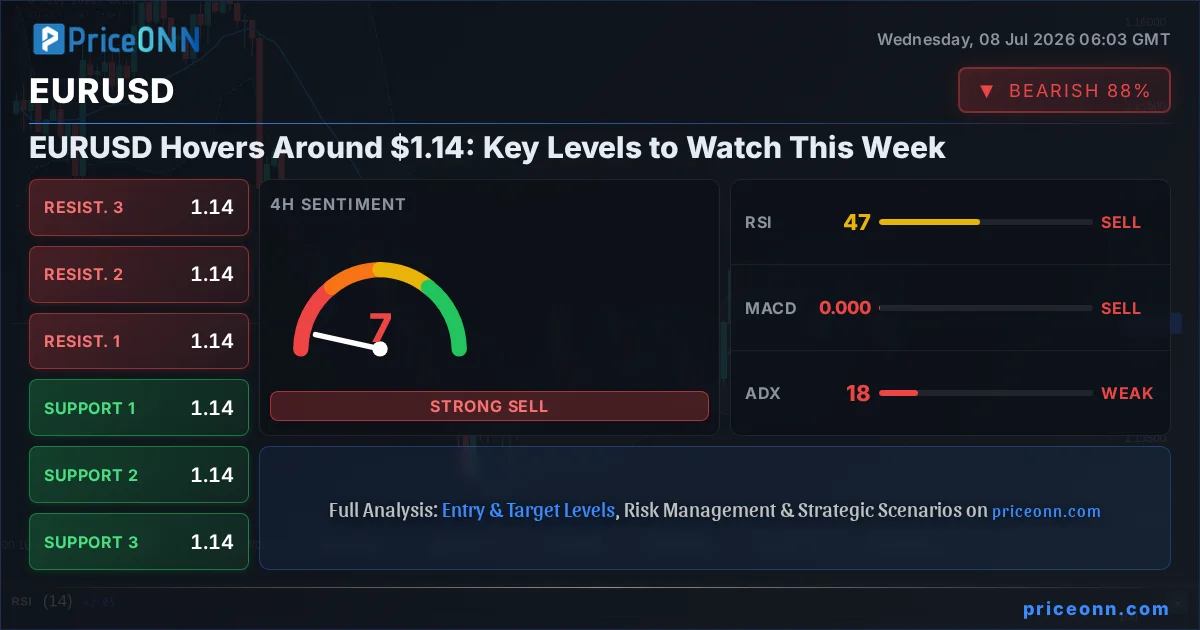
EUR/USD trades in a narrow range on Tuesday as traders await greater clarity on the Federal Reserve's (Fed) and European Central Bank's (ECB) interest rate paths. At the time of writing, EUR/USD is trading around 1.1436, little changed on the day.
PriceONN News
Last week’s post-US NFP rebound has given NZD/USD some breathing room, but it has done little to convince traders that the recent downtrend has run its course. With the Reserve Bank of New Zealand set to announce its policy decision this week, the Kiwi now faces a catalyst that could determine whether the recovery develops […] The post NZD/USD Bears Await RBNZ Verdict After Relief Rally appeared first on ActionForex.
PriceONN News
The Euro (EUR) trades 0.1% higher to near 185.20 against the Japanese Yen (JPY) during the European trading session on Wednesday.
PriceONN News
Gold (XAU/USD) maintains its bid tone heading into the European session on Wednesday and, for now, seems to have snapped a two-day losing streak to sub-$4,100 levels, or the weekly trough touched the previous day.
PriceONN News
Gold is attempting to break its medium-term trend, with the latest US labour market data acting as the main catalyst. The US employment report released on 2 July came in noticeably weaker than expected, with the pace of hiring slowing to its lowest level in several months. This may have dampened expectations of a near-term […] The post Gold Resumes Its Advance Following the US Labour Market Report appeared first on ActionForex.
PriceONN News
The EUR/USD pair trades marginally lower at around 1.1433 during the European trading session on Tuesday.
PriceONN News
Eurozone PPI rose 0.2% mom in May, matching market expectations, while annual producer inflation accelerated from 5.0% yoy to 5.9% yoy, slightly above the 5.7% yoy consensus. The data suggest producer price pressures remained elevated even as monthly price growth moderated from April’s 0.7% increase. The monthly increase reflected diverging trends across sectors. Prices for […] The post Eurozone Producer Inflation Holds Firm as Core Factory Prices Continue to Rise appeared first on ActionForex.
PriceONN News
The US Dollar (USD) appreciates against the Japanese Yen (JPY) for the fourth consecutive day on Wednesday, fuelled by the resumption of hostilities in the Middle East and dovish comments from Bank of Japan (BoJ) officials.
PriceONN News
The Australian Dollar (AUD) trades 0.23% higher to near 0.6943 against the US Dollar (USD) during the Asian trading session on Wednesday.
PriceONN News
The US Dollar Index (DXY), which measures the value of the US Dollar (USD) against six major currencies, is holding gains for the second consecutive day and trading around 101.10 during the Asian session on Wednesday.
PriceONN News
AUD/NZD declines after three days of gains, trading around 1.2170 during the Asian hours on Wednesday. The currency cross falls nearly 0.25% as the New Zealand Dollar (NZD) gains ground following the release of the interest rate decision by the Reserve Bank of New Zealand (RBNZ).
PriceONN News
There is a certain honesty to a currency with nothing to say for itself, and the Swiss Franc spent Tuesday doing exactly that. With not one Swiss data release on the calendar this week, the Franc has no story of its own, leaving USD/CHF to drift on whatever the Dollar side of the tape serves up.