
NZD/USD Bears Await RBNZ Verdict After Relief Rally
 PriceONN Editorial Desk
Multi-source verification
PriceONN Editorial Desk
Multi-source verification
Market Holds Breath for RBNZ Policy Clues
The NZD/USD pair is experiencing a brief respite following a rebound that coincided with softer US nonfarm payrolls data last week. However, this bounce has done little to quell underlying bearish sentiment, leaving many market participants questioning if the recent downtrend has truly exhausted itself. All eyes are now fixed on the Reserve Bank of New Zealand (RBNZ) as it prepares to unveil its latest monetary policy verdict this week. This announcement presents a critical juncture that will likely dictate whether the current recovery gains traction or if sellers will soon reassert control.
The RBNZ finds itself navigating a complex economic landscape, where compelling arguments exist for both maintaining the status quo and implementing further tightening. Persistent inflation, exacerbated by recent energy market shocks, bolsters the case for pushing interest rates closer to neutral territory. Yet, the domestic economy shows signs of strain, with subdued consumer spending and lingering unemployment. Furthermore, a de-escalation in geopolitical tensions, particularly following a US-Iran ceasefire, has somewhat diminished the immediate urgency for aggressive action.
Divergent Views on Monetary Path Ahead
This policy quandary is clearly reflected in the opinions of economic forecasters. The NZIER Monetary Policy Shadow Board, for instance, narrowly favors keeping the Official Cash Rate (OCR) steady at 2.25%. Nevertheless, they characterize the upcoming July meeting as an exceptionally tight decision. Supporters of a rate hike point to the stubbornness of inflation, while those advocating for a hold emphasize the need to assess the full economic impact of the earlier energy price surge and cooling domestic activity.
Despite the short-term uncertainty, there appears to be a broad consensus regarding the medium-term trajectory of monetary policy. A significant majority of shadow board members anticipate the OCR will gradually climb towards the 3.00%-3.25% range within the next year. Major New Zealand banks echo this divided outlook.
ANZ and BNZ project a 25 basis point increase this week. ANZ, however, cautions that any hike should be accompanied by balanced forward guidance to prevent policymakers from being locked into an overly aggressive tightening path should economic data falter. BNZ aligns with this view, asserting that inflation risks remain a concern despite global geopolitical improvements.
Conversely, ASB and Westpac are forecasting an unchanged OCR. ASB shifted its stance from expecting a July hike to predicting a hold, influenced by the easing of Middle East tensions. Westpac believes policymakers are now more inclined to seek consensus for a delayed tightening than they were at the May meeting. Both institutions highlight the importance of allowing more time to gauge the persistence of inflation pressures following the energy shock.
Technical Weakness Underscores Caution
Given the divided outlook, the market's focus may shift from the headline policy decision itself to the forward guidance provided by the RBNZ. A hold, if it signals only a temporary delay before another hike, could provide a floor for the Kiwi dollar. Conversely, a 25 basis point increase coupled with softer forward guidance might struggle to sustain any upward momentum.
Investors will be keenly scrutinizing clues about the RBNZ's expected pace of policy normalization back toward neutral, rather than viewing this week's decision in isolation. From a technical standpoint, the NZD/USD pair retains a vulnerable profile. The recent recovery from last week's lows appears primarily driven by a generalized weakening of the US Dollar, a consequence of the softer US employment report, rather than a substantial improvement in New Zealand's economic prospects.
Resistance around the 0.5768 level, which includes the 38.2% Fibonacci retracement of the move from 0.5993 to 0.5625 (at 0.5766), continues to act as a ceiling for rallies. Until this level is decisively breached, the near-term trading bias remains tilted towards the downside. A decisive break below the 0.5625 mark could signal a resumption of the decline from the 0.6092 high, potentially targeting the 0.5579 structural support level.
The longer-term chart perspective reinforces this cautious outlook. The price action observed since the 2025 low at 0.5484 appears to be a corrective phase within a larger downtrend originating from the 2021 peak of 0.7463. While current momentum indicators have not yet confirmed a definitive bearish breakout, a sustained period of trading below 0.5625 would strongly suggest that the corrective move has concluded, increasing the probability of a retest of the 2025 lows.
Reading Between the Lines
The upcoming RBNZ decision presents a classic central bank dilemma: inflation versus growth. For traders, the key takeaway is that the market may be more sensitive to the RBNZ's forward guidance than the actual rate decision. A hold with hawkish undertones (signaling a hike is imminent) could support the Kiwi, while a hike accompanied by dovish commentary (suggesting a pause in further tightening) might limit upside potential.
This situation creates ripple effects across related markets. The US Dollar Index (DXY) could see renewed strength if the RBNZ signals a less aggressive tightening path than anticipated, contrasting with the Federal Reserve's stance. Commodity currencies like the Australian Dollar (AUD/USD) may also be influenced, given the close economic ties between the two nations. Additionally, global bond yields could react to any hints of shifting central bank policy, particularly if they suggest a divergence in global monetary tightening cycles.
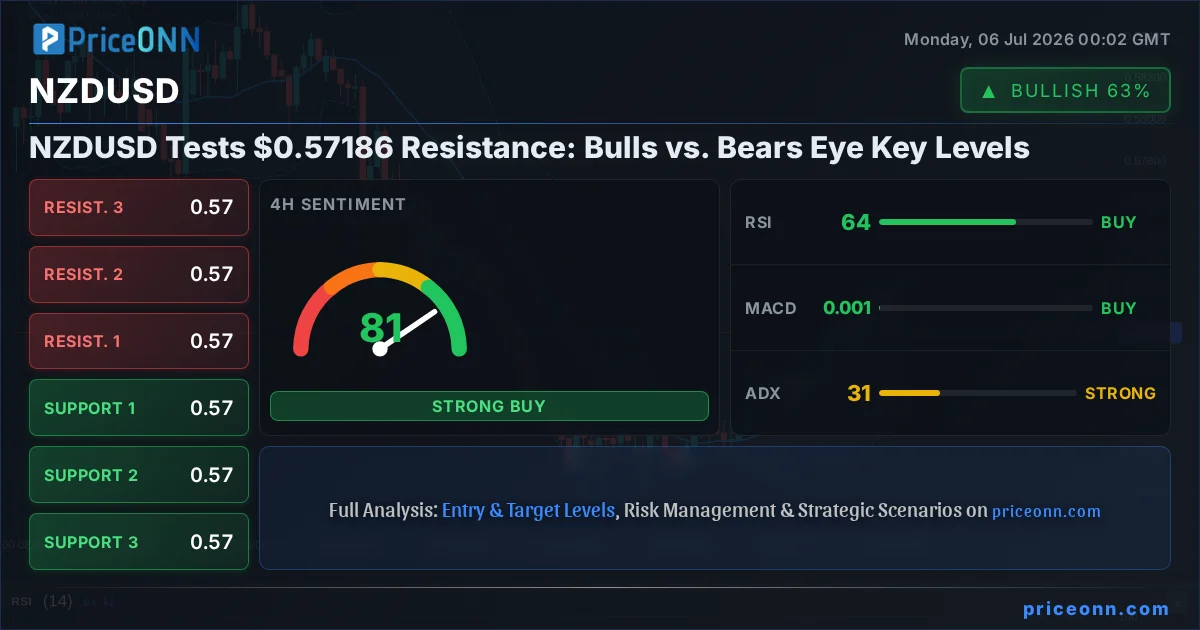
Traders should monitor key technical levels closely, especially the resistance at 0.5768 and support at 0.5625. A failure to break above the former could reignite downside pressure, while a breach of the latter would confirm a continuation of the downtrend. The risk lies in misinterpreting the RBNZ's message; a seemingly hawkish hike could be overshadowed by cautious language, leading to unexpected price action.
Track markets in real-time
Empower your investment decisions with AI-powered analysis, technical indicators and real-time price data.
Join Our Telegram Channel
Get breaking market news, AI analysis and trading signals delivered instantly to your Telegram.
Join Channel PriceONN News
NZD/USD depreciates after two days of gains, trading around 0.5690 during the Asian hours on Monday. The pair loses ground as the New Zealand Dollar (NZD) weakens following the ANZ World Commodity Price Index, which fell 1.0% in June as easing Middle East tensions and lower oil prices weighed.
PriceONN News
AUD/NZD declines after three days of gains, trading around 1.2170 during the Asian hours on Wednesday. The currency cross falls nearly 0.25% as the New Zealand Dollar (NZD) gains ground following the release of the interest rate decision by the Reserve Bank of New Zealand (RBNZ).
PriceONN News
NZD/USD inches lower for the second successive day, trading around 0.5700 during the Asian hours on Tuesday. The currency pair depreciates as the US Dollar (USD) holds ground, which could be attributed to the renewed geopolitical tensions in the Strait of Hormuz.
PriceONN News
European Central Bank (ECB) Governing Council member Emmanuel Moulin said at the Rencontres Economiques conference in Aix-en-Provence on Saturday that the central bank is in a “good position” after raising interest rates in its June policy meeting, with inflation easing alongside the slump in oil pr
PriceONN News
The Euro (EUR) trades 0.1% higher to near 185.20 against the Japanese Yen (JPY) during the European trading session on Wednesday.
PriceONN News
Gold (XAU/USD) maintains its bid tone heading into the European session on Wednesday and, for now, seems to have snapped a two-day losing streak to sub-$4,100 levels, or the weekly trough touched the previous day.
PriceONN News
The US Dollar (USD) appreciates against the Japanese Yen (JPY) for the fourth consecutive day on Wednesday, fuelled by the resumption of hostilities in the Middle East and dovish comments from Bank of Japan (BoJ) officials.
PriceONN News
The Australian Dollar (AUD) trades 0.23% higher to near 0.6943 against the US Dollar (USD) during the Asian trading session on Wednesday.
PriceONN News
The US Dollar Index (DXY), which measures the value of the US Dollar (USD) against six major currencies, is holding gains for the second consecutive day and trading around 101.10 during the Asian session on Wednesday.
PriceONN News
There is a certain honesty to a currency with nothing to say for itself, and the Swiss Franc spent Tuesday doing exactly that. With not one Swiss data release on the calendar this week, the Franc has no story of its own, leaving USD/CHF to drift on whatever the Dollar side of the tape serves up.
PriceONN News
EUR/USD trades in a narrow range on Tuesday as traders await greater clarity on the Federal Reserve's (Fed) and European Central Bank's (ECB) interest rate paths. At the time of writing, EUR/USD is trading around 1.1436, little changed on the day.
PriceONN News
USD/JPY is holding near 161.84 on Tuesday, with the yen close to 40-year lows. Pressure on the Japanese currency remains as market participants continue to bet against it, with no visible currency interventions from Japanese authorities having materialised. At the same time, investors are closely monitoring potential action from Tokyo. Japanese Finance Minister Satsuki Katayama […] The post Yen Still Under Pressure: Markets Await Action from Authorities appeared first on ActionForex.