
Yen Still Under Pressure: Markets Await Action from Authorities
 PriceONN Editorial Desk
Multi-source verification
PriceONN Editorial Desk
Multi-source verification

The Yen's Unrelenting Descent
Tuesday's trading saw the USD/JPY pair holding its ground near 161.84, a stark indicator of the yen's precarious position. The currency is teetering on the edge of levels not seen in four decades, a testament to sustained market conviction against it. Skepticism is rife, as traders perceive a lack of decisive intervention from Japanese authorities capable of materially altering the yen's trajectory.
Investors worldwide are now keenly observing Tokyo for any sign of concrete action. Japanese Finance Minister Satsuki Katayama has publicly affirmed the government's readiness to step into the foreign exchange arena should conditions necessitate it. Furthermore, she highlighted ongoing, close dialogues between Tokyo and Washington concerning currency policy dynamics. Yet, these assurances have done little to sway market sentiment.
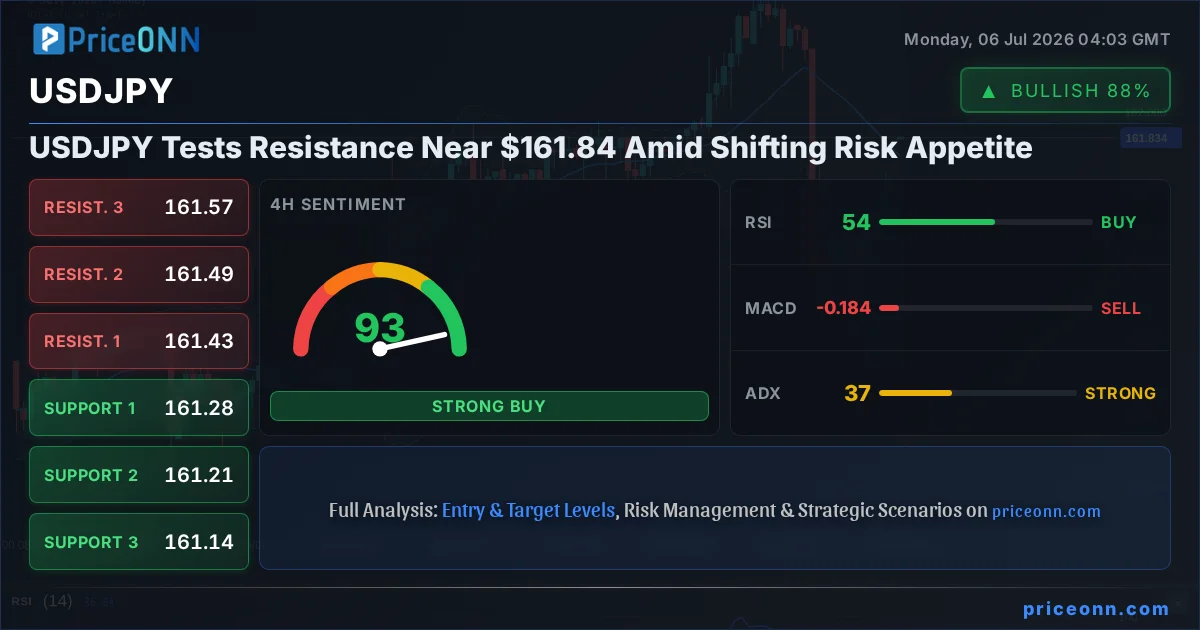
The prevailing view among market participants is that currency interventions alone, without a fundamental shift in the Bank of Japan's ultra-accommodative monetary policy, will prove insufficient for any lasting yen support. This lack of a dual approach fuels the ongoing bearish bets.
Adding to the yen's headwinds are burgeoning expectations of increased government spending, a move that could further dilute the currency's value. Simultaneously, the Bank of Japan's deliberately slow path toward policy normalization continues to widen the interest rate differential with major economies, a key driver for currency depreciation.
Domestic Data Paints a Mixed Picture
Recent economic indicators from Japan offer a complex narrative. On the one hand, nominal wages saw a respectable rise of 3.2% year-on-year in May. This suggests some upward pressure on household incomes. However, this positive note is significantly tempered by a 0.4% decline in household spending during the same period. This contraction points to persistent weakness in domestic demand, raising concerns about the underlying health of the Japanese economy and its ability to absorb currency depreciation.
The interplay of these factors creates a challenging environment for the yen. While wage growth might theoretically support consumer spending, the actual fall indicates consumers are either saving more, perhaps in anticipation of future economic uncertainty or due to a lack of confidence, or that other costs are rising faster than wages.
Market Ripple Effects
The sustained weakness in the yen has significant implications beyond the immediate USD/JPY cross. A weaker yen typically makes Japanese exports cheaper for foreign buyers, potentially boosting the competitiveness of major Japanese corporations like Toyota or Sony in international markets. This could translate into stronger earnings for these firms, positively impacting their stock prices.
Conversely, a depreciating yen increases the cost of imports for Japan, including essential commodities like oil and raw materials. This can contribute to inflationary pressures within Japan. For global commodity markets, particularly oil producers, a sustained weak yen might indirectly support demand if it fuels Japanese industrial activity, though the immediate impact is often overshadowed by broader global supply and demand dynamics.
Furthermore, the diverging monetary policy stances between the Bank of Japan and other major central banks, like the U.S. Federal Reserve, continue to influence global capital flows. As interest rate differentials remain wide, capital may continue to seek higher yields abroad, putting further downward pressure on the yen and potentially impacting other Asian currencies or emerging market assets that compete for investment capital.
Reading Between the Lines
While Japanese officials signal vigilance and a willingness to intervene, the market's persistent skepticism is rooted in historical precedent and economic fundamentals. Past intervention attempts, when not backed by a shift in monetary policy or significant rate differentials, have often proven to be temporary bandages on a deeper wound. The market is betting that without the Bank of Japan altering its near-zero interest rate policy and balance sheet expansion plans, any intervention will be a short-term game of cat and mouse.
The mixed domestic data, particularly the fall in household spending despite nominal wage increases, suggests that internal economic strength is not yet robust enough to counterbalance external pressures and the effects of a weak currency. This creates a difficult environment for policymakers, who must balance the potential benefits of a weaker yen for exporters against the risks of imported inflation and diminished domestic purchasing power.
What astute traders are watching closely is not just the verbal assurances from the Ministry of Finance, but the actual scale and duration of any intervention, should it occur. They are also scrutinizing the Bank of Japan's upcoming communications for any subtle hints of a policy shift, however distant. The divergence in policy outlooks between Japan and other major economies remains the central theme, and until that narrative changes, the yen's path of least resistance appears to be lower.
Track markets in real-time
Empower your investment decisions with AI-powered analysis, technical indicators and real-time price data.
Join Our Telegram Channel
Get breaking market news, AI analysis and trading signals delivered instantly to your Telegram.
Join Channel PriceONN News
The Japanese Yen (JPY) has resumed its broader downtrend against the US Dollar (USD) on Monday following a mild relief last week.
PriceONN News
There is a certain honesty to a currency with nothing to say for itself, and the Swiss Franc spent Tuesday doing exactly that. With not one Swiss data release on the calendar this week, the Franc has no story of its own, leaving USD/CHF to drift on whatever the Dollar side of the tape serves up.
PriceONN News
The EUR/USD pair trades marginally lower at around 1.1433 during the European trading session on Tuesday.
PriceONN News
GBP/USD continues its winning streak for the ninth consecutive day, trading around 1.3390 during the Asian hours on Tuesday.
PriceONN News
The Kiwi Dollar clears the 0.5700 figure on Friday, clings to gains of over 0.22% against the Greenback after hitting a daily low of 0.5689. At the time of writing, the NZD/USD trades at 0.5709.
PriceONN News
The Australian Dollar (AUD) trades 0.23% higher to near 0.6943 against the US Dollar (USD) during the Asian trading session on Wednesday.
PriceONN News
The US Dollar Index (DXY), which measures the value of the US Dollar (USD) against six major currencies, is holding gains for the second consecutive day and trading around 101.10 during the Asian session on Wednesday.
PriceONN News
AUD/NZD declines after three days of gains, trading around 1.2170 during the Asian hours on Wednesday. The currency cross falls nearly 0.25% as the New Zealand Dollar (NZD) gains ground following the release of the interest rate decision by the Reserve Bank of New Zealand (RBNZ).
PriceONN News
EUR/USD trades in a narrow range on Tuesday as traders await greater clarity on the Federal Reserve's (Fed) and European Central Bank's (ECB) interest rate paths. At the time of writing, EUR/USD is trading around 1.1436, little changed on the day.
PriceONN News
The Indian Rupee (INR) holds onto Monday’s losses against the US Dollar (USD) in the opening session on Tuesday.
PriceONN News
NZD/USD inches lower for the second successive day, trading around 0.5700 during the Asian hours on Tuesday. The currency pair depreciates as the US Dollar (USD) holds ground, which could be attributed to the renewed geopolitical tensions in the Strait of Hormuz.
PriceONN News
Sterling’s rally has been about more than better sentiment toward the UK. It has been driven by the disappearance of one of the market’s biggest bearish trades. As political uncertainty faded following the resolution of Labour’s leadership transition, investors who had built sizeable short Sterling positions found themselves on the wrong side of the market. […] The post GBP/CHF Nears Trend-Reversal Zone as Political Risk Fades and Sterling Shorts Unwind appeared first on ActionForex.