
AUD/USD treads water near 0.7000 ahead of make-or-break CPI
 PriceONN Editorial Desk
Multi-source verification
PriceONN Editorial Desk
Multi-source verification

Market Equilibrium Tested Ahead of Crucial Inflation Data
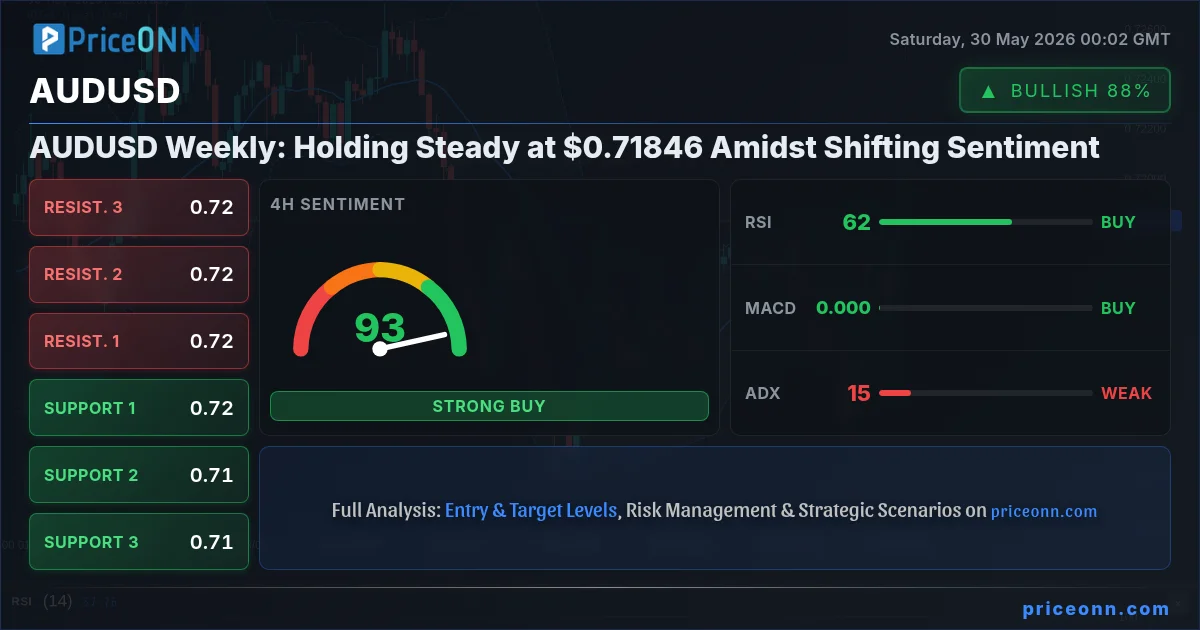
The AUD/USD currency pair is exhibiting remarkable stillness, trading essentially unchanged for the week and clinging precariously to the 0.7000 psychological level. This calm follows a period of intense volatility that saw the pair experience significant swings, breaching 0.7120 before plummeting to 0.6910, only to rebound. Traders are now holding their breath, awaiting the release of Australia's Consumer Price Index (CPI) data, a critical economic indicator that could decisively shape the pair's direction.
Several fundamental pillars underpin the Australian Dollar's valuation. Foremost among these is the monetary policy stance of the Reserve Bank of Australia (RBA). The central bank's decisions on interest rates directly influence the cost of borrowing within the nation's banking system, cascading through the wider economy. The RBA's primary mandate centers on maintaining price stability, targeting an inflation rate between 2% and 3%. Consequently, interest rate differentials compared to other major economies play a pivotal role; higher rates tend to bolster the AUD, while lower rates exert downward pressure. Beyond interest rates, the RBA also wields tools like quantitative easing and tightening, which can impact credit conditions, with easing generally being AUD-negative and tightening AUD-positive.
Key Drivers Shaping the Aussie Dollar
Australia's status as a resource-rich nation places significant emphasis on commodity prices, particularly iron ore, its principal export. The ebb and flow of global demand for raw materials, heavily influenced by the economic vitality of China – Australia's largest trading partner – exerts a profound impact. When China's economy flourishes, its appetite for Australian goods and services increases, driving demand for the AUD and subsequently its value. Conversely, a slowdown in Chinese growth often translates to diminished demand for Australian exports, weakening the currency. Surprises in Chinese economic data, whether positive or negative, therefore, frequently ripple through the AUD's exchange rates.
The significance of iron ore cannot be overstated. In 2021 alone, this commodity accounted for approximately $118 billion in export revenue, with China being the primary destination. Fluctuations in iron ore prices often mirror movements in the Australian Dollar. A surge in iron ore prices typically correlates with an appreciation of the AUD, as increased demand for this key export boosts overall demand for the currency. The reverse holds true when iron ore prices decline. Furthermore, elevated iron ore prices often contribute to a more favorable Trade Balance for Australia, an outcome that is inherently supportive of the AUD.
The Trade Balance itself, representing the disparity between a nation's export earnings and its import expenditures, serves as another critical determinant of the Australian Dollar's strength. When Australia successfully exports goods and services that are in high global demand, its currency tends to appreciate. This occurs as foreign buyers require more of the domestic currency to acquire these sought-after exports, creating a surplus demand. Consequently, a positive net Trade Balance acts as a tailwind for the AUD, while a negative balance presents headwinds.
Reading Between the Lines
The current consolidation near 0.7000 suggests market participants are adopting a cautious stance ahead of the upcoming Australian CPI release. This inflation data is pivotal; a significantly higher-than-expected print could prompt renewed hawkish expectations for the RBA, potentially lifting the AUD/USD. Conversely, softer inflation figures might reinforce dovish sentiment, signaling potential rate cuts sooner rather than later, and exerting downward pressure on the pair.
The broader market sentiment, often categorized as 'risk-on' or 'risk-off', also plays a crucial role. During periods of global optimism, investors tend to favor riskier assets, which often benefits commodity-linked currencies like the Australian Dollar. In contrast, during times of uncertainty or fear, a 'risk-off' environment typically sees a flight to perceived safe-haven assets, leading to outflows from currencies like the AUD.
Considering these factors, the upcoming CPI data represents a make-or-break event for the AUD/USD in the short term. The market's reaction will depend not only on the headline number but also on its underlying components and what it signals about future RBA policy. The interplay between domestic inflation, global commodity prices, and China's economic trajectory will continue to dictate the Australian Dollar's fortunes.
Track markets in real-time
Empower your investment decisions with AI-powered analysis, technical indicators and real-time price data.
Join Our Telegram Channel
Get breaking market news, AI analysis and trading signals delivered instantly to your Telegram.
Join Channel PriceONN News
AUD/USD’s late break of 0.7183 resistance suggests that pullback from 0.7277 has already completed at 0.7076, after defending 55 D EMA. Initial bias is back on the upside this week for retesting 0.7277 high first. Firm break there will resume larger up trend. For now, risk will stay on the upside as long as 0.7076 […] The post AUD/USD Weekly Report appeared first on ActionForex.
PriceONN News
The USD/JPY pair is flirting with the 160 level as stalled US-Iran negotiations and hawkish Federal Reserve rhetoric fuel inflation concerns. Traders are closely watching upcoming US Non-Farm Payrolls and Eurozone CPI data.
PriceONN News
EUR/USD stalled below 1.1660 as the US Dollar defied expectations, refusing to weaken despite reports of a US-Iran ceasefire extension. Market participants remain cautious, awaiting concrete confirmation and assessing lingering inflationary pressures.
PriceONN News
EUR/USD closed at 1.1640, showing resilience amid mixed signals. Easing US-Iran tensions initially pressured the dollar, but persistent inflation concerns and political ratification hurdles are keeping the greenback surprisingly steady.
PriceONN News
The EUR/USD faces headwinds as core US PCE inflation unexpectedly rose to 3.3% year-over-year, reinforcing a 'higher for longer' interest rate narrative. Meanwhile, a US-Iran ceasefire extension boosted global risk appetite, potentially drawing capital away from safe-haven currencies.
PriceONN News
EUR/USD stabilized around 1.1640 as reports of a US-Iran ceasefire extension and potential Strait of Hormuz reopening eased inflation fears. However, the US Dollar's resilience suggests lingering caution among forex traders.
PriceONN News
USDJPY has returned to the area of previous interventions. The ECB is moving towards a rate hike in June. The US dollar retreated on Friday amid new record highs for stock indices and rumours of amendments to the US-Iran agreement. However, tit-for-tat exchanges between the adversaries pushed the dollar index back into the support zone […] The post Yen Braces for a New Storm appeared first on ActionForex.
PriceONN News
Markets are pricing in a potential de-escalation in the US-Iran conflict, leading to a significant drop in crude oil prices and a weakening US Dollar as diplomatic efforts appear to be gaining traction.
PriceONN News
USD/CAD faces pressure as Canada's economy shows signs of stalling, with Q1 GDP contracting 0.1% and domestic demand weakening. This comes as trade negotiations and geopolitical shifts add layers of uncertainty.
PriceONN News
USD/CAD is showing signs of potential upward movement as Canada's economy grapples with a significant slowdown, marked by weak domestic demand and stalled investment, while trade negotiations loom large.
PriceONN News
USD/JPY is testing the critical 160 level as stalled US-Iran negotiations and hawkish Federal Reserve rhetoric fuel inflation concerns and a potential for further rate hikes. Traders are closely watching upcoming US Non-Farm Payrolls and Eurozone CPI data for direction.
PriceONN News
Canada's economy showed signs of weakness in early 2026, but upcoming May jobs data is expected to reveal a moderate uplift. Analysts anticipate job growth of around 25,000 positions and a potential dip in the unemployment rate to 6.8%.