
AUD/USD Tumbles Below 0.6900 as Geopolitical Fears Drive Demand for the US Dollar

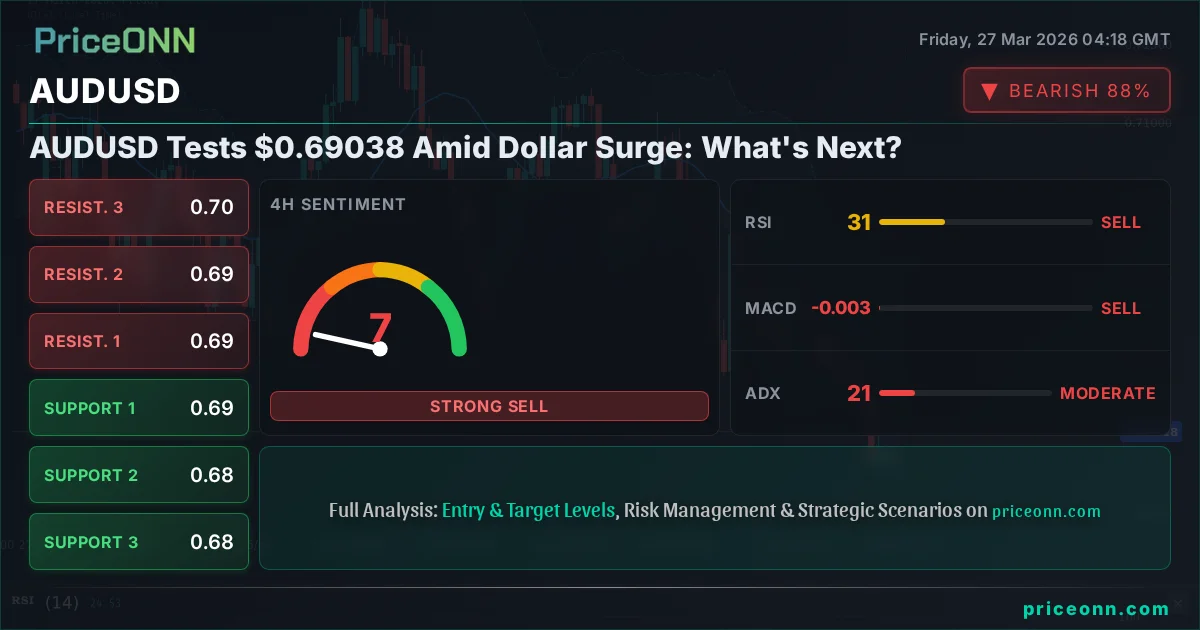
AUD/USD has experienced a sharp sell-off, breaking below the significant 0.6900 level and marking its third consecutive day of declines. The pair is currently down 0.76%, reflecting a dramatic shift in global market sentiment driven by heightened fears of Middle East conflict escalation. Doubts over a potential ceasefire agreement between the United States and Iran have fueled a robust demand for safe-haven assets, with the US Dollar emerging as the primary beneficiary.
Market Context
The move lower in AUD/USD underscores a global retreat from riskier assets as geopolitical uncertainties intensify. This risk-averse environment is causing investors to divest from currencies perceived as more vulnerable, such as the Australian Dollar. The narrative has rapidly shifted from hopes of diplomatic progress to renewed anxieties about wider regional instability. Such geopolitical tremors have historically triggered immediate capital flows into perceived safe havens, and the USD's status as a premier global reserve currency positions it to capture these inflows during periods of heightened global uncertainty. This dynamic is creating significant headwinds for commodity-linked currencies.
Analysis & Drivers
The primary driver behind the AUD/USD's recent slide is the escalating geopolitical tension in the Middle East. Uncertainty surrounding a potential ceasefire agreement between the US and Iran has stoked fears of a broader conflict, prompting a flight to safety. This 'risk-off' sentiment typically benefits the US Dollar, which is widely regarded as the world's foremost safe-haven currency. Market data shows that during such periods, investors prioritize capital preservation, leading to a retreat from speculative assets and a surge in demand for perceived stable assets like U.S. Treasury bonds and the dollar itself.
Historically, the Australian Dollar thrives in 'risk-on' environments, characterized by global economic optimism and robust demand for commodities. Its value is closely tied to the export of raw materials, and a strong global economy typically drives up commodity prices, bolstering the AUD. However, the current climate of geopolitical instability overrides these positive fundamentals. The Reserve Bank of Australia's (RBA) monetary policy also plays a crucial role; while not the immediate catalyst, any indication of dovish policy or lower interest rates relative to other major economies can further pressure the currency.
Trader Implications
Traders are now closely watching the AUD/USD for signs of stabilization or further decline. The break below 0.6900 represents a significant technical level, and failure to reclaim it could open the door for further downside. Key levels to monitor include the recent two-month low around 0.6880. A sustained move below this point could signal a deeper correction. Investors should be wary of sharp intraday reversals as market sentiment can be volatile amidst geopolitical news. The US Dollar Index (DXY) remains a key barometer for USD strength; a continued upward trend in DXY would likely keep pressure on AUD/USD.
For traders, the current environment suggests caution. While the AUD is oversold in the short term, the prevailing risk-averse sentiment could continue to weigh on the pair. Key risk factors include any further escalation of Middle East tensions or a surprisingly hawkish tone from the RBA. Conversely, any de-escalation of geopolitical risks or positive economic data from China could provide a temporary reprieve for the Australian Dollar. Trading strategies might involve looking for short-term opportunities on bounces, but the overall trend appears bearish as long as geopolitical fears persist.
Outlook
The outlook for AUD/USD remains subdued as long as geopolitical uncertainties in the Middle East persist. The safe-haven appeal of the US Dollar is likely to continue dominating market sentiment, potentially pushing AUD/USD towards lower levels. Traders will be looking for any signs of de-escalation in the Middle East or shifts in central bank policy to signal a potential change in direction. Until then, the path of least resistance appears to be lower for the Australian Dollar against the strengthening US Dollar.
Frequently Asked Questions
What is the current trading level for AUD/USD?
As of the latest market data, AUD/USD has fallen below the 0.6900 level, extending its losses for the third consecutive day and trading around 0.6880 during Asian hours.
What are the main drivers causing AUD/USD to fall?
The primary driver is escalating geopolitical tensions in the Middle East, leading to increased demand for the US Dollar as a safe-haven asset. Doubts over a US-Iran ceasefire agreement have amplified this 'risk-off' sentiment, pressuring the Australian Dollar.
What is the near-term outlook for AUD/USD?
The outlook for AUD/USD remains bearish in the short term, primarily due to ongoing geopolitical risks and the resulting strength of the US Dollar. Traders should monitor for any de-escalation in the Middle East or significant shifts in economic data that could alter market sentiment.
Track markets in real-time
Empower your investment decisions with AI-powered analysis, technical indicators and real-time price data.
Join Our Telegram Channel
Get breaking market news, AI analysis and trading signals delivered instantly to your Telegram.
Join Channel

PriceONN