AUDUSD Tests $0.69038 Amid Dollar Surge: What's Next?
AUDUSD at $0.69038 faces resistance as DXY climbs. Analysis reveals mixed signals, with key levels at $0.68557 support and $0.69368 resistance.
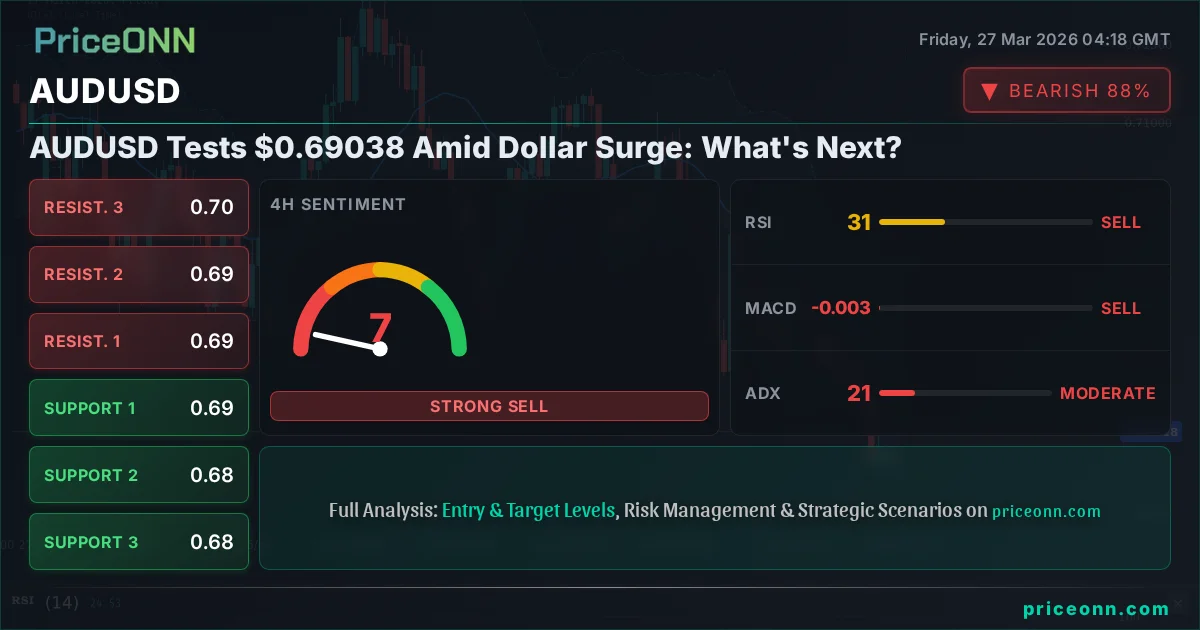
Now this is where it gets interesting! The Australian Dollar versus the US Dollar (AUDUSD) is currently dancing around the $0.69038 mark, and the narrative is becoming increasingly complex. For weeks, we’ve been watching the Aussie dollar grapple with its US counterpart, and today's action is a direct reflection of broader market forces, particularly the resurgent strength of the US Dollar Index (DXY). While the AUDUSD has seen some modest daily gains, approaching $0.69038, the underlying pressure from a strengthening dollar, currently testing key resistance levels itself, paints a nuanced picture for traders. The question on everyone's mind is whether this current price action is a mere pause before a continued trend or a precursor to a more significant shift. Understanding the interplay between the DXY's ascent, commodity price movements, and the economic outlook for both Australia and the US is paramount for navigating this pair.
- RSI at 47.99 signals neutral pressure, with a slight downward lean, indicating no immediate bullish exhaustion but caution is warranted.
- Critical support sits at $0.68557, a level that has historically provided a floor, while resistance looms at $0.69368, a key barrier for any upward momentum.
- MACD shows positive momentum on the 1H chart, but the overall trend on daily and 4H charts remains bearish, suggesting short-term gains could be fleeting.
- The DXY's push towards 99.76 is a significant driver, correlating inversely with AUDUSD and demanding close attention from currency traders.
Navigating the Dollar's Resurgence
The US Dollar Index (DXY) has been making headlines, climbing for three consecutive days and nearing the significant 99.90 mark. This surge is not happening in a vacuum; it’s a clear signal of increasing safe-haven demand amidst a backdrop of geopolitical jitters and economic uncertainties. As the DXY strengthens, it typically exerts downward pressure on riskier assets and currencies, including the Australian Dollar. For AUDUSD, this means that even small upward price movements can be hard-won battles. The current price action around $0.69038 needs to be viewed through this lens. We’re seeing a tug-of-war: the Aussie trying to hold its ground against a dollar that seems to have found renewed conviction. This dynamic is crucial for understanding short-term trading opportunities and longer-term directional biases.
Historically, the Australian Dollar often acts as a barometer for global risk appetite, given its strong ties to commodity prices and China's economic health. When risk sentiment is high, the AUD tends to perform well. Conversely, during periods of uncertainty or risk aversion, investors flock to perceived safe havens like the US Dollar, pushing pairs like AUDUSD lower. The recent geopolitical tensions, as highlighted by news concerning Middle East instability and potential oil price spikes to $200, are undoubtedly fueling this flight to safety. This makes the DXY's performance a critical indicator to watch for any AUDUSD trader. The fact that the DXY is showing strong upward momentum on the daily chart, with ADX at 31.64, underscores the current market preference for the greenback.
The Aussie's Tightrope Walk: Technical Indicators in Focus
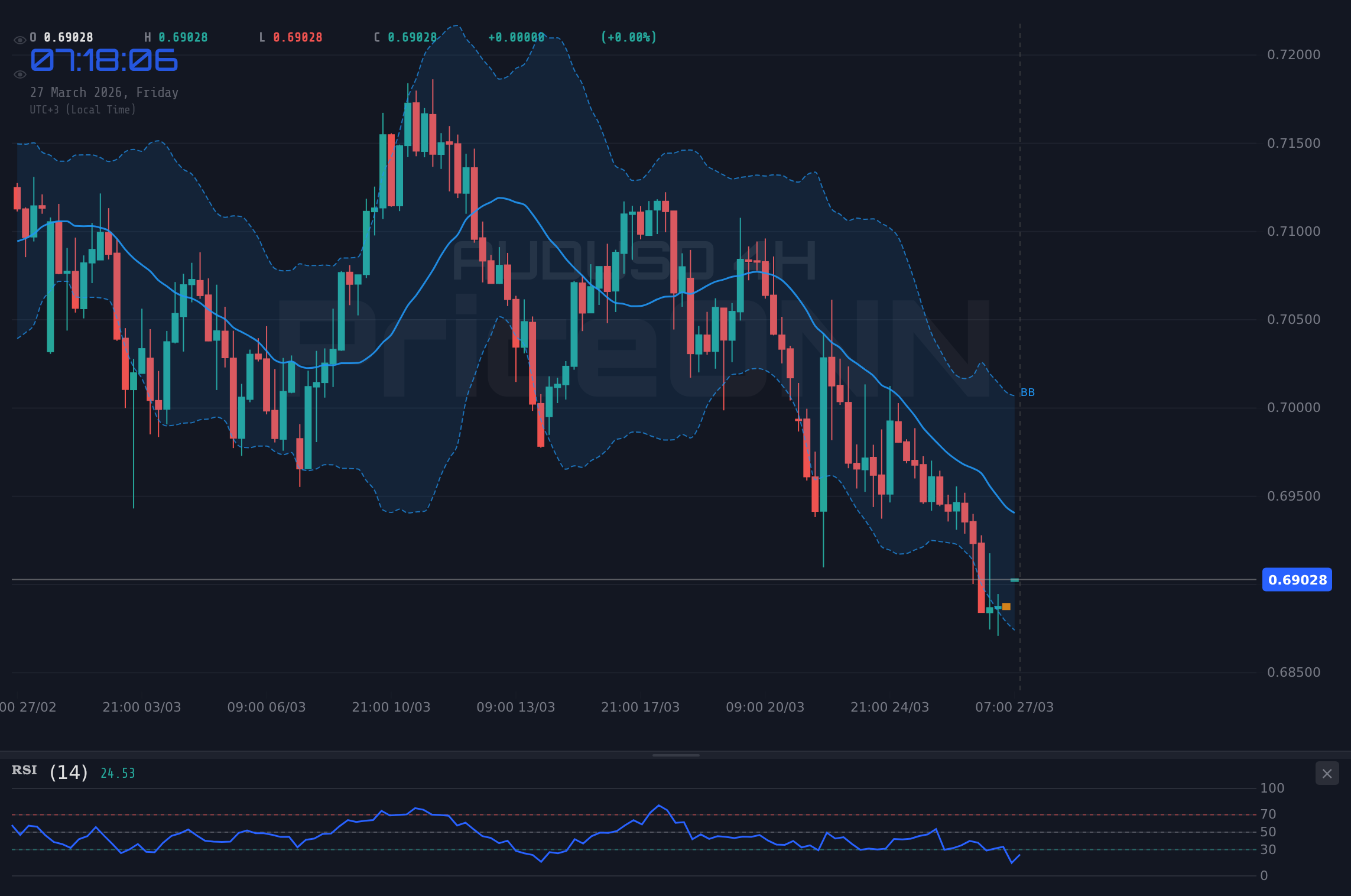
Looking at the technical indicators for AUDUSD, the picture is decidedly mixed, reflecting the current indecision in the market. On the 1-hour chart, the RSI is sitting at 47.99, which is firmly in neutral territory but shows a slight downward eğilim. This suggests that while there isn't immediate selling pressure, the bulls aren't exactly charging ahead either. The MACD on this timeframe is positive, with the MACD line above the signal line, offering a glimmer of short-term optimism. However, this is immediately contrasted by the ADX, which at 29.32 on the 1H chart indicates a strong trend, but the overall trend signals on the 4-hour (ADX 21.05) and daily (ADX 24.69) charts lean towards a bearish trend, albeit with moderate strength.
The 4-hour chart presents a more bearish outlook. The RSI at 31.15 is approaching oversold conditions, which could signal a potential bounce, but the overall trend is still downwards. The MACD is negative, and the Bollinger Bands are showing a downtrend. Stochastic K and D lines are in oversold territory, suggesting a potential reversal, but this must be viewed with caution given the prevailing bearish momentum. On the daily timeframe, the situation is similarly cautious. The RSI is at 40.21, indicating a bearish bias but far from extreme oversold levels. The MACD remains negative, and the Bollinger Bands are below the middle band, reinforcing the bearish sentiment. The ADX at 24.69 confirms a moderately strong downtrend. This confluence of indicators suggests that any rallies might be short-lived unless significant fundamental shifts occur.
Fundamental Crosscurrents: What's Driving the Pair?
The fundamental drivers behind AUDUSD's current stance are multifaceted, involving economic data releases from both Australia and the United States, as well as broader global macroeconomic trends. Recent economic data from the US has been a significant factor. For instance, the latest PMI figures showed a reading of 52.4 for the services sector, surpassing the forecast of 51.5. This indicates a more robust expansion in the US services industry than anticipated, providing a fundamental tailwind for the US Dollar. Similarly, the manufacturing PMI, while slightly below forecast at 51.1 compared to 52, still suggests economic activity is expanding, albeit at a slower pace.
On the other side of the pair, Australian economic data has been less consistently strong. While the latest GBP data showed a steady 3% unemployment rate, which is a positive sign for the UK economy, it doesn't directly translate to strength for the AUD. We need to look at Australian-specific data. If upcoming Australian employment figures or inflation data show weakness, it could further pressure AUDUSD. For now, the market is heavily focused on US economic resilience and the Federal Reserve's likely policy path. The market is pricing in certain interest rate expectations, and any deviation from these expectations, driven by incoming data, can cause significant volatility. The current pricing suggests a cautious approach from the Fed, but stronger US data could embolden them to maintain a hawkish stance for longer, which would invariably support the dollar and weigh on AUDUSD.
Geopolitical Ripples and Commodity Links
The influence of geopolitical events cannot be overstated in the current market environment. Escalating tensions in the Middle East, as reported by various news outlets, are a major catalyst. The potential for oil price spikes, even if speculative, creates a ripple effect across global markets. Brent crude is currently trading around $104.72, showing upward momentum. This rise in oil prices, a key commodity, can have a dual impact. On one hand, it might suggest inflationary pressures, which could theoretically lead to higher interest rates and support the dollar. On the other hand, it can also signal heightened global risk, driving demand for safe-haven assets like the US Dollar and potentially hurting commodity-linked currencies like the AUD. The news about Iraq's economy plummeting due to a Strait of Hormuz blockade highlights the fragility of energy supply routes and the potential for significant market disruption.
Furthermore, the correlation between AUDUSD and commodity prices, particularly metals like gold and silver, is a well-established relationship. Gold is currently trading at $4433.1, showing a significant daily increase. Silver, at $69.2, is also on the rise. While a strong commodity complex might typically support the Australian Dollar, the overwhelming strength of the US Dollar is currently dampening this effect. Traders are weighing the positive sentiment in commodities against the safe-haven appeal of the USD. This complex interplay means that a breakout in AUDUSD might require not only positive commodity news but also a softening of the US Dollar or a shift in global risk sentiment.
The Trader's Perspective: What Levels Matter Now?
For traders looking at AUDUSD right now, the $0.69038 level is more than just a price point; it's a battleground. The immediate resistance is clearly defined around the $0.69368 mark. A decisive break and sustained hold above this level would be a significant bullish signal, potentially opening the door for further upside towards $0.69867. This scenario would likely require a combination of weakening US Dollar sentiment and continued strength in commodity prices. On the flip side, the support at $0.68557 is critical. If the pair falters and closes below this level, it would strongly suggest that the bearish trend is resuming, with further downside likely towards $0.68245 and potentially lower.
The current technical setup, with its mixed signals across different timeframes, suggests that we might be in for a period of consolidation or choppy trading. The ADX readings, while showing some trend strength on daily charts, are not exceptionally high, indicating that the market might not have a strong conviction in either direction yet. This means that breakout strategies might be more appealing than range-trading, but traders need to wait for clear confirmation. Patience is key. Watching how AUDUSD reacts to the $0.69038 level and the immediate resistance and support zones will be crucial in the coming sessions. Any significant news flow, particularly from the US economic calendar or geopolitical developments, could act as the catalyst needed to break this stalemate.
Scenario Analysis: Mapping Potential Paths
Bearish Scenario: Dollar Dominance Continues
65% ProbabilityNeutral Scenario: Consolidation Around Key Levels
25% ProbabilityBullish Scenario: Aussie Fights Back
10% ProbabilityFrequently Asked Questions: AUDUSD Analysis
What happens if AUDUSD breaks below the $0.68557 support level?
If AUDUSD closes decisively below the $0.68557 support, it signals a resumption of the bearish trend. This could lead to further declines towards the $0.68245 level, driven by continued US Dollar strength and potentially weaker Australian economic data.
Should I consider buying AUDUSD at current levels near $0.69038 given the mixed technical signals?
Buying AUDUSD at $0.69038 requires caution due to the strong DXY and bearish daily trends. A confirmed break above $0.69368 resistance, coupled with a DXY pullback, would offer a higher-probability bullish setup, potentially targeting $0.69867.
Is the RSI at 47.99 a sell signal for AUDUSD right now?
An RSI of 47.99 is not an immediate sell signal; it indicates neutral pressure with a slight downward lean. While it suggests limited upside potential in the short term, a confirmed bearish signal would require a break below key support levels like $0.68557 or a more pronounced downturn in momentum indicators.
How will upcoming US economic data, like the PMI figures, affect AUDUSD this week?
Stronger-than-expected US PMI data, such as the recent 52.4 services reading, generally supports the US Dollar and weighs on AUDUSD. If upcoming US data continues to surprise to the upside, it could reinforce the bearish outlook for AUDUSD, potentially pushing it towards lower support levels.
Track markets in real-time
AI-powered analysis, technical indicators and real-time price data.
Join Our Telegram Channel
Breaking market news, AI analysis and trading signals instantly.
Join Channel