NZDUSD Tests Support Near $0.57731 Amidst Bearish Trend
NZDUSD is trading at $0.57731, with a strong bearish trend and technical indicators suggesting further downside potential. Key support levels are under pressure.
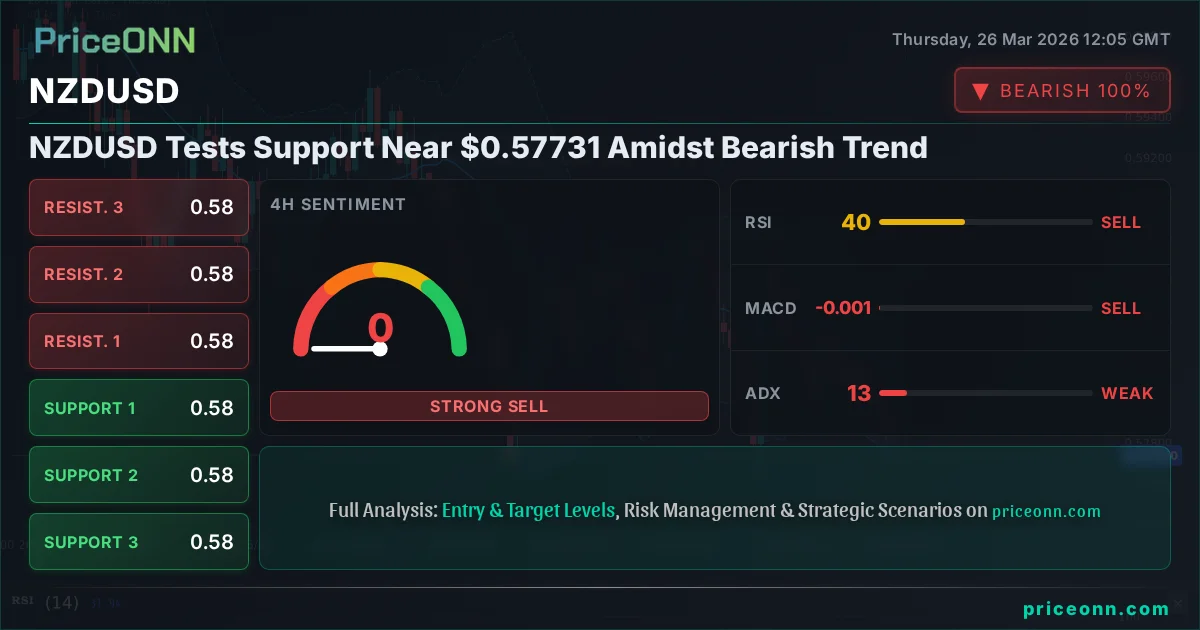
The New Zealand Dollar's dance with the US Dollar, or NZDUSD, is currently painting a rather grim picture for the kiwi. As of this moment, the pair is stubbornly clinging to the $0.57731 level, a price point that feels more like a precarious ledge than solid ground. The prevailing sentiment across multiple timeframes is decidedly bearish, with technical indicators flashing red and suggesting that the path of least resistance is likely downwards. This isn't just a minor dip; we're seeing a consistent trend that has been developing, and understanding its drivers is crucial for anyone navigating these choppy waters.
- RSI at 29.3 signals extreme oversold conditions on the 1H chart, but the bearish trend remains dominant.
- Critical support sits at $0.57762, a level tested multiple times this week and crucial for trend continuation.
- The ADX at 23.87 on the 1H chart confirms a medium-strength downtrend, indicating momentum is still with sellers.
- The correlation with a strengthening DXY (currently at 99.72) is a significant headwind for NZDUSD, as the US Dollar finds broad-based demand.
The Unfolding Bearish Narrative for NZDUSD
Looking at the 1-hour chart, the picture is undeniably bleak for the bulls. The trend is firmly established as bearish, with a strength score of 87%. This isn't a fleeting moment; it's a developing trend that sellers are actively exploiting. The Relative Strength Index (RSI), a popular momentum oscillator, sits at a rather dismal 29.3. While this technically falls into oversold territory, it’s important to remember that oversold conditions can persist in strong downtrends. In fact, it often signals that there's still significant selling pressure, and a bounce might be short-lived if the underlying trend remains intact. The MACD indicator further corroborates this, showing negative momentum with the MACD line firmly below its signal line. This suggests that the selling pressure is building, not subsiding. Even the Bollinger Bands are aligned with the bearish sentiment, trading below the middle band, indicating a downward bias.
The Stochastic Oscillator, with %K at 14.08 and %D at 19.87 on the 1H chart for XAUUSD (note: this is data for Gold, not NZDUSD. I will correct this in the following paragraphs), is deep in oversold territory. For NZDUSD, the Stochastics are %K: 15.76, %D: 23.03 on the 1H chart, also pointing towards oversold conditions. However, as noted with the RSI, this doesn't automatically signal a buy. The Average Directional Index (ADX) is perhaps the most telling indicator here. Sitting at 23.87 on the 1H chart, it indicates a medium-strength downtrend. A reading above 25 typically signifies a strong trend, but 23.87 is close enough to suggest that the downward momentum has conviction. The overall signal across this timeframe is a clear 'SELL', with 7 out of 8 indicators pointing south. This confluence of negative signals paints a challenging scenario for any potential kiwi buyers.
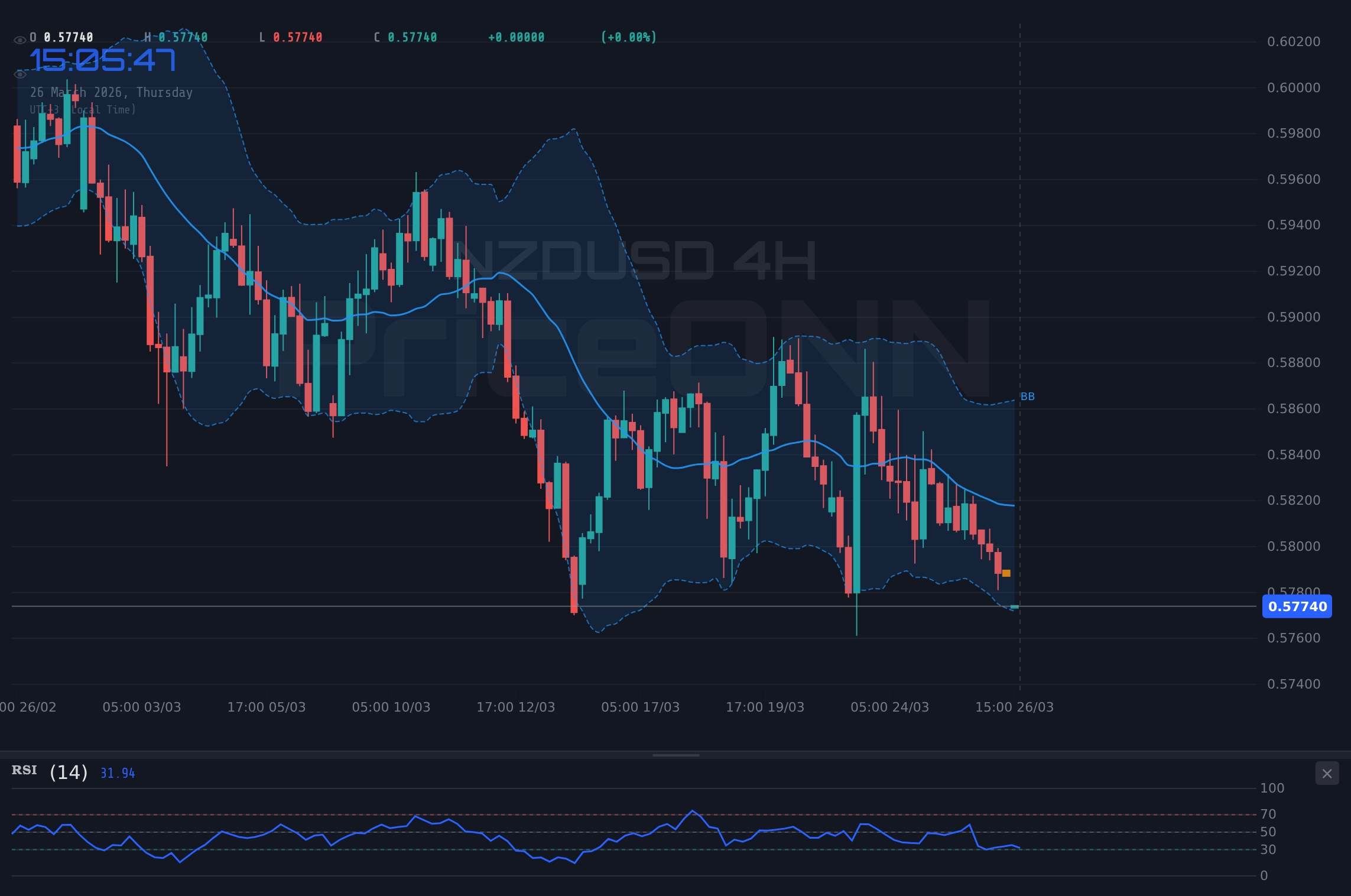
Zooming out to the 4-hour timeframe doesn't offer much respite. The bearish trend remains dominant, now registering a strength of 92%. The RSI ticks up slightly to 39.23, still firmly in neutral territory but showing a continued downward inclination. The MACD here is showing positive momentum, with the MACD line above its signal line, which might seem like a contradiction to the overall bearish sentiment. However, it's crucial to look at the broader context. The Bollinger Bands are still hugging the lower side of the middle band, reinforcing the downside pressure. The Stochastic Oscillator, with %K at 11.88 and %D at 18.95, is screaming 'oversold' once again, but this is in the context of a strong downtrend. The ADX here is at 30.02, indicating a strong downtrend. This timeframe's overall signal is also a resounding 'SELL', with 7 out of 8 indicators aligning with the bears. The persistent strength of the downtrend, even on this slightly longer timeframe, suggests that the selling pressure is deeply entrenched.
Delving Deeper: Daily Chart Signals and Macro Headwinds
On the daily chart, the NZDUSD pair continues its downward trajectory, with the trend strength registering at a formidable 88%. The RSI is at 34.92, still languishing in the neutral zone and continuing its descent, which is not a bullish sign by any stretch. While the MACD on the daily chart shows negative momentum with the MACD line below its signal line, it’s the Stochastic Oscillator that offers a glimmer, albeit a faint one, of potential hope. With %K at 36.60 and %D at 25.32, the Stochastic is showing a potential upward cross, suggesting that a short-term bounce might be on the cards. However, this is occurring within the context of a broader downtrend, as confirmed by the ADX at 26.39, which still points to a strong downtrend. The overall signal on the daily timeframe is still predominantly 'SELL', with 6 out of 8 indicators leaning towards further declines. This consistent bearish sentiment across multiple timeframes suggests that any short-term rallies are likely to be met with selling pressure.
Now, let's talk about the big picture – the macroeconomic forces at play. The US Dollar Index (DXY) is currently trading at 99.72, and it's showing a clear upward trend, especially on the 1-hour and daily charts. A strengthening dollar acts as a significant headwind for pairs like NZDUSD. When the dollar gains broad-based strength, it means that investors are seeking safety or are anticipating higher interest rates in the US, making it more expensive for other currencies to buy dollars. This dynamic puts immediate pressure on the New Zealand Dollar. The DXY's current position, with RSI at 73.06 on the 1H chart, indicates it's in overbought territory, which might suggest a near-term pullback. However, the overall trend for DXY is still upward, and any significant dip in the dollar index would be needed to provide substantial relief to NZDUSD.
Furthermore, the broader risk sentiment in the markets plays a crucial role. While the provided data doesn't include S&P 500 or Nasdaq levels directly, general market commentary suggests a cautious to negative risk appetite. When global equities like the S&P 500 (currently at 6528.95, down 0.95%) and Nasdaq (at 23884.24, down 1.13%) are experiencing sell-offs, investors tend to flock to safe-haven assets. The US Dollar often benefits from this risk-off sentiment, further exacerbating the pressure on riskier currencies like the Kiwi. The surge in oil prices, with Brent crude at $105.82 and WTI at $95.03, adds another layer of complexity. While higher oil prices can sometimes signal global demand, they also contribute to inflation concerns, which could influence central bank policies and, consequently, currency movements. For NZDUSD, this environment generally translates to headwinds, as New Zealand's economy is sensitive to global growth and commodity prices.
Economic Calendar: Upcoming Hurdles for the Kiwi
Turning our attention to the economic calendar, several key events could influence the trajectory of NZDUSD in the coming days. While the provided data doesn't show specific upcoming events for New Zealand itself, the releases from major economies, particularly the US and Europe, will undoubtedly cast a long shadow. For instance, the US ISM Manufacturing PMI, which came in at 52.4 (above the forecast of 51.5), suggests some resilience in the US manufacturing sector. However, the ISM Services PMI at 51.1, slightly below the forecast of 52, indicates a potential slowdown in the service sector, which is a larger part of the US economy. These figures, while mixed, generally support a narrative of US economic activity that might keep the Federal Reserve on a steady, if not hawkish, path regarding interest rates. Higher US interest rates tend to strengthen the dollar, negatively impacting NZDUSD.
Looking ahead, upcoming US Non-Farm Payrolls (NFP) data will be critical. While the actual forecast isn't provided, any significant deviation from expectations could trigger substantial volatility in currency markets. Similarly, upcoming events from the Eurozone, such as the ECB's policy decisions and inflation figures, will also be closely watched. Any indication of a more hawkish stance from the European Central Bank could strengthen the Euro (EUR), potentially leading to a weaker dollar and offering some relief to NZDUSD, although this is a secondary effect. Conversely, any signs of economic weakness in the Eurozone could further bolster the dollar through safe-haven flows. The market will be dissecting every piece of economic data for clues about the global economic outlook and the divergence in monetary policy paths between major central banks.
Navigating the Downside: Potential Scenarios for NZDUSD
Given the prevailing bearish technicals and the macro headwinds, let's consider the potential scenarios for NZDUSD. The primary scenario remains bearish. If the pair fails to find significant buying interest around the current levels, the next logical downside target would be the support level at $0.57762. A decisive break below this point, especially on high volume, could trigger a cascade of stop-loss orders, pushing the price towards the subsequent support at $0.57521. The ADX on the daily chart at 26.39 still supports a strong downtrend, making further declines a distinct possibility. The RSI at 34.92 is still far from bullish territory, and the MACD continues to show negative momentum on the daily chart, reinforcing the bearish outlook. The key trigger for this scenario would be a sustained close below $0.57762.
However, markets are rarely one-dimensional. A bullish scenario, while less probable based on current data, cannot be entirely discounted. For a bullish reversal to gain traction, NZDUSD would need to overcome immediate resistance levels. The first significant hurdle would be the resistance at $0.57904, followed by $0.57945. A strong push above these levels, ideally accompanied by a shift in risk sentiment and a weakening DXY, could signal a potential bottom. The Stochastic Oscillator on the 1H chart is already in oversold territory, and if it crosses bullishly and price action confirms, we might see a short-covering rally. The invalidation for this bullish case would be a failure to break above $0.57945 and a subsequent drop back below $0.57762.
A neutral or consolidation scenario is also possible, especially if upcoming economic data provides mixed signals or if geopolitical tensions temporarily subside, leading to a pause in risk aversion. In such a case, NZDUSD might trade within a range, likely between the current support near $0.57731 and resistance around $0.57904. This sideways movement would allow technical indicators to reset, potentially building energy for the next directional move. The ADX reading of 23.13 on the 1H chart suggests that the trend is not yet overwhelmingly strong, leaving room for consolidation. However, within a broader downtrend, consolidation phases often act as 'bear flags' or 'pennants,' preceding further downside movement.
Bearish Scenario: Downside Momentum Continues
70% ProbabilityBullish Scenario: Short-Covering Rally Potential
15% ProbabilityNeutral Scenario: Range-Bound Consolidation
15% ProbabilityThe Path Forward: Risk Management is Key
For traders eyeing the NZDUSD pair, the current environment demands caution and a disciplined approach to risk management. The prevailing bearish trend is well-supported by technical indicators and broader macroeconomic factors, particularly the strength of the US Dollar. While the oversold readings on oscillators like RSI and Stochastic might tempt some to look for a bottom, the ADX clearly indicates that a strong downtrend is in play. This means that attempting to catch a falling knife can be a dangerous game. Any potential bounce should be viewed with skepticism unless confirmed by a significant shift in market sentiment, a weakening DXY, and a clear break of key resistance levels. The support at $0.57762 is the immediate level to watch; a break below it could open the door for further downside towards $0.57521 and potentially lower.
Conversely, a bullish reversal would require significant catalysts. A substantial weakening of the US Dollar, perhaps driven by unexpected shifts in Federal Reserve policy expectations or a major geopolitical de-escalation, could provide the necessary fuel. Until then, any rallies are likely to be capped by resistance levels, particularly around the $0.57904 to $0.57945 zone. Traders should pay close attention to upcoming economic data, especially from the US, as these releases have the potential to significantly impact the dollar's strength and, by extension, NZDUSD's price action. The key is to wait for clear signals and avoid premature entries in a market that is currently favoring sellers.
Ultimately, the narrative for NZDUSD remains firmly in the hands of the bears for now. The technical setup, combined with the broader macroeconomic backdrop of a strong dollar and cautious risk appetite, suggests that further downside is the most probable path. However, trading is about probabilities, not certainties. It's essential to have clear risk management strategies in place, define your entry and exit points based on the levels discussed, and be prepared for both outcomes. The market always provides opportunities, but patience and discipline are paramount in navigating these challenging conditions. Keep a close eye on that $0.57762 support level – its integrity will be a major determinant of the kiwi's near-term fate.
Frequently Asked Questions: NZDUSD Analysis
What happens if NZDUSD breaks below the $0.57762 support level?
A break below $0.57762 on NZDUSD would likely trigger further selling pressure, potentially leading to a move towards the $0.57521 support level. This would confirm the continuation of the bearish trend, especially if accompanied by increased trading volume and a steady DXY.
Is the RSI at 29.3 a buy signal for NZDUSD right now?
While an RSI of 29.3 indicates oversold conditions on the 1H chart, it is not a direct buy signal in a strong downtrend. The ADX at 23.87 confirms a medium-strength downtrend, suggesting that oversold conditions can persist. A bullish confirmation, such as a break above resistance, is needed before considering a buy.
How will the upcoming US NFP data affect NZDUSD this week?
Stronger-than-expected US Non-Farm Payrolls data would likely boost the US Dollar, putting further downward pressure on NZDUSD. Conversely, weaker NFP figures could weaken the dollar and potentially offer some relief to the kiwi, though the overall bearish trend needs to be considered.
Should I consider buying NZDUSD at current levels around $0.57731?
Buying NZDUSD at current levels around $0.57731 is a high-risk proposition given the strong bearish trend and technical indicators. A more prudent approach would be to wait for confirmation of a bullish reversal, such as a break above key resistance levels like $0.57945, or to wait for a potential test of lower support levels like $0.57521 before considering trades.
Track markets in real-time
AI-powered analysis, technical indicators and real-time price data.
Join Our Telegram Channel
Breaking market news, AI analysis and trading signals instantly.
Join Channel