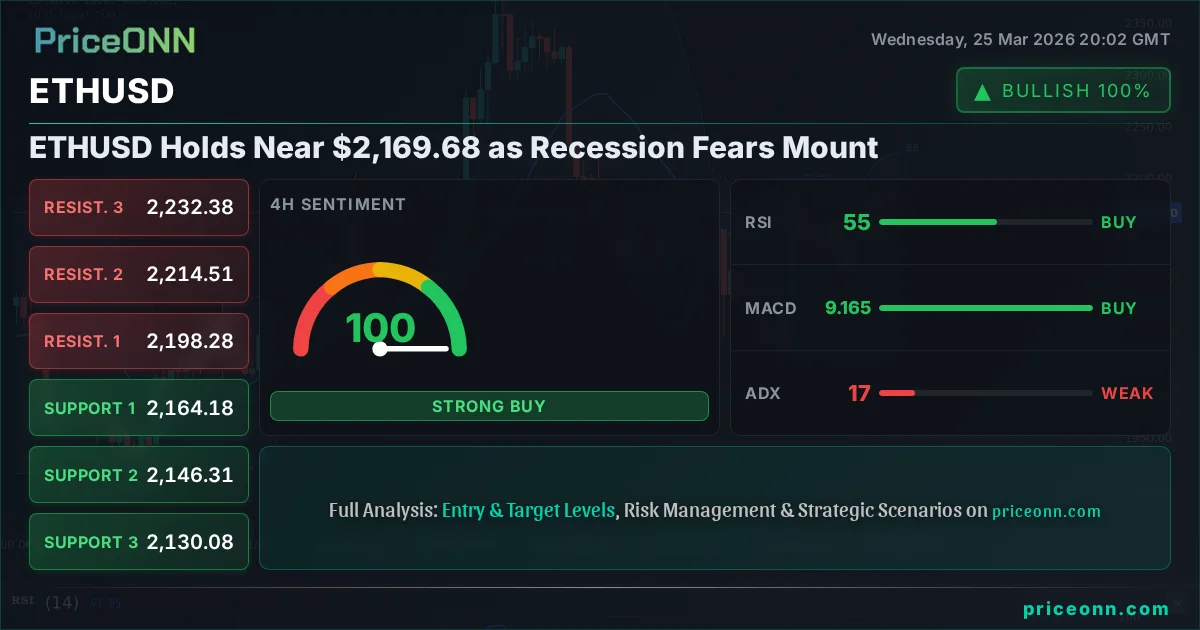
ETHUSD Holds Near $2,169.68 as Recession Fears Mount
ETHUSD hovers around $2,169.68 amid rising recession odds and geopolitical jitters. Technical indicators show mixed signals as traders await crucial economic data.
The cryptocurrency market, and Ethereum (ETHUSD) in particular, is facing a complex tug-of-war. ETHUSD is currently trading precariously close to the $2,169.68 mark, a level that is proving to be a significant psychological and technical pivot point. This price action unfolds against a backdrop of escalating global recession fears, heightened geopolitical tensions, and volatile energy prices, all of which are creating a murky outlook for risk assets. While some technical indicators on shorter timeframes hint at potential upside, the broader daily trend and macroeconomic headwinds suggest caution is the prevailing sentiment among market participants. The interplay between these factors is crucial for understanding ETHUSD's immediate trajectory and its potential path forward.
- ETHUSD is currently trading at $2,169.68, hovering near a critical resistance level.
- Recession odds have surged past 45% according to Wall Street economists, increasing demand for safe-haven assets and pressuring riskier investments like ETHUSD.
- The 1-hour RSI at 52.14 shows a neutral-to-upward bias, but the daily RSI at 34.72 indicates significant selling pressure and a downtrend.
- Key support for ETHUSD lies at $2,137.77 on the 1-hour chart and $2,034.73 on the daily chart, while resistance looms around $2,184.93 (1H) and $2,251.93 (1D).
- Geopolitical risks and rising oil prices are contributing to inflation concerns, potentially influencing central bank policy and, consequently, crypto market sentiment.
Navigating the $2,169.68 Crossroads: ETHUSD's Technical Tightrope
The Immediate ETHUSD Picture: A Battle for Control
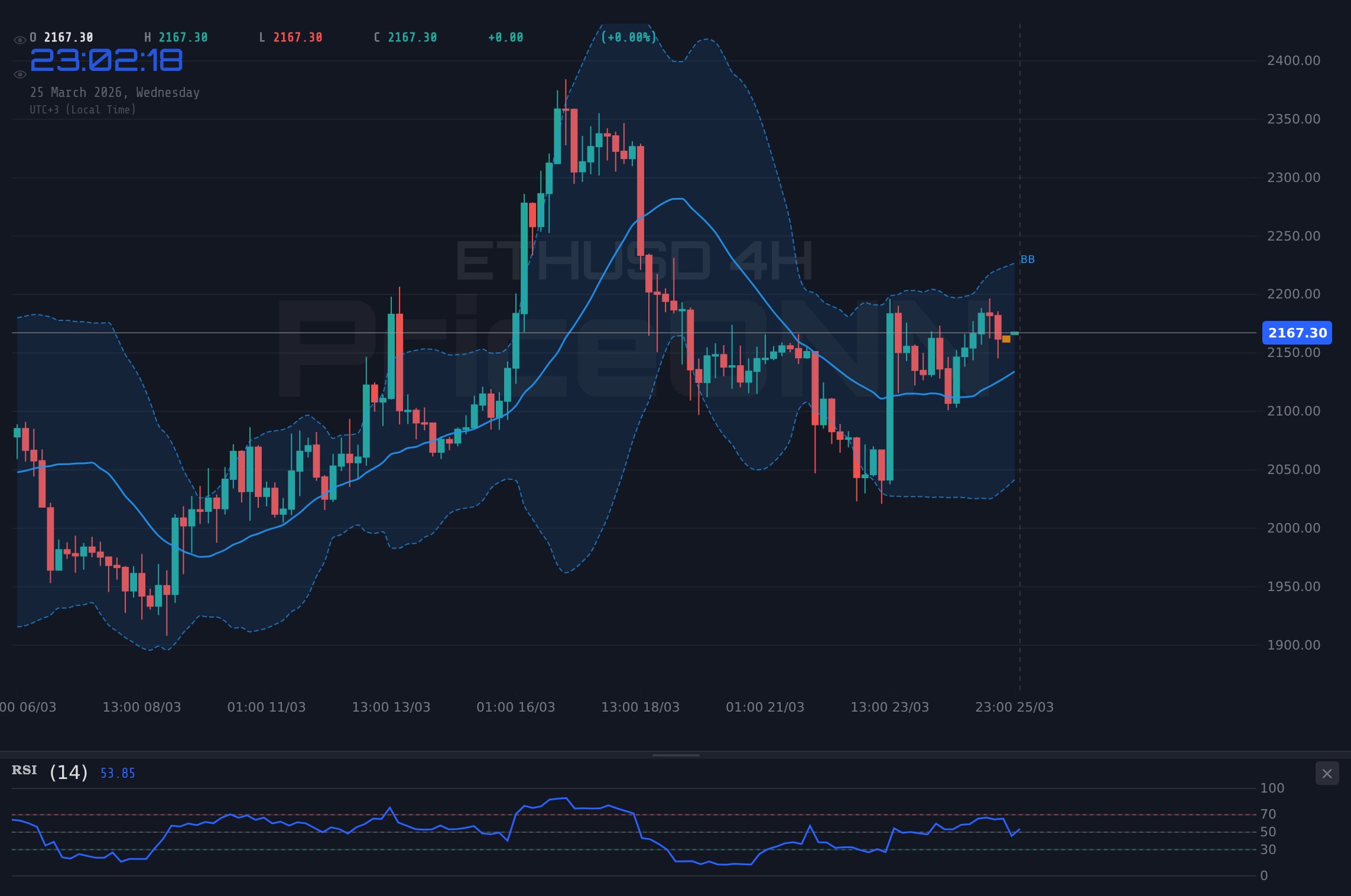
Ethereum's current position at $2,169.68 represents a critical juncture. On the 1-hour chart, the Relative Strength Index (RSI) hovers at 52.14, suggesting a neutral stance with a slight upward lean, indicating that buyers are not entirely absent. However, this optimism is tempered by the MACD, which is showing negative momentum, and the Stochastic oscillator %K line dipping below %D, both signalling potential weakness. The ADX at a low 15.55 on this timeframe underscores the lack of a strong, committed trend, suggesting chop and indecision. This environment is often characterized by sharp, short-lived moves that can trap unwary traders. The overall signal on the 1-hour timeframe leans towards 'SELL' (3 Sell, 5 Buy, 0 Neutral), reflecting this inherent conflict and the prevailing bearish undertones despite the neutral RSI reading.
The situation becomes more complex when we shift to the 4-hour timeframe. Here, the RSI at 48.16 dips slightly, reinforcing a cautious sentiment, while the MACD flips to positive momentum, signalling a potential counter-trend move or a brief reprieve for bulls. The Stochastic, however, remains firmly in overbought territory with K at 78.91 and D at 83.07, showing %K < %D, which is a classic bearish signal. The ADX here climbs to 39.63, indicating a strong downtrend is in play, contradicting the brief positive MACD signal. This divergence between the MACD and other oscillators on the 4-hour chart highlights the choppiness and lack of conviction in the market. The consensus signal here is also 'SELL' (3 Buy, 5 Sell, 0 Neutral), indicating that the short-term technical picture, despite some conflicting signals, is predominantly bearish.
The Daily Trend: A Bearish Shadow Over Ethereum
When we zoom out to the daily chart, the narrative for ETHUSD becomes starkly bearish. The current price of $2,169.68 is well below the daily resistance levels, with the closest significant barrier at $4,536.64 and further resistance at $4,599.29. More importantly, the daily trend is firmly classified as 'Downtrend' with a strength of 94%. The daily RSI at 34.72 is deep in the neutral zone but trending downwards, suggesting ample room for further downside before reaching oversold conditions. The MACD is firmly negative, with the MACD line below its signal line, confirming bearish momentum. Bollinger Bands on the daily chart show price trading below the middle band, indicating a bearish bias and potential for further contraction.
The Stochastic oscillator on the daily chart presents a confusing picture: K is at 34.6 and D is at 17.29, with %K > %D, usually signalling a bullish reversal. However, this is occurring within a strong downtrend, making it a potentially deceptive signal. The ADX at 27.45, while slightly lower than the 4-hour reading, still signifies a strong downtrend. The overwhelming 'SELL' signal on the daily timeframe (2 Buy, 6 Sell, 0 Neutral) cannot be ignored. This daily bearish consensus is the dominant force, and any short-term rallies on lower timeframes should be viewed with extreme skepticism, likely representing bear market bounces rather than sustainable trend reversals. The support levels on the daily chart - $4,358.65, $4,243.31, and $4,180.66 - represent significant psychological and technical zones that could come into play if the current bearish pressure intensifies.
Macroeconomic Storm Clouds Gathering: Recession Fears and Oil Shocks
The Looming Recession: A Threat to Risk Assets
The macroeconomic landscape is darkening considerably, with Wall Street economists significantly increasing their recession risk assessments. Reports indicate that odds of a recession have surged past 45%, a stark warning sign for risk-sensitive assets like Ethereum. This heightened probability is driven by a confluence of factors, including persistent inflation concerns, tightening monetary policy, and, critically, escalating geopolitical tensions. When the specter of recession looms large, investors tend to shift their capital away from speculative assets and towards perceived safe-haven instruments. This flight to safety typically benefits assets like the US Dollar Index (DXY), gold, and high-quality government bonds, while assets like cryptocurrencies, equities, and commodities often face downward pressure. The current DXY is at 99.39, showing strength, which further correlates with potential weakness in ETHUSD.
The implications for Ethereum are profound. A significant economic downturn typically leads to reduced consumer spending and corporate investment, directly impacting the demand for new technologies and speculative assets. For ETHUSD, this could translate into decreased network activity, lower transaction fees, and a general dampening of speculative interest that has historically fueled its price. The fact that recession odds are climbing past 45% suggests that the market is starting to price in this possibility, which could lead to a preemptive sell-off in risk assets. The contrast between the current price of $2,169.68 and the potential downside targets highlighted by the daily support levels at $2,034.73 and below, underscores the risk associated with holding ETHUSD in such an environment.
Energy Prices and Inflation: A Vicious Cycle
Adding fuel to the fire are the surging oil prices. Brent crude is trading at $101.71, and WTI at $91.38, both showing significant daily gains. This spike is directly linked to ongoing geopolitical tensions in the Middle East, which threaten supply chains and create uncertainty. Higher energy costs have a ripple effect throughout the global economy, acting as a de facto tax on consumers and businesses. This can exacerbate inflationary pressures, forcing central banks to maintain a hawkish stance or even consider further tightening, despite the growing risk of recession. The elevated oil prices are a significant inflationary driver, and their sustained rise could complicate monetary policy decisions, potentially leading to a stagflationary environment - a scenario where inflation remains high while economic growth stagnates.
For cryptocurrencies like Ethereum, this inflationary environment presents a mixed bag. Historically, some have viewed Bitcoin and Ethereum as potential inflation hedges, similar to gold. However, the current correlation with risk assets suggests that in the short to medium term, ETHUSD is more sensitive to risk appetite than to inflation hedging narratives. The rising oil prices, by increasing inflation and potentially leading to tighter monetary policy, are creating a risk-off environment that is generally detrimental to ETHUSD. The market is grappling with the question of whether central banks will prioritize fighting inflation with potentially growth-damaging policies or pivot to supporting the economy, a decision that will heavily influence asset prices. The current strength in the DXY at 99.39 further compounds the pressure on ETHUSD, as a stronger dollar typically makes dollar-denominated assets less attractive to foreign investors.
Correlation Analysis: DXY, Equities, and the ETHUSD Puzzle
The Dollar's Dominance: DXY at 99.39
The US Dollar Index (DXY) is currently trading at 99.39, exhibiting a strong upward trend, particularly on the daily timeframe where the ADX is a robust 32.05. This strength in the dollar typically exerts downward pressure on risk assets and commodities priced in dollars, including Ethereum. When the dollar strengthens, it becomes more expensive for holders of other currencies to buy dollar-denominated assets, potentially reducing demand. Furthermore, a rising DXY often signals a global 'risk-off' sentiment, as investors seek the perceived safety of US dollar-denominated assets and treasuries. The current bullish momentum in DXY, despite some mixed signals on intraday timeframes, suggests that the broader market environment is favouring the dollar, which is a headwind for ETHUSD trading at $2,169.68.
The correlation between DXY and ETHUSD is not always straightforward, but in the current macro environment, a strengthening dollar is generally a negative signal for risk assets. The fact that the DXY is showing a strong daily uptrend, with an RSI at 57.59 and positive MACD momentum on the daily chart, reinforces this view. While intraday indicators for DXY show some overbought conditions (Stochastic K=86, D=80.87), the overall daily trend strength, indicated by the ADX at 32.05, suggests underlying upward momentum. This persistent dollar strength can make it challenging for ETHUSD to find sustained upward traction, even if short-term technicals offer some glimmer of hope.
Equities Under Pressure: SP500 and Nasdaq's Mixed Signals
The major US equity indices are painting a mixed, yet cautious, picture. The SP500 is trading at 6595.3, showing a slight daily decline, with a strong daily downtrend indicated by an ADX of 45.56. This suggests that while the index might be consolidating on shorter timeframes, the dominant daily trend is downward. Similarly, the Nasdaq 100 is at 24170.93, also showing a slight daily dip and a strong daily downtrend with an ADX of 40.91. This broad weakness in major equity indices further supports the narrative of declining risk appetite. In a risk-off environment, capital tends to flow out of speculative assets like cryptocurrencies and growth stocks, and into safer assets. The fact that both SP500 and Nasdaq are exhibiting strong daily downtrends, despite some intraday bullish signals, indicates a cautious market sentiment that is unfavorable for ETHUSD.
The correlation between cryptocurrencies and the broader stock market, particularly tech-heavy indices like the Nasdaq, has been well-documented. When equities sell off, cryptocurrencies often follow suit, albeit sometimes with greater volatility. The current technical setup in both SP500 and Nasdaq, characterized by strong daily downtrends and RSI levels below 40 (SP500 at 38.31, Nasdaq at 40.82), suggests that the risk-off sentiment is likely to persist. This makes it difficult for ETHUSD to sustain any rallies, especially as it hovers around the $2,169.68 resistance. The potential for further downside in equities, driven by recession fears and geopolitical risks, adds another layer of downward pressure on Ethereum.
Understanding Conflicting Signals: The Art of Reading Between the Lines
Divergence on the Charts: What MACD and Stochastic Are Telling Us
One of the most challenging aspects of technical analysis is interpreting conflicting signals from different indicators. For ETHUSD, this is particularly evident when examining the shorter timeframes. On the 1-hour chart, the MACD is showing negative momentum, while the RSI is neutral-to-slightly bullish. The Stochastic oscillator is also signalling caution. This creates ambiguity. A 'SELL' signal from the MACD suggests that recent price action is not supported by underlying momentum, potentially indicating a weakening trend or an impending reversal. However, the RSI's position does not yet confirm extreme bearishness, and the ADX's low reading suggests a lack of directional conviction.
The 4-hour chart presents a similar dilemma. The MACD shows positive momentum, which might entice some traders to look for buying opportunities. Yet, the Stochastic oscillator is firmly in overbought territory with a bearish crossover (%K < %D), and the ADX indicates a strong downtrend. This is a classic case of divergence where short-term momentum indicators might be lagging or giving misleading signals within a larger trend. The key here is to understand that while a positive MACD on the 4-hour chart might suggest a temporary bounce, the stronger bearish signals from the Stochastic and the significant ADX reading point towards the continuation of the larger downtrend. Traders must be wary of chasing short-term bullish signals when the daily trend and broader market conditions are overwhelmingly bearish.
The Daily Chart's Dominance: Why We Trust the Long-Term View
In periods of high uncertainty and conflicting signals, longer timeframes often provide a more reliable picture of the market's true direction. The daily chart for ETHUSD, with its strong downtrend classification (94% strength) and ADX at 27.45, presents a clear bearish bias. The RSI at 34.72, while not yet oversold, indicates significant selling pressure has been in play, and the MACD confirms this bearish momentum. The fact that the price is consolidating around $2,169.68, a level that is below significant daily resistance, further reinforces the bearish outlook. While the daily Stochastic shows a potential bullish reversal signal (%K > %D), this is often a lagging indicator within a strong downtrend and should be treated with caution. The market is essentially giving a clear warning: the path of least resistance for ETHUSD is downwards.
The 'SELL' signals across multiple timeframes, particularly the dominant daily trend, suggest that any upward moves are likely to be met with selling pressure. Traders looking for opportunities should be considering how to position for potential declines rather than chasing what could be a bear market rally. The support levels on the daily chart, starting at $2,034.73, become increasingly relevant as potential targets if the bearish sentiment intensifies. It is crucial for traders to align their strategies with the prevailing trend, especially when macroeconomic conditions are also signalling caution. The $2,169.68 price point is not a level to be bullish above; rather, it's a potential area where sellers might re-enter the market, further solidifying the bearish thesis.
The Path Forward: Navigating Uncertainty with Discipline
Scenario Planning: Bullish, Bearish, and Neutral Possibilities
Given the current market environment, a multi-scenario approach is essential for navigating ETHUSD's price action around $2,169.68. The bearish scenario remains the most probable, driven by macroeconomic headwinds and a strong daily downtrend. This scenario envisions ETHUSD failing to break above the immediate resistance levels, with price eventually succumbing to selling pressure and testing lower support levels. The trigger for this would be a failure to hold above the $2,137.77 support on the 1-hour chart, invalidating any short-term bullish hopes. Targets would then extend towards the daily support levels, starting with $2,034.73 and potentially reaching $1,900.
Conversely, a bullish scenario would require a significant shift in market sentiment and a decisive break above key resistance levels. This would likely be triggered by a major positive development, such as a surprisingly dovish turn from the Federal Reserve or a significant de-escalation of geopolitical tensions, coupled with a strong break above the $2,184.93 resistance on the 1-hour chart. Such a move would need to be sustained and confirmed by increasing volume and bullish technical signals across multiple timeframes. Invalidation for this bullish case would occur if ETHUSD closes decisively below the $2,137.77 support. Targets in this scenario could initially aim for the $2,251.93 daily resistance, with a more ambitious push towards $2,300.
A neutral or consolidation scenario is also possible, especially if key economic data releases provide mixed signals or if market participants adopt a wait-and-see approach. In this case, ETHUSD might continue to trade within a range, likely between the immediate 1-hour support at $2,137.77 and resistance at $2,184.93. This sideways movement could allow technical indicators to reset, potentially leading to clearer signals in the future. The trigger for this consolidation would be the inability to break decisively either way, with invalidation occurring on a clear break above $2,184.93 or below $2,137.77. This scenario, while less dramatic, could extend the current period of uncertainty.
Bearish Scenario: Downside Momentum Continues
65% ProbabilityNeutral Scenario: Range-Bound Consolidation
25% ProbabilityBullish Scenario: Rebound on Positive Catalysts
10% ProbabilityThe Trader's Mindset: Patience and Risk Management
In an environment as uncertain as this, characterized by conflicting technical signals and significant macroeconomic risks, discipline and patience are paramount. Chasing price action or jumping into trades based on short-term indicators without considering the broader context can be a recipe for disaster. The current ETHUSD price of $2,169.68 is a level where caution should be the default setting. Traders should focus on waiting for clear setups that align with the dominant trend or for significant shifts in market sentiment that would signal a change in direction.
Risk management remains the cornerstone of successful trading. This means employing appropriate stop-losses, managing position sizes prudently, and never risking more than a small percentage of capital on any single trade. For ETHUSD, the support levels on the 1-hour chart at $2,137.77 and the daily chart at $2,034.73 are critical areas to watch. A break below these could signal further downside. Conversely, a sustained move above the $2,184.93 resistance would be needed to even consider a bullish bias. Until then, the prevailing bearish sentiment driven by recession fears and geopolitical instability suggests that opportunities may lie more in shorting rallies than in buying dips.
Frequently Asked Questions: ETHUSD Analysis
What happens if ETHUSD breaks below the $2,137.77 support level on the 1-hour chart?
A break below $2,137.77 on the 1-hour chart would invalidate short-term bullish hopes and likely trigger further selling pressure. This could lead ETHUSD towards the next significant daily support level, which is around $2,034.73, as the bearish trend gains momentum.
Should I consider buying ETHUSD at current levels around $2,169.68 given the mixed signals?
Given the strong daily downtrend and rising recession fears, buying at $2,169.68 carries significant risk. While some short-term indicators are neutral, the overall market sentiment and longer-term technicals favour caution. It would be prudent to wait for clearer signals or a confirmed break of resistance before considering long positions.
Is the RSI at 34.72 on the daily chart a sell signal for ETHUSD?
An RSI of 34.72 on the daily chart indicates that selling momentum has been strong, pushing the price down significantly. While it's not yet in oversold territory (<30), it confirms the bearish pressure and suggests that the downtrend is dominant, making it a signal to be cautious about buying.
How will upcoming inflation data and geopolitical events affect ETHUSD this week?
Stubbornly high inflation data or escalating geopolitical tensions could increase recession fears, strengthen the DXY, and put further downward pressure on ETHUSD. Conversely, signs of easing inflation or de-escalation in the Middle East could reduce risk aversion, potentially benefiting ETHUSD if it breaks through immediate resistance levels.
Track markets in real-time
AI-powered analysis, technical indicators and real-time price data.
Join Our Telegram Channel
Breaking market news, AI analysis and trading signals instantly.
Join Channel