USDJPY Tests $159.25 Resistance Amidst Shifting Macro Winds
USDJPY is testing resistance at $159.25, caught between a strengthening dollar and a cautious Bank of Japan. Key levels and economic data releases will dictate its next move.
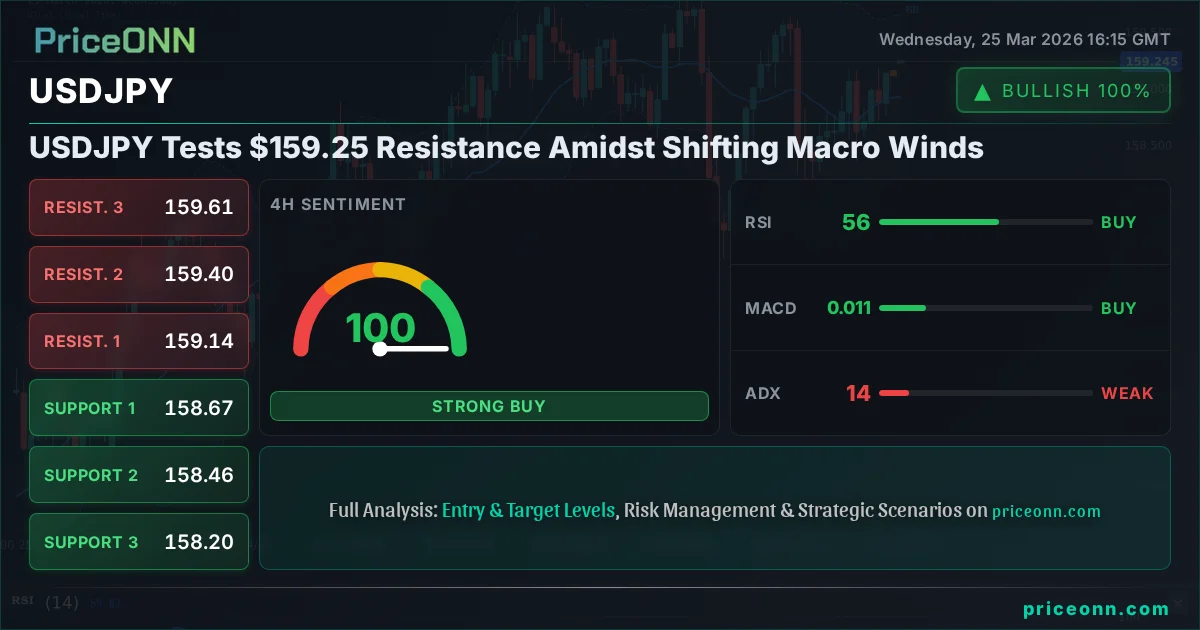
- USDJPY is currently testing resistance at $159.25, a key psychological and technical level.
- The DXY (Dollar Index) is showing strength, currently trading at 99.38, which typically pressures USDJPY.
- On the 1-day chart, RSI is at 58.57, indicating upward momentum but still in neutral territory.
- The Bank of Japan's stance on monetary policy remains a significant factor, with market participants closely watching for any hints of a shift away from negative interest rates.
The Bullish Case: Yen Weakness Persists
The prevailing trend for USDJPY has been one of sustained strength, driven by the widening interest rate differential between the United States and Japan. While the US Federal Reserve has been on a path of monetary tightening, or at least maintaining higher rates, the Bank of Japan (BOJ) has been notably hesitant to abandon its ultra-loose policy. This divergence creates a powerful incentive for carry trades, where investors borrow in a low-interest-rate currency like the Japanese Yen and invest in higher-yielding assets, typically denominated in currencies like the US Dollar. The current price of $159.25 is a testament to this persistent demand for the dollar against the yen.
Looking at the technical indicators, the 1-hour chart presents a bullish picture with a strong trend (Power: 92%) and a general signal of 'BUY' (8-0-0). The RSI(14) at 62.38 on this timeframe suggests that while the upward momentum is strong, it's not yet in extreme overbought territory, leaving room for further gains. Similarly, the Stochastic oscillator, with K=85.88 and D=56.9, clearly indicates a bullish signal with %K above %D, reinforcing the idea that buyers are in control in the short term. Even on the 4-hour chart, the signals lean bullish (8-0-0), with RSI at 56.27 and Stochastic showing %K above %D. This short-to-medium term bullish bias supports the argument for continued yen weakness.
Furthermore, the broader market context often plays a crucial role. The Dollar Index (DXY) is currently trading at 99.38, showing a daily increase of 0.52%. A stronger DXY typically exerts downward pressure on pairs like USDJPY, as it signifies a stronger US dollar across the board. However, in this specific case, the yen's weakness has been so pronounced that even a rising DXY hasn't prevented USDJPY from pushing higher, highlighting the overwhelming influence of interest rate differentials and carry trade dynamics. The fact that USDJPY is pushing towards resistance levels like $159.604 (R2 on the daily chart) even with a strong dollar index underscores the underlying bullish sentiment in this particular pair.
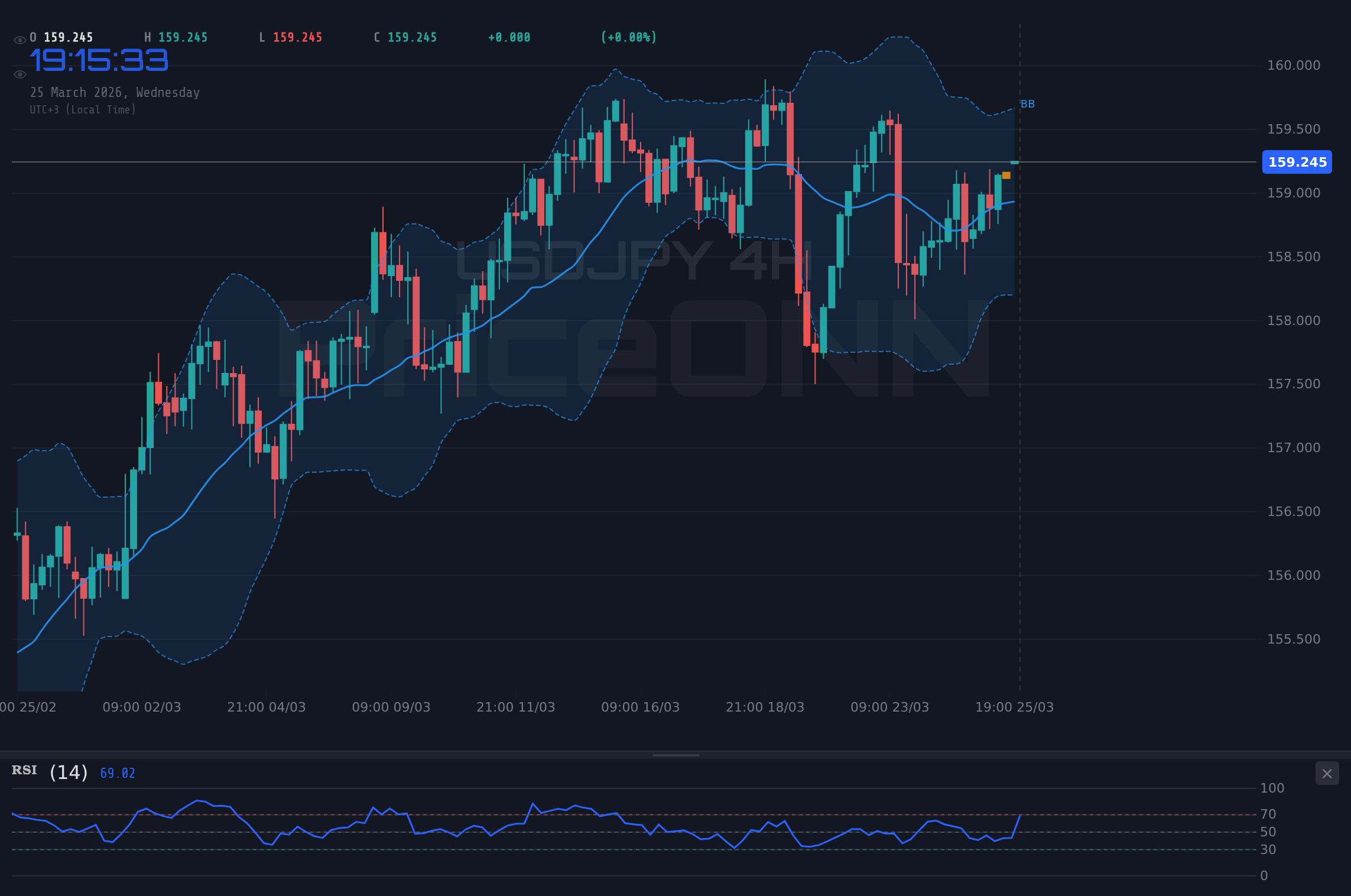
The carry trade remains a dominant theme. As long as the BOJ maintains its accommodative stance while other major central banks keep rates elevated or are slow to cut, the yen is likely to remain under pressure. This structural demand for USD against JPY is a powerful tailwind for the bulls.
The Bearish Counter-Argument: A Yen Reversal on the Horizon?
Despite the strong bullish signals in the shorter timeframes, a closer examination of the longer-term charts and potential catalysts reveals a compelling bearish case for USDJPY. The daily chart, while showing a 'BUY' signal (5-2-0), presents a more nuanced picture. The RSI(14) at 58.57, though indicating upward momentum, is teetering on the edge of overbought territory. More importantly, the MACD is showing negative momentum, with the MACD line below its signal line. This suggests that the bullish momentum might be waning, and a correction could be on the cards.
The ADX indicator is also telling a story. On the 1-hour chart, ADX is at a weak 13.27, indicating a lack of strong trend. On the 4-hour, it's at 14, still weak. However, on the daily chart, the ADX is 21.32, suggesting a moderate uptrend. This is not an alarm bell, but it doesn't scream strong conviction either. If USDJPY fails to decisively break through the resistance at $159.604 and subsequently $160.026, we could see a significant pullback. The daily support levels at $158.198, $157.776, and $157.284 become critical if the bears regain control.
The primary driver for a potential yen reversal lies with the Bank of Japan. Recent comments from BOJ officials have increasingly hinted at a possible shift away from negative interest rates, perhaps as early as April. If the BOJ were to signal or implement a rate hike, even a small one, it could trigger a significant appreciation of the Japanese Yen. Such a move would drastically alter the interest rate differential narrative that has been fueling USDJPY's ascent. Moreover, any hints of intervention from Japanese authorities to curb excessive yen weakness could also provide a catalyst for a sharp reversal. While direct intervention is rare, verbal warnings and market smoothing operations are always on the table when currency pairs move too rapidly.
The correlation with other markets also presents a potential bearish signal. While the DXY is currently strong, if US Treasury yields were to ease significantly due to, for example, stronger-than-expected US employment data that doesn't fuel inflation fears, or a pivot from the Fed, it could reduce the attractiveness of the dollar. A fall in US yields would lessen the incentive for carry trades and could put downward pressure on USDJPY, especially if coupled with any hawkish signals from the BOJ. The current price action around $159.25 feels like a point of inflection, where the market is weighing these competing forces.
A surprise hawkish shift from the Bank of Japan, or a significant dovish pivot from the US Federal Reserve, could trigger a rapid and substantial depreciation of the USD against the JPY. Traders must remain vigilant for policy shifts.
Navigating the $159.25 Crossroads: What the Data Tells Us
The current market data paints a picture of conflicting signals, especially when looking across different timeframes. The 1-hour and 4-hour charts are predominantly bullish, driven by strong short-term momentum and the persistent carry trade effect. However, the daily chart introduces caution. The RSI(14) at 58.57 is not yet overbought, but the MACD's negative momentum and the Stochastic's potential for a pullback are signals that bulls might be overextending themselves without sufficient fundamental backing for a sustained move higher.
The ADX values are particularly interesting. The weak ADX on the 1-hour and 4-hour charts (13.27 and 14, respectively) suggests that the current upward move might lack conviction and could be susceptible to reversal. While the daily ADX at 21.32 indicates a moderate uptrend, it's not a runaway trend. This suggests that the market is in a phase where new fundamental drivers are needed to break the current stalemate or confirm a directional bias.
The price action itself at $159.25 is a critical juncture. This level represents a significant resistance zone. If USDJPY can decisively break and hold above $159.604 (R1 on the 4H) and then $160.026 (R2 on the 1D), the bullish case would be significantly strengthened, potentially opening the door for further upside. However, failure to overcome this resistance, especially on increasing volume or on the back of dovish BOJ hints or strong US economic data suggesting a Fed pause, could lead to a sharp reversal. The support levels at $158.198 (S1 on 1D) and below would become the immediate targets in such a scenario.
Correlation analysis adds another layer of complexity. The DXY is currently strong at 99.38. If the DXY continues to climb, it would typically support USDJPY. However, if the narrative shifts towards a potential BOJ policy change, the yen's strength could override the dollar's general strength, leading to a decoupling. The current environment demands a nuanced approach, avoiding overly simplistic interpretations of individual indicators or single data points. It's the confluence of these factors - interest rate differentials, central bank policy expectations, technical levels, and broader market sentiment - that will ultimately determine USDJPY's next major move.
The $159.25 level is a critical confluence point. It represents a technical resistance zone and a psychological barrier. Failure to break decisively here could signal a short-term top, especially if accompanied by dovish BoJ whispers or weak US data.
Economic Calendar Watch: Key Catalysts Ahead
The economic calendar is a vital source of potential catalysts that could sway the USDJPY pair. For the US Dollar, key upcoming events include employment data and inflation figures. Any data that suggests a faster-than-expected cooling of the US economy or a significant drop in inflation could lead to increased expectations of Fed rate cuts, potentially weakening the dollar. Conversely, hotter inflation or a surprisingly robust labor market could reinforce the 'higher for longer' narrative for US interest rates, providing further support for USDJPY.
The real wildcard, however, remains the Bank of Japan. While specific dates for policy shifts are not always announced in advance, any speeches or meeting minutes from BOJ officials will be scrutinized for clues about their future monetary policy. If the BOJ signals an imminent end to negative interest rates or negative deposit rates, it could trigger significant volatility and a sharp appreciation of the Yen. For instance, if the upcoming 'USD' data release for PMI comes in significantly below forecast at 51.1, it might increase the odds of a Fed pause, but if the 'GBP' data release for interest rates (Actual: 3%) aligns with expectations, it keeps the focus on BOJ policy.
The market's reaction to these economic releases will be amplified by the current positioning. Many traders are likely already positioned for a weaker yen, making them susceptible to sharp moves if the narrative shifts. The current price of $159.25 is a battleground where these expectations are being tested. The upcoming economic calendar events will provide the fundamental data needed to either confirm the existing trend or trigger a significant reversal. Understanding these potential catalysts and their implications is paramount for navigating the USDJPY market.
Pay close attention to any statements from Bank of Japan officials regarding monetary policy. A shift in their stance, even a subtle one, could be the trigger for a significant USDJPY correction.
The Verdict: A Precarious Resistance Level
USDJPY is at a critical juncture, trading precisely at the $159.25 resistance level. The bullish momentum, especially in shorter timeframes, is undeniable, fueled by the persistent interest rate differential and carry trade dynamics. The strong DXY at 99.38 further supports the dollar's general strength. However, the daily chart presents a more cautious outlook, with potential for waning momentum and the ever-present threat of a policy shift from the Bank of Japan. The ADX at 21.32 on the daily chart indicates a trend is present, but not overwhelmingly strong, suggesting room for reversals.
The immediate future of USDJPY hinges on whether it can decisively break and hold above the $159.604 resistance. A successful breakout, perhaps fueled by hawkish US data or continued BOJ dovishness, could see the pair extend its gains towards $160.026 and beyond. Conversely, failure to breach this level, especially if accompanied by any indication of a BOJ policy change or a significant risk-off sentiment in global markets, could lead to a sharp retracement towards the daily support levels starting at $158.198.
For traders, this level demands caution and a clear strategy. Waiting for confirmation - either a decisive break above resistance or a clear reversal signal from support - is paramount. The conflicting signals across timeframes and the potential for a BOJ policy surprise mean that the risk of a sharp move in either direction is elevated. Managing risk through appropriate stop-loss orders and position sizing is crucial when trading at such pivotal levels. The market is at a crossroads, and the next few trading sessions will likely provide clarity on whether the yen's weakness will continue or if a significant correction is due.
Frequently Asked Questions: USDJPY Analysis
What happens if USDJPY breaks above the $159.25 resistance level?
If USDJPY breaks decisively above $159.25, especially with strong volume, it could target the next resistance level at $159.604. A sustained move higher might then aim for $160.026, but this would likely require confirmation from US economic data or continued BOJ dovishness.
Should I consider selling USDJPY at the current $159.25 levels given the daily chart's mixed signals?
Selling at resistance carries risk. While the daily chart shows potential for a pullback (RSI 58.57, MACD negative momentum), the shorter timeframes are bullish. A more prudent approach might be to wait for a clear break below daily support around $158.198 or for definitive dovish signals from the BOJ before considering a short position.
Is the RSI at 58.57 on the daily chart a sell signal for USDJPY?
An RSI of 58.57 is not typically considered a sell signal; it indicates upward momentum but is still within neutral territory. A sell signal would usually require RSI to be above 70 and showing divergence or a clear reversal pattern. The current RSI suggests the uptrend still has some room, though caution is warranted at resistance.
How will potential Bank of Japan policy changes affect USDJPY this week?
Any hint of the Bank of Japan shifting away from its ultra-loose monetary policy, such as ending negative rates, could trigger a sharp appreciation of the Japanese Yen. This would likely cause USDJPY to fall significantly, potentially breaking below key support levels like $158.198, overriding even a strong DXY.
Bearish Scenario: Yen Rebound at Resistance
65% ProbabilityNeutral Scenario: Consolidation Around $159.25
25% ProbabilityBullish Scenario: Resistance Breakout
10% ProbabilityTrack markets in real-time
AI-powered analysis, technical indicators and real-time price data.
Join Our Telegram Channel
Breaking market news, AI analysis and trading signals instantly.
Join Channel