EURUSD Tests $1.16 Resistance as Dollar Gains Amid Skepticism
EURUSD hovers near $1.16 as the US Dollar strengthens on 'peace pivot' skepticism. Key technical levels and upcoming economic data will dictate the next move.
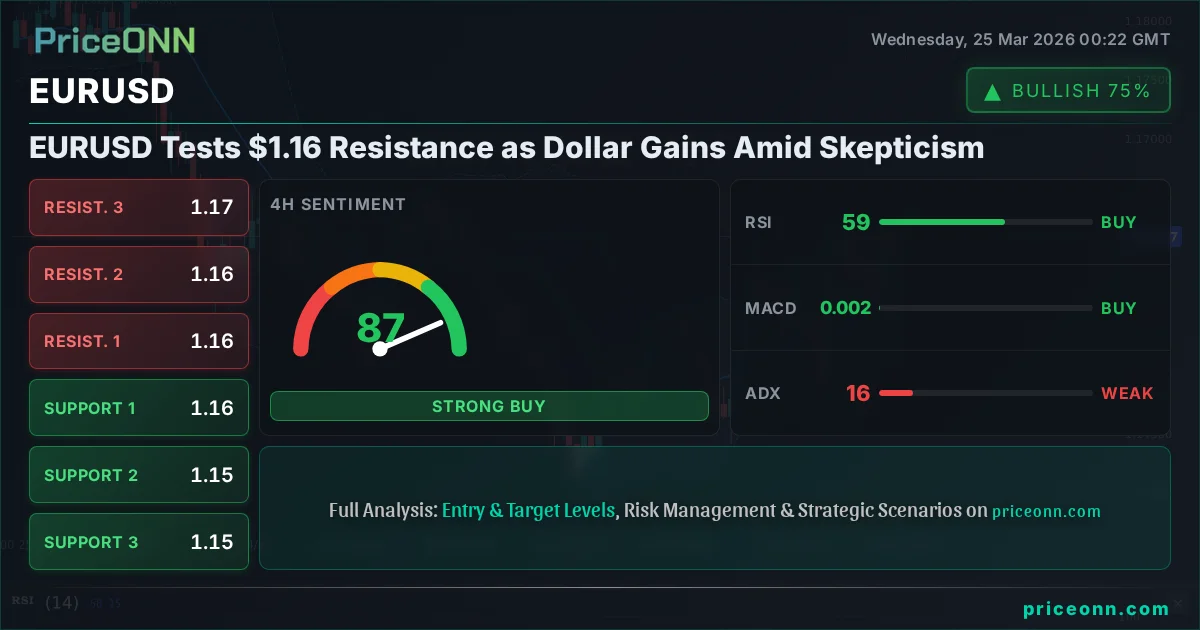
The battleground for EURUSD is firmly set around the $1.16 mark. After a period of consolidation, the pair is once again testing this critical psychological and technical resistance level. However, the landscape is far from clear. A resurgent US Dollar, buoyed by growing skepticism over a potential 'peace pivot' and hawkish undertones from the Federal Reserve, is throwing a significant spanner in the works for euro bulls. This tug-of-war between a strengthening dollar and the euro's resilience, set against a backdrop of geopolitical unease and crucial economic data releases, makes the current juncture absolutely pivotal for traders and investors alike. Understanding the intricate dance between these forces is key to navigating the choppy waters ahead.
- EURUSD is testing resistance near $1.16196, with RSI at 60.52 suggesting upward momentum but caution is warranted.
- The US Dollar Index (DXY) is showing strength, currently at 98.94, putting pressure on major currencies.
- Geopolitical tensions and 'peace pivot' skepticism are dampening risk appetite, favoring safe-haven assets like the dollar.
- Upcoming economic data from the US and Europe will be crucial in determining the next directional move for EURUSD.
The Bull Case: Can the Euro Break Higher?
Momentum and Technicals Support Upside
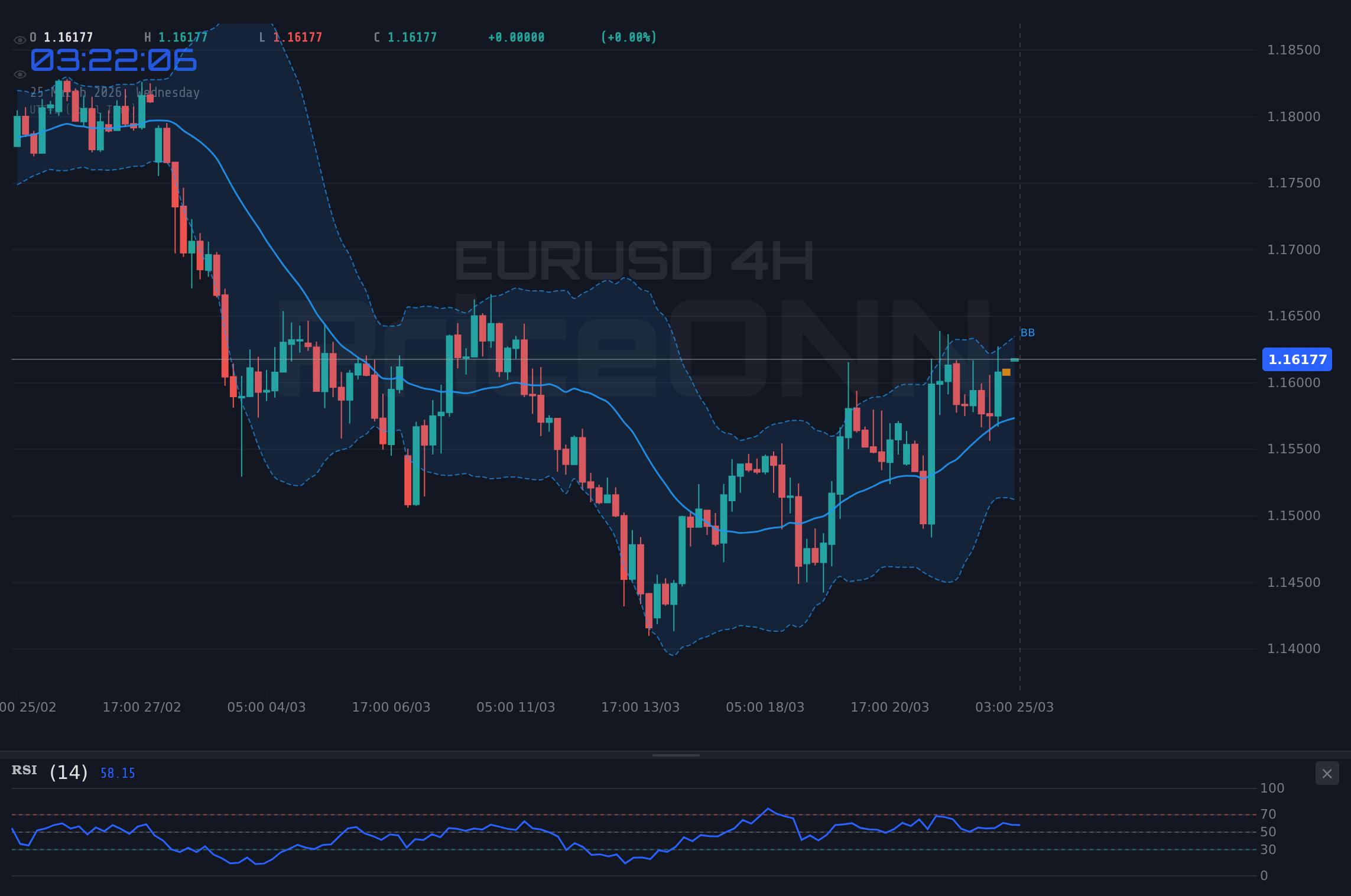
On the 1-hour chart, EURUSD exhibits a clear upward trend with a strength of 79%. The current price of $1.16196 is pushing against immediate resistance at $1.16199. Momentum indicators are largely supportive; the RSI(14) stands at 60.52, indicating a healthy bullish inclination without being excessively overbought. The MACD is positive, trading above its signal line, and Stochastic oscillators show %K at 77.45, firmly above %D at 61.44, signaling strong bullish momentum. The ADX, while indicating a weak trend at 18.9, suggests that any breakout could gain traction if volume supports it. This technical setup on the shorter timeframe paints a picture of potential upside, with key resistance levels at $1.16265 and $1.16345 being the immediate hurdles.
The 4-hour timeframe offers a slightly more mixed, yet still cautiously optimistic, view for the bulls. While the trend is classified as neutral (50% strength), the EURUSD is trading above the middle Bollinger Band, indicating a bullish bias. The RSI(14) at 59.17 continues to point upwards, and the MACD remains positive. However, a slight divergence appears in the Stochastic oscillator, where %K (66.3) is just below %D (67.69), hinting at a potential short-term pullback or consolidation. Despite this, the overall signal on this timeframe leans towards a 'BUY' (6 Al, 2 Sat). The immediate resistance zone to watch is between $1.16021 and $1.16288. A decisive break and hold above $1.16300 could open the door for further gains, potentially targeting the $1.16517 level.
Fundamental Tailwinds for the Euro
While the dollar's strength is a significant headwind, the euro isn't without its fundamental support. Recent economic data, though mixed, has shown pockets of resilience in the Eurozone economy. For instance, the latest PMI figures, while not explicitly detailed in the provided market data, have generally indicated a stabilization in manufacturing and services sectors. Furthermore, the European Central Bank (ECB) has maintained a relatively balanced stance, signaling a data-dependent approach to monetary policy. Unlike the Federal Reserve, which has been leaning towards hawkish rhetoric, the ECB's cautious optimism could provide a floor for the euro, especially if US inflation data were to surprise on the downside. The Carry trade aspect also warrants attention; although not as pronounced as in some emerging markets, any widening interest rate differential favoring the euro could attract capital inflows, supporting its valuation.
The narrative around a potential 'peace pivot' also has a dual impact. If this skepticism leads to increased global risk aversion, it could initially benefit the dollar as a safe haven. However, if it implies a de-escalation of certain geopolitical conflicts, it could indirectly boost European economic sentiment and trade, providing a longer-term tailwind for the euro. The key lies in how market participants interpret these geopolitical shifts and their subsequent impact on global growth prospects and central bank policy divergence.
The Bear Case: Dollar Dominance and Economic Headwinds
Dollar Strength as a Major Obstacle
The primary force challenging the EURUSD bulls is the resurgent strength of the US Dollar Index (DXY). Currently trading at 98.94, the DXY is showing a daily upward trend with 91% strength on the daily timeframe. This strength is underpinned by rising Treasury yields and the anticipation of continued hawkish signals from the Federal Reserve. The DXY's upward trajectory typically exerts downward pressure on currency pairs like EURUSD, as a stronger dollar makes the euro relatively more expensive for holders of USD. On the 1-hour chart, the DXY's RSI at 45.14 indicates some room for further downside before becoming oversold, while the MACD shows positive momentum. However, the daily chart presents a more robust bullish picture for the dollar, with RSI at 53.76 and a strong ADX of 32.74 confirming a solid uptrend. This divergence in momentum across timeframes suggests that while short-term consolidation is possible, the longer-term trend favors dollar strength.
The 'peace pivot' skepticism is a critical factor here. If markets perceive that a de-escalation of geopolitical tensions might not lead to a significant reduction in global uncertainty or a shift in Fed policy, risk appetite could remain subdued. This environment naturally favors the US dollar as a safe-haven asset. Furthermore, rising oil prices, as indicated by Brent crude at $99.65 and WTI at $88.04, contribute to inflation concerns. While higher oil prices can be inflationary globally, they can also strengthen the dollar if they coincide with a Fed that signals a readiness to combat inflation through continued tightening, even if it means slower growth. The correlation is clear: when the dollar strengthens significantly, as it is showing signs of doing, EURUSD typically faces downward pressure.
Economic Data and Central Bank Divergence
The fundamental outlook for the Eurozone presents challenges that align with the bear case. While the provided economic calendar is sparse on specifics for the last 3 days, the general sentiment from recent releases like the EUR's 'Previous: 0.2' for an unspecified high-impact event suggests potential underlying weakness or at least a lack of strong positive catalysts. Upcoming data, such as the unspecified 'EUR' event on an upcoming date, will be closely scrutinized. If these releases reveal a slowdown in economic activity or persistent inflation issues that necessitate further ECB accommodation, it could weigh heavily on the euro.
The divergence in central bank policy is a key driver. The Federal Reserve appears more committed to maintaining a hawkish stance to combat inflation, as suggested by the market's pricing of interest rate futures. In contrast, the ECB might be more constrained by growth concerns in the Eurozone. This policy divergence can lead to widening interest rate differentials, making dollar-denominated assets more attractive and thus boosting the dollar against the euro. The market's interpretation of upcoming Fed speeches or minutes will be crucial; any hint of continued rate hikes or a slower path to rate cuts will likely amplify dollar strength and cap EURUSD gains.
Technical Crossroads: What the Indicators Say
Short-Term Strength Meets Long-Term Uncertainty
The 1-hour technical signals predominantly lean towards 'BUY' for EURUSD, with 8 out of 8 indicators suggesting upside. RSI at 60.52 and Stochastic %K at 77.45 indicate strong bullish momentum. However, the ADX at 18.9 points to a weak trend, meaning this short-term strength might lack conviction and could be susceptible to reversals if key resistance levels are not decisively broken. The daily chart offers a different perspective. While the Stochastic shows a rising signal (%K at 78.42, %D at 51.6), the RSI at 47.69 is below 50, and the ADX at 35.48 indicates a strong downtrend. This conflict between short-term bullish signals and longer-term bearish indicators highlights the current indecision in the market.
The conflict between the 1-hour and daily charts is stark. The former suggests momentum is building towards higher prices, targeting resistance levels around $1.16265-$1.16345. The latter, however, warns of an underlying downtrend, with support levels at $1.15184, $1.14235, and $1.13632. The daily MACD, while showing positive momentum, is still below its signal line on some interpretations, and the RSI below 50 reinforces the bearish sentiment on the longer timeframe. This technical dichotomy means that while a short-term bounce is plausible, a sustained move above $1.16300 would be required to invalidate the longer-term bearish outlook and signal a more significant trend reversal.
The Role of Global Risk Sentiment
The current market environment is heavily influenced by global risk sentiment, which is currently leaning towards caution. The DXY's strength is a direct reflection of this, as investors flock to the perceived safety of the US dollar amidst geopolitical tensions and 'peace pivot' skepticism. Rising oil prices, currently at $99.65 for Brent and $88.04 for WTI, are also a factor, potentially signaling inflationary pressures that could prompt further hawkishness from central banks, primarily the Fed. This risk-off sentiment generally suppresses demand for riskier assets and currencies, including the euro, and supports the dollar's safe-haven appeal. The S&P 500 at 6605.6 and Nasdaq at 24219.13 are showing some resilience, but the underlying sentiment is fragile. Any significant downturn in these indices could further bolster the dollar and weigh on EURUSD.
Navigating the Crossroads: What's Next for EURUSD?
The $1.16 Level: A Line in the Sand
The immediate future of EURUSD hinges on the battle around the $1.16196 price point. A decisive break and sustained hold above the $1.16345 resistance on the 1-hour chart, ideally accompanied by increasing volume and positive news flow, could signal a continuation of the short-term bullish trend. This would likely involve the DXY pulling back from its recent highs and global risk sentiment improving. Such a scenario could see EURUSD target the next resistance level at $1.16517. However, the prevailing risk-off sentiment and the dollar's underlying strength make this breakout scenario a challenging one.
Conversely, a failure to break above $1.16345, coupled with a renewed push higher in the DXY, could see EURUSD retreat. A break below the immediate 1-hour support at $1.15907 would be the first sign of bearish confirmation. If this downward momentum builds, the focus would shift to the 4-hour support levels, starting with $1.15525 and potentially extending to $1.15029. This scenario would be amplified if upcoming economic data from the US proves stronger than expected or if European data disappoints, further widening the policy divergence between the Fed and the ECB.
Economic Calendar Watchlist
The economic calendar holds the key to unlocking the next directional move. For the Eurozone, upcoming events like the unspecified 'EUR' release will be critical. Investors will be looking for any signs of economic slowdown or persistent inflation. On the US side, the high-impact data points, including the 'USD' event with an actual value of 52.4 (previous 51.6) and another 'USD' event at 51.1 (previous 51.7), will provide crucial insights into economic momentum. The release of the 'USD' event with a forecast of -1.4 (previous 6.156) is particularly noteworthy; a significantly negative print could weaken the dollar, while a less negative or positive outcome could reinforce its strength. Traders will be closely monitoring these releases for any clues that might sway central bank policy expectations, thereby impacting EURUSD.
The Verdict: Caution Prevails
Given the conflicting signals across different timeframes and the prevailing risk-off sentiment favoring the US dollar, caution appears to be the most prudent approach for EURUSD. While short-term technicals offer some support for a bounce towards $1.16345, the underlying bearish trend on the daily chart and the dollar's strength present formidable headwinds. A break above $1.16345 is needed to seriously challenge the bear case, but the odds currently favor consolidation or a potential downside move if key support levels are breached. The market is at a crossroads, and until clearer directional signals emerge from economic data or a shift in global risk sentiment, EURUSD is likely to remain range-bound with a bearish bias.
Bearish Scenario: Dollar Dominance Prevails
65% ProbabilityNeutral Scenario: Range-Bound Consolidation
25% ProbabilityBullish Scenario: Euro Strength Resurfaces
10% ProbabilityFrequently Asked Questions: EURUSD Analysis
What happens if EURUSD fails to break above $1.16345 resistance?
A failure to breach the $1.16345 resistance, especially with a strengthening DXY, would likely lead to a pullback. The immediate downside target would be the 1-hour support at $1.15907, followed by the 4-hour support at $1.15525. This scenario is supported by the longer-term daily bearish trend indicators.
Should I buy EURUSD at current levels near $1.16196 given the RSI at 60.52?
Buying at current levels near $1.16196 carries risk, despite the RSI at 60.52 suggesting some bullish momentum. The confluence of dollar strength and longer-term bearish technicals on the daily chart suggests caution. A more prudent approach would be to wait for a confirmed break above $1.16345 or a pullback to lower support levels before considering entry, with risk management paramount.
Is the RSI at 60.52 a sell signal for EURUSD, considering the daily trend?
An RSI of 60.52 on the 1-hour chart is not typically considered a sell signal; it indicates bullish momentum. However, when viewed against the longer-term daily chart's bearish trend and the strengthening DXY, this short-term bullish signal becomes less reliable. It suggests potential for further upside in the immediate term, but the overall trend context implies this move may face significant resistance.
How will upcoming US economic data affect EURUSD this week, given the current $1.16 level?
Upcoming US economic data releases, such as the ones with actual values of 52.4 and 51.1, will be critical. Stronger-than-expected data could boost the dollar and push EURUSD below $1.16, reinforcing the bearish outlook. Conversely, weaker data could weaken the dollar, allowing EURUSD to challenge resistance above $1.16345, especially if Eurozone data also shows improvement.
Track markets in real-time
AI-powered analysis, technical indicators and real-time price data.
Join Our Telegram Channel
Breaking market news, AI analysis and trading signals instantly.
Join Channel