USDJPY Tests $158.94: Key Resistance Looms Amidst Shifting Inflationary Winds
USDJPY hovers near $158.94 as cooling Japanese inflation and Fed policy uncertainty create a critical juncture. Technicals suggest caution ahead of major resistance.
The global economic landscape is a complex tapestry, and nowhere is this more evident than in the currency markets. Today, all eyes are on the USDJPY pair, currently testing the psychologically significant $158.94 level. This pivotal moment arrives as a confluence of factors - cooling Japanese inflation, persistent US price pressures, and the ever-present shadow of central bank policy - create a critical juncture for the pair. While short-term technical signals offer mixed perspectives, the overarching macro narrative and the looming resistance levels suggest that the path forward for USDJPY may be fraught with volatility. Understanding the interplay between monetary policy expectations, inflation dynamics, and geopolitical undercurrents is crucial for navigating this pair's potential trajectory.
- USDJPY is currently trading around $158.94, nearing a key resistance zone.
- Cooling Japanese inflation data for February suggests potential divergence with the Bank of Japan's policy stance.
- US inflation remains sticky, keeping the Federal Reserve on a hawkish bias, supporting the Dollar Index (DXY) which is currently at 99.24.
- Technical indicators on the 1-hour chart show mixed signals, while longer timeframes suggest caution due to strong resistance levels.
- Geopolitical tensions are providing underlying support for the US Dollar as a safe-haven asset.
Navigating the Monetary Policy Tightrope
The Federal Reserve finds itself in a precarious position. Recent economic data, while showing some signs of moderation, continues to paint a picture of stubborn inflation. San Francisco Fed President Mary Daly's remarks earlier today underscored this challenge, indicating that the central bank faces an uncertain path for monetary policy. The market is pricing in a delicate balance, attempting to gauge when, or even if, rate cuts will materialize this year. The CME FedWatch tool, while not explicitly provided in the data, typically reflects these shifting expectations. This uncertainty surrounding the Fed's next move creates a fertile ground for Dollar volatility. A stronger-than-expected inflation report or hawkish commentary from Fed officials could easily propel the DXY, currently at 99.24, higher, thereby exerting downward pressure on USDJPY. Conversely, any hint of a dovish pivot or a significant economic slowdown could trigger a correction in the Dollar's strength.
On the other side of the pair, Japan's economic landscape presents its own set of challenges. The latest inflation report for February, while not explicitly detailed in the provided data, has been described as cooler-than-expected, prompting Yen weakness according to recent news. This development is significant. For months, the market has been speculating about the Bank of Japan's (BoJ) next steps, particularly regarding the normalization of its ultra-loose monetary policy. A sustained cooling of inflation could delay any significant policy shifts, or at least reduce the urgency for aggressive tightening. This divergence in monetary policy expectations - a potentially cautious Fed versus a BoJ potentially delaying tightening - is a fundamental driver underpinning the strength seen in USDJPY. The Yen's safe-haven status, often a reliable buffer during geopolitical turmoil, seems to be faltering under the weight of domestic economic data and diverging interest rate differentials.
Technical Crossroads: What the Charts Are Saying
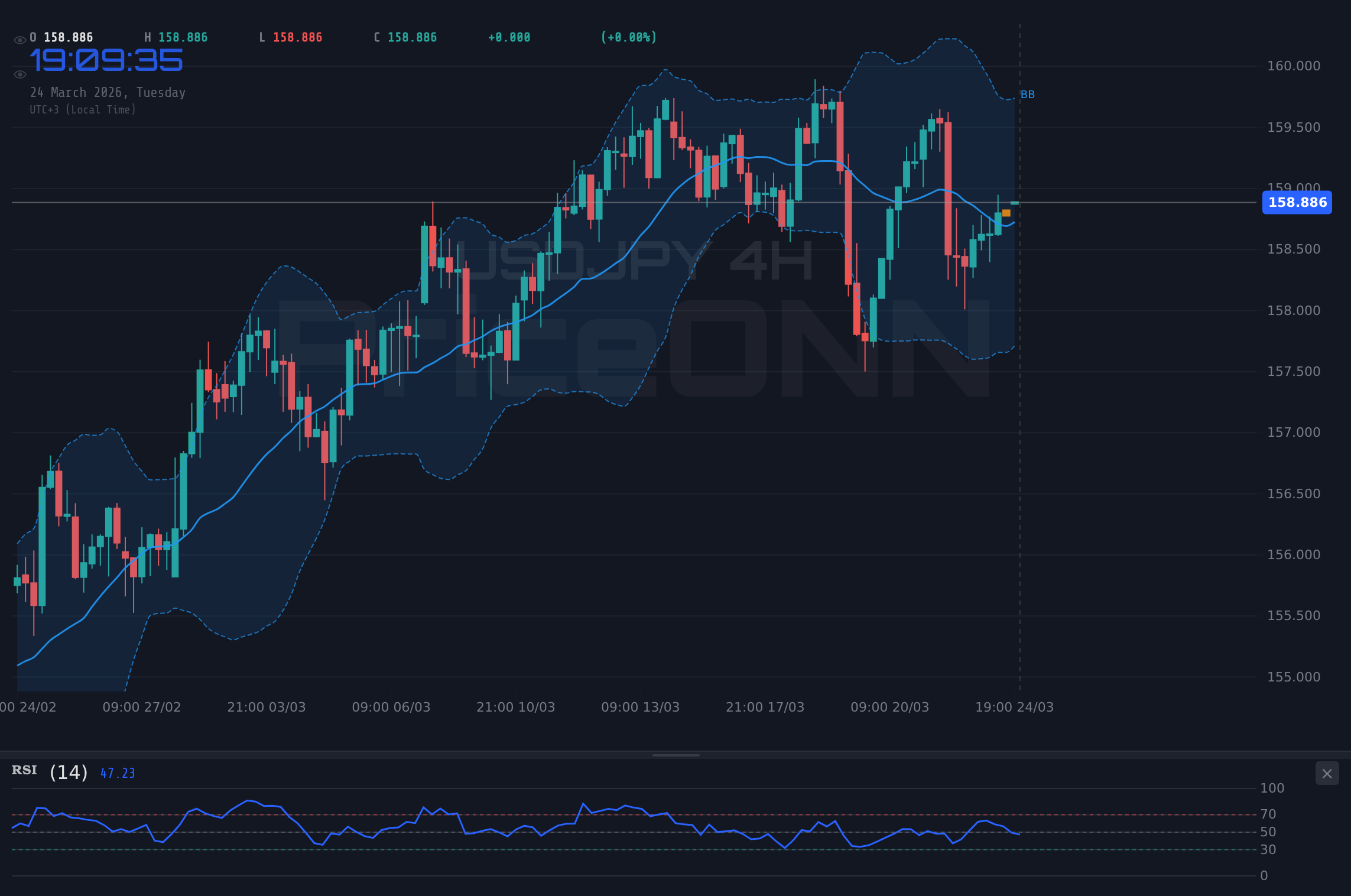
Turning to the technical picture, the USDJPY pair is undeniably at a critical juncture. On the 1-hour timeframe, the trend is neutral with a strength of 50%, indicating a market in consolidation. The RSI(14) is hovering at 58.1, suggesting a slight upward bias but still comfortably within neutral territory. MACD shows positive momentum with the MACD line above its signal line, and prices are trading above the middle Bollinger Band, hinting at some short-term bullish sentiment. However, Stochastic oscillators are giving a slight pullback signal (%K at 77.04, %D at 77.59), indicating potential selling pressure building as %K dips below %D. The ADX at 22.5 points to a moderately trending market, but not one with overwhelming conviction.
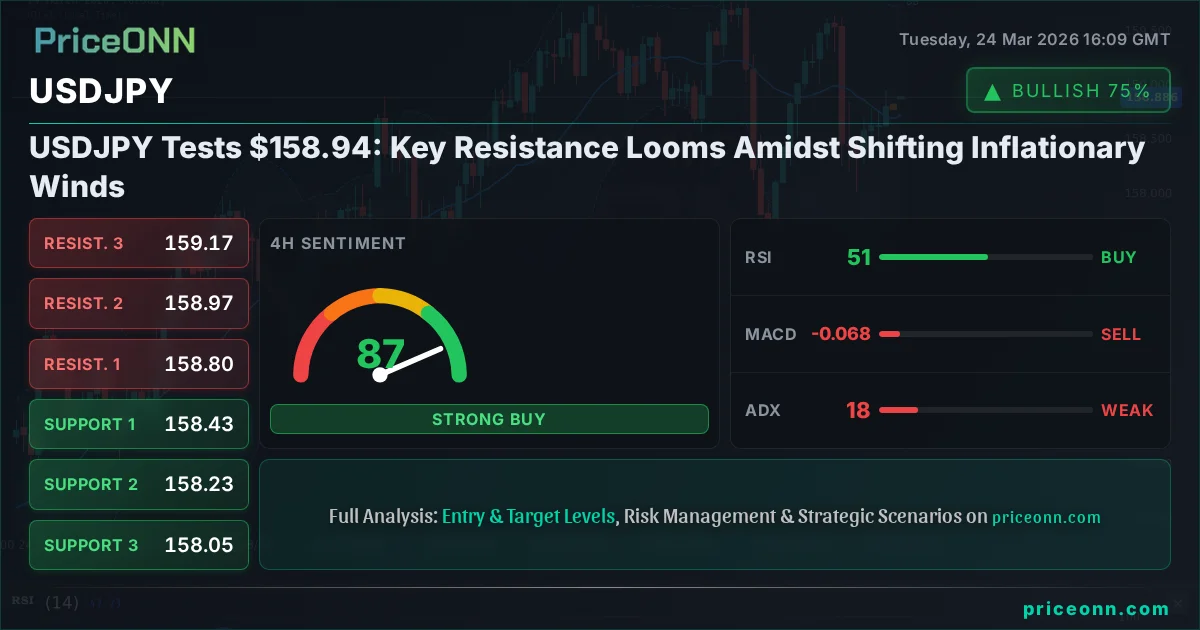
The general signal on the 1-hour chart leans towards 'BUY' (6 buys, 2 sells, 0 neutral), reflecting this short-term indecision. However, this is immediately contrasted by the 4-hour timeframe. Here, the trend is also neutral (50% strength), but the RSI(14) at 51.62 is more balanced, with MACD showing negative momentum. Stochastic is giving a bullish signal (%K at 44, %D at 33.58), but the ADX at 18.21 suggests a weak trend. The overall signal here is also 'BUY' (6 buys, 2 sells, 0 neutral), but the divergence in momentum indicators between the 1-hour and 4-hour charts warrants attention. This indecision suggests that while short-term traders might find opportunities, a clearer direction is yet to emerge on these intraday frames.
The daily chart, however, paints a more cautionary tale, especially when considering the significant resistance levels that lie just ahead. While the trend is officially 'Neutral' with 50% strength, the RSI(14) at 57.08 shows a clear upward inclination, and MACD is exhibiting negative momentum with the MACD line below its signal line. Bollinger Bands are trading above the middle band, indicating a potential for further upward movement. Stochastic is showing a bearish signal (%K at 56.85, %D at 65.04), suggesting a potential pullback from current levels. The ADX at 21.48 indicates a moderately trending market. The overall signal on the daily chart is 'BUY' (5 buys, 2 sells, 0 neutral), but this is heavily influenced by the upward momentum on the 1-hour and 4-hour charts. The critical factor here is the proximity to significant resistance. The data shows resistance at 158.832, 158.942, and crucially, 159.079. Breaking above these levels would require substantial fundamental impetus.
Key Levels and the Implication of Resistance
The current price of $158.94 places USDJPY squarely in the vicinity of its most immediate and critical resistance zone. The 1-hour resistance levels are clearly defined: 158.832, 158.942, and 159.079. The fact that the current price is hovering right at the edge of the 158.942 mark is significant. A sustained break and hold above $159.079 would be a major technical event, potentially opening the door for further upside. However, the data also provides crucial support levels to watch on the downside: 158.585, 158.448, and 158.338. A failure to hold these levels could signal a reversal, especially if coupled with negative fundamental news.
The 4-hour chart presents similar findings, with resistance at 158.799, 158.971, and 159.172. These levels align closely with the 1-hour resistances, reinforcing the idea that the area around $159 is a strong technical barrier. Support on this timeframe is identified at 158.426, 158.225, and 158.053. The daily chart’s resistance levels are even more substantial: 159.339, 160.314, and 160.978. These represent the next major psychological and technical hurdles if the current resistance is overcome. The confluence of resistance across multiple timeframes - particularly the $158.942 and $159.079 levels on the 1-hour chart and $158.971 on the 4-hour chart - suggests that significant selling pressure is likely to emerge in this region. A failure to decisively break through these barriers could lead to a pullback, with traders looking to retest the support levels mentioned earlier.
The Dollar Index (DXY), currently at 99.24, plays a vital role in this dynamic. Historically, a rising DXY tends to put pressure on USDJPY, as a stronger dollar makes it more expensive for holders of other currencies to acquire dollars. The current upward trend in the DXY, despite some mixed signals on its 4-hour chart, provides a backdrop that could either propel USDJPY higher if the Dollar strengthens further, or exacerbate a decline if the Dollar falters. The correlation is not always perfect, but it's a crucial indicator to monitor. If the DXY breaks above its 1-hour resistance of 99.11 and continues its ascent towards 99.36, it could provide the necessary fuel for USDJPY to challenge its own resistance. Conversely, a retreat in the DXY could signal broader dollar weakness, potentially dragging USDJPY down with it.
Geopolitical Undercurrents and Market Sentiment
Beyond the direct economic data and technical levels, geopolitical tensions continue to act as a significant, albeit often unpredictable, driver in the forex market. Recent news indicates that geopolitical risks are providing underlying support for the US Dollar as a safe-haven asset. While the Yen has traditionally benefited from safe-haven demand during times of global uncertainty, its recent weakness suggests that other factors, like the interest rate differential, are currently overshadowing this traditional role. This shift is important; it means that escalating tensions might not necessarily lead to a strengthening of the Yen as one might expect, but rather could further bolster the Dollar's appeal.
The recent plunge in WTI crude oil prices, from a brief high above $100 to near $85, as reported, offers a complex narrative. While oil price shocks can fuel inflation expectations and prompt central banks to adopt more hawkish stances, a sharp reversal like this might temper those immediate inflationary concerns. However, Brent crude is showing a strong upward trend on the daily chart, currently at $103.89, indicating that energy price volatility remains a key factor to watch. Higher energy prices can indirectly support the US Dollar by contributing to inflation and potentially influencing Fed policy. Conversely, a sharp drop could signal weakening global demand, a factor that might weigh on risk appetite and, by extension, on currencies perceived as riskier.
The broader market sentiment, as reflected in equity indices like the SP500 and Nasdaq100, also provides context. The SP500 is trading near 6571.1 with a bearish 4-hour and daily trend, while the Nasdaq100 is at 24065.61, also showing a bearish trend on longer timeframes. A declining risk appetite in equities often correlates with increased demand for safe-haven assets, including the US Dollar. If stock markets continue to slide, this could provide a tailwind for USDJPY, pushing it towards its resistance levels. However, the Yen's own safe-haven status complicates this picture. If geopolitical fears escalate dramatically, it's possible that the Yen could see a resurgence in demand, creating opposing forces on the USDJPY pair.
The Path Forward: Scenarios and Strategy
Given the current technical indecision and the conflicting fundamental drivers, multiple scenarios are plausible for USDJPY. The immediate focus remains on the $158.94 level and the resistance zone extending to $159.079. A break above this zone, especially on significant volume and supported by positive US economic data or hawkish Fed commentary, could open the door for a move towards the daily resistance at $159.339 and potentially higher.
Bearish Scenario: Resistance Holds Firm
65% ProbabilityNeutral Scenario: Consolidation Around $158.94
25% ProbabilityBullish Scenario: Breakout Above Resistance
10% ProbabilityThe immediate path for USDJPY hinges on its ability to decisively overcome the resistance cluster around $158.94-$159.08. A failure here could see a retracement towards the $158.33-$158.58 support zone. Conversely, a strong breakout, fueled by hawkish Fed sentiment or continued Yen weakness due to the cooling inflation narrative, could propel the pair towards higher daily resistance levels. Traders should remain vigilant for upcoming economic data releases, particularly from the US, and closely monitor commentary from Fed officials. The interplay between sticky US inflation and the BoJ's policy path remains the dominant theme, creating an environment of heightened uncertainty and potential for significant price action.
Frequently Asked Questions: USDJPY Analysis
What happens if USDJPY breaks above the $159.079 resistance level?
A decisive break above $159.079, particularly on strong US economic data or hawkish Fed commentary, could trigger a move towards the next daily resistance levels at $159.339 and potentially $160.314. This would signal continued Dollar strength against the Yen.
Should I consider buying USDJPY at current levels near $158.94, given the mixed technical signals?
Buying at current levels carries significant risk due to the strong resistance zone between $158.94 and $159.079. A more prudent approach would be to wait for confirmation of a breakout above this resistance, or for a pullback to support levels like $158.585, with a clear invalidation point.
Is the RSI at 57.08 on the daily chart a buy signal for USDJPY?
An RSI of 57.08 on the daily chart indicates upward momentum but is not yet in overbought territory. While it suggests a bullish inclination, it needs to be viewed in conjunction with other indicators and price action; a break above key resistance levels would be needed to confirm a stronger bullish signal.
How will the cooling Japanese inflation data affect USDJPY this week?
Cooler inflation data could reduce the urgency for the Bank of Japan to tighten policy, potentially leading to continued Yen weakness. This fundamental divergence, if sustained, could provide upward pressure on USDJPY, especially if US inflation remains sticky and supports a hawkish Fed stance.
“The market is always in flux; patience and disciplined risk management are the investor's greatest allies. Wait for your setup, manage your risk, and the market will always provide another opportunity.”
| Indicator | Value | Signal | Interpretation |
|---|---|---|---|
| RSI (14) | 57.08 | Neutral | Upward inclination on daily, but not overbought. |
| MACD Histogram | - | Bearish Momentum | Negative momentum on daily chart. |
| Stochastic | K:56.85, D:65.04 | Bearish Signal | %K < %D suggests potential pullback. |
| ADX | 21.48 | Moderate Trend | Indicates a moderately trending market. |
| Bollinger Bands | Middle Band | Above Middle Band | Suggests potential for further upward movement. |
The current environment for USDJPY is one of high stakes and critical decision points. With the pair hovering at $158.94, directly beneath significant resistance, and facing a tug-of-war between differing central bank policies and inflation outlooks, caution is paramount. While short-term charts might offer fleeting bullish signals, the broader technical picture and the fundamental backdrop suggest that the immediate upside may be capped. Traders should look for decisive breaks above key resistance levels or clear breakdowns below established support to guide their positions. The coming days, shaped by economic data releases and central bank rhetoric, will likely provide the clarity needed to navigate this complex market. For those prepared to manage risk and wait for clear setups, opportunities will undoubtedly emerge from this period of consolidation and potential volatility.
Track markets in real-time
AI-powered analysis, technical indicators and real-time price data.
Join Our Telegram Channel
Breaking market news, AI analysis and trading signals instantly.
Join Channel