Australian Dollar moves little following RBA’s Kent cautious remarks

Market Pause as RBA Commentary Resonates
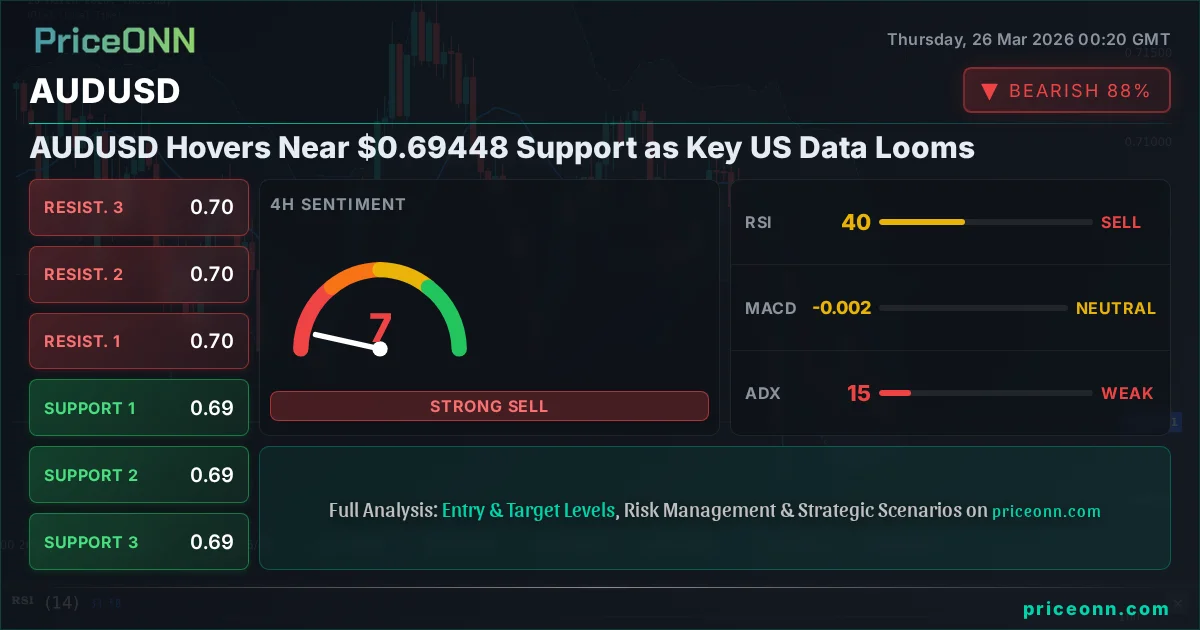
The Australian Dollar found a moment of calm in Asian trading on Thursday, stabilizing around the 0.6950 level against the US Dollar. This followed a two-day dip in the currency's value, suggesting a temporary reprieve for AUD bulls. The market's reaction appears to be digesting remarks from an RBA official, which have injected a note of caution into the economic outlook.
Several critical forces shape the trajectory of the Australian Dollar. At the forefront is the monetary policy stance of the Reserve Bank of Australia (RBA). Decisions on interest rates directly influence the cost of borrowing within Australia, impacting the broader economy. The RBA's primary mandate centers on maintaining inflation within a 2% to 3% target band, a goal pursued through adjustments to its benchmark interest rate. When Australian rates present a higher yield compared to those offered by other major central banks, the AUD typically finds support. Conversely, a widening rate differential in favor of other nations tends to weigh on the currency.
Beyond domestic monetary policy, Australia's identity as a major commodity exporter places significant weight on global resource prices. Specifically, the value of Iron Ore, the nation's principal export, plays a pivotal role. Demand from China, Australia's largest trading partner, is a crucial determinant of both Iron Ore prices and the overall health of the Australian economy. A robust Chinese economy translates to increased demand for Australian raw materials, bolstering the AUD. Conversely, signs of economic deceleration in China often exert downward pressure on the Australian currency.
The nation's economic performance, measured by its growth rate and trade balance, also contributes to the AUD's valuation. A healthy Trade Balance, where export earnings exceed import costs, signifies strong international demand for Australian goods and services, thereby strengthening the currency. Furthermore, global investor sentiment, characterized by risk appetite (risk-on) or risk aversion (risk-off), significantly impacts the AUD. Periods of heightened global optimism often see investors flocking to higher-yielding assets like the Australian Dollar, while times of uncertainty prompt a flight to perceived safe-haven assets.
Reading Between the Lines
The recent cautious commentary from RBA's Kent suggests the central bank is carefully monitoring economic data, likely balancing inflation concerns with growth headwinds. This measured approach implies that a rapid pivot to aggressive rate cuts or hikes is not immediately on the cards, leading to the currency's current stabilization. The market is now keenly focused on upcoming economic indicators from both Australia and China to gauge the next directional move for AUD/USD.
The interplay between domestic inflation data, employment figures, and global commodity prices will be critical. Any unexpected surge in Australian inflation could prompt a hawkish response from the RBA, providing a lift to the AUD. Conversely, weakening Chinese manufacturing data or a slump in Iron Ore prices would likely trigger renewed selling pressure. Traders are watching the 0.6900 level as a key support zone; a decisive break below this could open the door for further downside towards 0.6850.
The RBA's toolkit extends beyond interest rate adjustments. Quantitative easing (QE) and quantitative tightening (QT) policies can also influence credit conditions. QE typically expands the money supply, potentially weakening the currency, while QT aims to contract it, offering potential support. For now, the market is pricing in a period of relative stability, but the underlying economic fundamentals and global risk sentiment remain potent drivers.
Market Ripple Effects
The current AUD/USD consolidation has implications beyond the immediate currency pair. A stable or slightly strengthening AUD can provide a minor tailwind for Australian equities, particularly those with significant export exposure. Conversely, a sustained weakening could put pressure on the local stock market. The US Dollar Index (DXY), which measures the greenback against a basket of major currencies, is also a key factor; any renewed strength in the DXY would naturally weigh on AUD/USD.
Furthermore, commodity markets closely linked to Australian exports, such as copper and gold, may see muted reactions in the short term. However, any significant shift in the AUD's direction, driven by substantial changes in Chinese demand or RBA policy, could ripple through these commodity prices. Investors are also keeping an eye on the New Zealand Dollar (NZD), given the close economic ties between the two nations. A firmer AUD often correlates with a firmer NZD.
Trader Takeaways
The cautious remarks from RBA official Kent have temporarily halted the Australian Dollar's descent, creating a period of consolidation around the 0.6950 mark. This pause allows traders to reassess the economic landscape, weighing inflation against growth concerns. Key levels to monitor include the immediate support at 0.6900 and resistance around 0.7000. A breach of either could signal the next significant move.
The immediate outlook suggests that the AUD will likely remain sensitive to shifts in global risk sentiment and developments in China's economy. Any unexpected economic data from Beijing or a sharp movement in Iron Ore prices could quickly alter the currency's course. Traders should remain vigilant for shifts in RBA rhetoric, as any hint of a more hawkish or dovish stance could reignite volatility. The pair's correlation with broader market risk appetite remains a critical theme to watch.
Track markets in real-time
Empower your investment decisions with AI-powered analysis, technical indicators and real-time price data.
Join Our Telegram Channel
Get breaking market news, AI analysis and trading signals delivered instantly to your Telegram.
Join Channel