
Australian Dollar weakens as Middle East tensions escalate
 PriceONN Editorial Desk
Multi-source verification
PriceONN Editorial Desk
Multi-source verification
Global Tensions Spill Into Asian Trading
The early hours of Monday's Asian trading session saw sellers emerge near the 0.7000 handle for the AUD/USD currency pair. A palpable shift towards risk aversion gripped currency markets, directly impacting the fortunes of the Australian Dollar. This sudden bearish turn is largely attributed to an unwelcome escalation of hostilities in the Middle East, a development that invariably sends investors scrambling for perceived safety.
The US Dollar, a traditional haven during times of global uncertainty, found renewed strength. As caution permeated trading floors, the greenback began to edge higher against its Australian counterpart. This dynamic underscores a recurring theme in financial markets: when geopolitical risks flare, the allure of safety trumps speculative appetite, often at the expense of riskier, growth-sensitive currencies like the AUD.
Unpacking the Australian Dollar's Core Drivers
Understanding the Australian Dollar's (AUD) trajectory requires a look beyond immediate market jitters. Several fundamental pillars support its value, each with its own influence. Chief among these is the monetary policy stance of the Reserve Bank of Australia (RBA). The central bank's decisions on interest rates directly shape the cost of borrowing and lending within the economy, acting as a powerful lever on currency valuations.
Australia's status as a major commodity exporter also places significant weight on global resource prices. Specifically, the price of iron ore, a cornerstone of the nation's export revenue, frequently moves in tandem with the AUD. When demand for raw materials surges, often driven by robust industrial activity, the Australian Dollar tends to benefit.
Furthermore, the economic health of China, Australia's primary trading partner, casts a long shadow. A thriving Chinese economy translates into greater demand for Australian goods and services, thereby boosting the AUD. Conversely, any slowdown or unexpected headwinds in China can quickly dampen demand and pressure the currency. Inflationary pressures within Australia and the nation's overall trade balance also play crucial roles, with a positive trade surplus typically providing a tailwind for the currency.
The RBA's Balancing Act and China's Economic Pulse
The Reserve Bank of Australia operates with a primary objective: maintaining inflation within a target band of 2-3%. To achieve this, the RBA strategically adjusts interest rates. When rates are perceived as relatively high compared to other major economies, the AUD often attracts foreign investment seeking better yields, thus appreciating in value. The inverse holds true when Australian rates lag behind global peers.
Beyond rate adjustments, the RBA possesses other tools, such as quantitative easing (QE) and tightening (QT). QE, which involves injecting liquidity into the financial system, is generally considered AUD-negative, while QT, the withdrawal of liquidity, can be AUD-positive. These policy nuances add another layer of complexity for currency watchers.
The intricate relationship between Australia and China cannot be overstated. As China's largest customer for raw materials, its economic performance is a critical barometer for the AUD. Positive economic data from Beijing often sparks increased orders for Australian exports, directly lifting demand for the Australian Dollar. Conversely, disappointing growth figures from China can trigger immediate selling pressure on the AUD, highlighting the currency's sensitivity to shifts in its neighbor's economic fortunes.
Iron Ore's Sway and Trade Balance Dynamics
Iron ore, a vital commodity for global steel production, represents a significant portion of Australia's export earnings, exceeding $118 billion annually according to 2021 figures. Its price fluctuations are therefore closely monitored by those tracking the AUD. A rising iron ore price generally correlates with an appreciating Australian Dollar, as increased export revenues flow back into the economy.
This correlation is not merely coincidental. Higher iron ore prices often contribute to a more favorable trade balance for Australia. The trade balance, representing the difference between a nation's export earnings and its import expenditures, acts as a direct indicator of international demand for a country's products. A substantial surplus, driven by strong export performance, inherently strengthens the AUD as foreign entities require more of the currency to acquire Australian goods.
Market Ripple Effects
The current risk-off sentiment, amplified by Middle Eastern tensions, is creating significant ripples across financial markets. The immediate impact is seen in the AUD/USD pair, which is experiencing downward pressure. This move is not isolated; broader commodity markets, particularly those tied to industrial demand like copper, may also see pullbacks as global growth concerns intensify.
Furthermore, the strengthening US Dollar, driven by safe-haven flows, could exert pressure on other emerging market currencies and even impact global equity indices. Investors will be closely watching how central banks react to any sustained geopolitical escalation and its subsequent effect on inflation and growth expectations. The interconnectedness of global events means that instability in one region can quickly transmit to seemingly unrelated asset classes worldwide, creating both risks and opportunities for astute traders.
Track markets in real-time
Empower your investment decisions with AI-powered analysis, technical indicators and real-time price data.
Join Our Telegram Channel
Get breaking market news, AI analysis and trading signals delivered instantly to your Telegram.
Join Channel PriceONN News
USDJPY has returned to the area of previous interventions. The ECB is moving towards a rate hike in June. The US dollar retreated on Friday amid new record highs for stock indices and rumours of amendments to the US-Iran agreement. However, tit-for-tat exchanges between the adversaries pushed the dollar index back into the support zone […] The post Yen Braces for a New Storm appeared first on ActionForex.
PriceONN News
Markets are pricing in a potential de-escalation in the US-Iran conflict, leading to a significant drop in crude oil prices and a weakening US Dollar as diplomatic efforts appear to be gaining traction.
PriceONN News
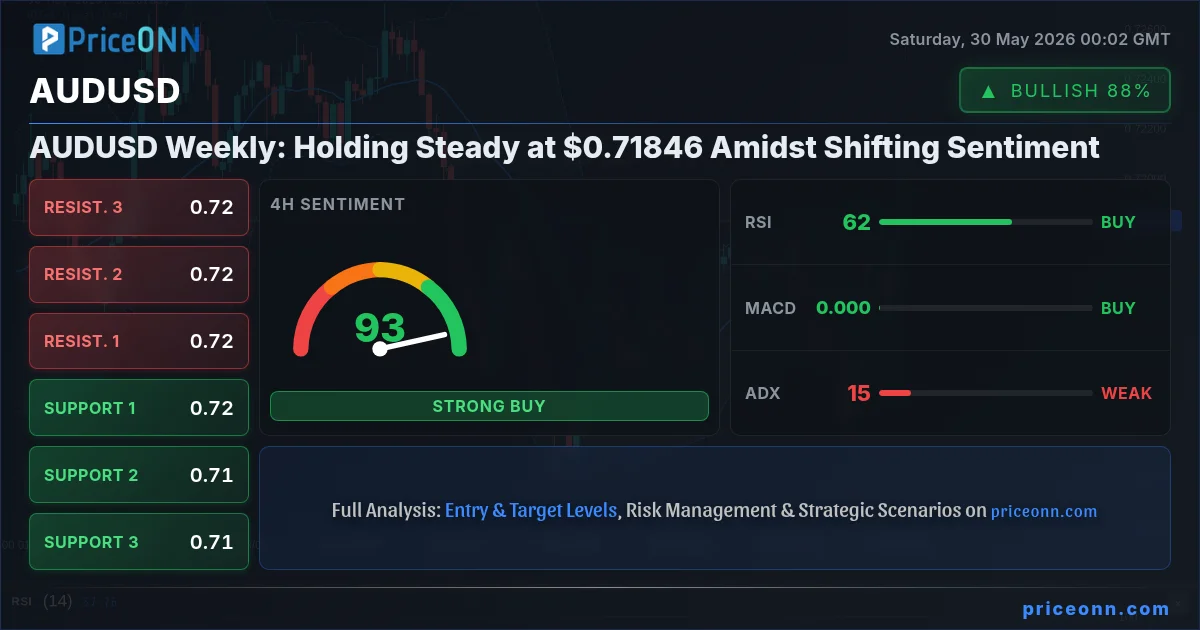
AUD/USD’s late break of 0.7183 resistance suggests that pullback from 0.7277 has already completed at 0.7076, after defending 55 D EMA. Initial bias is back on the upside this week for retesting 0.7277 high first. Firm break there will resume larger up trend. For now, risk will stay on the upside as long as 0.7076 […] The post AUD/USD Weekly Report appeared first on ActionForex.
PriceONN News
The USD/JPY pair is flirting with the 160 level as stalled US-Iran negotiations and hawkish Federal Reserve rhetoric fuel inflation concerns. Traders are closely watching upcoming US Non-Farm Payrolls and Eurozone CPI data.
PriceONN News
EUR/USD stalled below 1.1660 as the US Dollar defied expectations, refusing to weaken despite reports of a US-Iran ceasefire extension. Market participants remain cautious, awaiting concrete confirmation and assessing lingering inflationary pressures.
PriceONN News
EUR/USD closed at 1.1640, showing resilience amid mixed signals. Easing US-Iran tensions initially pressured the dollar, but persistent inflation concerns and political ratification hurdles are keeping the greenback surprisingly steady.
PriceONN News
The EUR/USD faces headwinds as core US PCE inflation unexpectedly rose to 3.3% year-over-year, reinforcing a 'higher for longer' interest rate narrative. Meanwhile, a US-Iran ceasefire extension boosted global risk appetite, potentially drawing capital away from safe-haven currencies.
PriceONN News
EUR/USD stabilized around 1.1640 as reports of a US-Iran ceasefire extension and potential Strait of Hormuz reopening eased inflation fears. However, the US Dollar's resilience suggests lingering caution among forex traders.
PriceONN News
The US Dollar experienced a notable decline last week as markets priced in a potential diplomatic resolution to the US-Iran conflict, leading to a drop in oil prices and Treasury yields. This shift in sentiment suggests a move away from stagflation fears towards a more stable economic outlook.
PriceONN News
USD/CAD faces pressure as Canada's economy shows signs of stalling, with Q1 GDP contracting 0.1% and domestic demand weakening. This comes as trade negotiations and geopolitical shifts add layers of uncertainty.
PriceONN News
USD/CAD is showing signs of potential upward movement as Canada's economy grapples with a significant slowdown, marked by weak domestic demand and stalled investment, while trade negotiations loom large.
PriceONN News
USD/JPY is testing the critical 160 level as stalled US-Iran negotiations and hawkish Federal Reserve rhetoric fuel inflation concerns and a potential for further rate hikes. Traders are closely watching upcoming US Non-Farm Payrolls and Eurozone CPI data for direction.