
Dow Jones futures climb as cooling economic data lower Fed rate hike odds
 PriceONN Editorial Desk
Multi-source verification
PriceONN Editorial Desk
Multi-source verification
Market Momentum Builds on Easing Inflation Signals
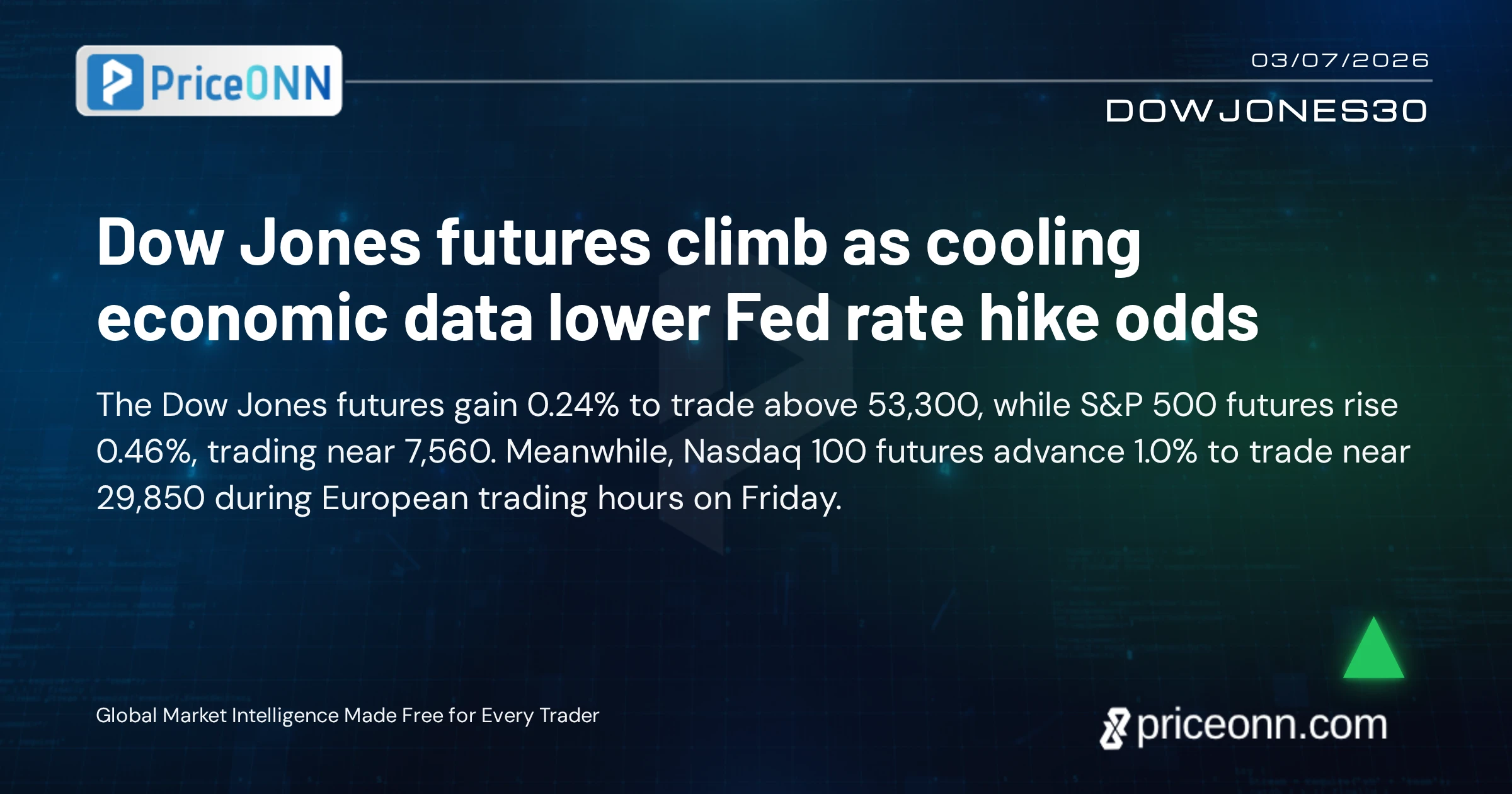
Anticipation is building across financial markets as recent economic readings paint a picture of cooling inflation, directly influencing expectations for the Federal Reserve's next policy move. Futures tied to the Dow Jones Industrial Average, a bellwether for 30 of the largest U.S. publicly traded companies, saw a notable uptick, trading 0.24% higher and surpassing the 53,300 level. This positive sentiment extended to other major indices, with the S&P 500 futures advancing 0.46% to hover near 7,560, and the tech-heavy 100 futures climbing a more significant 1.0% to trade close to 29,850 during Friday's European trading session.
The aggregate performance of the 30 companies that comprise the Dow Jones Industrial Average is a key determinant of its movement. These companies, representing a cross-section of American industry, report their financial health through quarterly earnings. However, investor sentiment is also heavily swayed by the broader economic landscape, both domestically and globally. Critical to this sentiment is the Federal Reserve's stance on interest rates. As rates influence the cost of capital for countless corporations, any shift in monetary policy, driven by inflation data and other economic metrics, can significantly impact the index.
Understanding the Dow's Mechanics and Historical Context
The Dow Jones Industrial Average, an enduring fixture in the financial world, traces its origins back to Charles Dow, the visionary founder of The Wall Street Journal. Unlike indices weighted by market capitalization, the DJIA employs a price-weighted methodology. This means that stocks with higher per-share prices exert a greater influence on the index's movement, a distinct characteristic from broader benchmarks like the S&P 500. Currently, its calculation involves summing the prices of its 30 constituent stocks and dividing by a divisor, which stands at approximately 0.152.
While historically significant, the DJIA has faced scrutiny for its limited scope, tracking only 30 large-cap companies. This narrow focus, critics argue, may not fully capture the overall health of the U.S. stock market when compared to more comprehensive indices. Nevertheless, its movements are closely watched, providing a pulse on major U.S. corporate performance and investor sentiment.
Dow Theory's Enduring Principles and Trading Avenues
Charles Dow also laid the groundwork for Dow Theory, a foundational approach to identifying primary market trends. This theory emphasizes the confirmation of trends by comparing the directional movement of both the Dow Jones Industrial Average and the Dow Jones Transportation Average. Divergence between these two key indices is seen as a warning sign, while their synchronized movement, supported by trading volume, offers a stronger indication of a prevailing trend. The theory further delineates market trends into three phases: accumulation, where informed investors begin positioning; public participation, marked by broader market involvement; and distribution, when astute traders exit their positions.
For those looking to engage with the DJIA, several avenues exist. Exchange Traded Funds (ETFs), such as the SPDR Dow Jones Industrial Average ETF (DIA), offer a simplified way to gain exposure to the index's performance without the complexity of trading individual stocks. Futures contracts allow for speculation on the index's future value, providing leverage for traders. Additionally, options contracts present opportunities to bet on price movements at predetermined levels, while mutual funds offer a diversified basket of DJIA components for more traditional investors seeking broad market exposure.
Market Ripple Effects
The cooling inflation data and the resulting shift in Federal Reserve rate hike expectations have significant implications beyond just the DJIA. This development directly impacts bond markets, particularly U.S. Treasury yields, which tend to move inversely to rate hike probabilities. A less hawkish Fed typically leads to lower long-term yields. Furthermore, the U.S. Dollar Index (DXY) could face downward pressure, as higher interest rates in the U.S. generally attract foreign capital, strengthening the dollar. Conversely, a weaker dollar can boost commodity prices, including gold and oil, as they become cheaper for holders of other currencies. Equity markets globally, especially those sensitive to interest rate changes and corporate earnings, will also react to this evolving monetary policy outlook.
Track markets in real-time
Empower your investment decisions with AI-powered analysis, technical indicators and real-time price data.
Join Our Telegram Channel
Get breaking market news, AI analysis and trading signals delivered instantly to your Telegram.
Join Channel PriceONN News
Here is what you need to know on Friday, July 3
PriceONN News
Key insights from the week that was. This week’s RBA minutes provided more colour around the Monetary Policy Board’s (MPB) June deliberations. Overall, the MPB views the economy as “operating with excess demand and widespread inflationary pressures”. On the domestic front, there were “somewhat differing views” among MPB members regarding the extent of current capacity […] The post Cliff Notes: On the Minds of Policy Makers appeared first on ActionForex.
PriceONN News
XAG/USD gains ground for the third consecutive day, trading around $60.20 per troy ounce during the Asian hours on Thursday. Silver prices find support following a less hawkish tone than expected from Federal Reserve (Fed) Chairman Kevin Warsh at Wednesday's ECB Forum on Central Banking.
PriceONN News
UK business activity weakened further in June as the services sector recorded its sharpest contraction in nearly three and a half years, highlighting a loss of economic momentum during the second quarter. The final S&P Global UK Services PMI Business Activity Index fell to 48.8 from 49.3 in May, its lowest reading since January 2023. […] The post UK Services PMI Falls to Lowest Since 2023 as Demand Weakens Despite Cooling Cost Pressures appeared first on ActionForex.
PriceONN News
Ethereum has staged a notable rebound after once again testing the heavily watched psychological zone around 1500$. Since bouncing off this support, ETH/USD has climbed roughly 13%, now trading around the $1,700 mark. This recovery is being driven by a combination of technical and fundamental factors. On the technical side, the aforementioned support zone has […] The post Ethereum: Has the Recovery Begun? appeared first on ActionForex.
PriceONN News
The GBP/JPY cross attracts fresh sellers in the vicinity of mid-215.00s and slides to the lower end of its daily range during the early European session on Friday.
PriceONN News
To achieve its development ambitions, China’s industrial might must pay off for households. The first half of 2026 has highlighted China’s industrial strength, the trade surplus widening back to near record highs and investment in high-tech manufacturing and services continuing at pace while authorities’ strategic reserves and pro-active decision making offered robust protection against an […] The post China’s Greatest Opportunity and Biggest Threat appeared first on ActionForex.
PriceONN News
Silver (XAGUSD) continues to exhibit an incomplete sequence from the January 29, 2026 high, suggesting that further downside remains possible. In the short term, the cycle from the May 14, 2026 high is unfolding as a double three Elliott Wave structure. From that peak, wave (W) concluded at 61.46, while the corrective rally in wave […] The post Elliott Wave Perspective: Silver (XAGUSD) Sequence Maintains Downside appeared first on ActionForex.
PriceONN News
The GBP/USD pair trades in positive territory around 1.3360 during the early European session on Friday. The British Pound (GBP) gathers strength against the US Dollar (USD) on a weaker-than-expected US Nonfarm Payrolls (NFP) report.
PriceONN News
The AUD/JPY cross trades in positive territory around 111.75 during the early European trading hours on Friday. The Australian Dollar (AUD) strengthens against the Japanese Yen (JPY) following the Chinese economic data.
PriceONN News
USD/IDR gains ground after registering minor losses in the previous day, trading around 18,000 during the Asian hours on Friday. The pair appreciates as the US Dollar (USD) holds its position despite a disappointing set of domestic labor data released on Thursday.
PriceONN News
The NZD/USD pair gathers strength to around 0.5705 during the Asian trading hours on Friday. The New Zealand (NZD) remains strong following the Chinese economic data. The US markets will be closed on Friday in observance of Independence Day.