
GBP/USD Price Forecast: Gathers strength above 1.3350, but stays capped below 100-day average
 PriceONN Editorial Desk
Multi-source verification
PriceONN Editorial Desk
Multi-source verification
Sterling's Foundations and Global Standing
With a lineage tracing back to 886 AD, the Pound Sterling stands as the world's most venerable currency and the official tender of the United Kingdom. Its global financial significance is undeniable; it ranks as the fourth most actively traded currency on foreign exchange markets, commanding approximately 12% of all transactions. This translates to an average daily turnover of around $630 billion, according to the latest available data from 2022.
The Sterling's most prominent trading relationships are with the US Dollar, a pairing colloquially known as ‘Cable’ and representing 11% of FX volume. Other significant pairs include GBP/JPY, which traders refer to as the ‘Dragon’ and accounts for 3% of transactions, and EUR/GBP, making up 2% of the market.
Monetary Policy and Economic Drivers of GBP
The Bank of England (BoE) wields the primary influence over the Sterling's value through its monetary policy decisions. The central bank's core mandate is to maintain price stability, targeting an inflation rate close to 2%. Interest rate adjustments serve as the BoE's principal instrument to achieve this objective.
When inflation pressures mount, the BoE typically escalates interest rates. This move increases the cost of borrowing for both individuals and corporations, a measure designed to cool down economic activity. For Sterling, higher interest rates often prove beneficial, as they enhance the UK's appeal to international investors seeking yield on their capital.
Conversely, a dip in inflation below the target signals a potential economic slowdown. In such circumstances, the BoE may contemplate reducing interest rates. Lower borrowing costs are intended to stimulate business investment in growth-oriented ventures.
Gauging Economic Health Through Data
The release of various economic indicators provides crucial insights into the UK's economic vitality and can significantly sway the Sterling's trajectory. Key metrics such as Gross Domestic Product (GDP) figures, Purchasing Managers' Indexes (PMIs) for both manufacturing and services sectors, and employment statistics are closely watched by market participants.
A robust economy generally bolsters the Sterling. It not only attracts a greater influx of foreign capital but can also prompt the BoE to adopt a tighter monetary stance through interest rate hikes, directly supporting GBP. Conversely, weak economic data typically exerts downward pressure on the currency.
Another critical data point for Sterling's valuation is the Trade Balance. This metric quantifies the difference between a nation's export revenues and its import expenditures over a specified period. A favorable net Trade Balance, indicating strong export demand from international buyers, tends to appreciate the currency, whereas a deficit typically has the opposite effect.
Market Ripple Effects
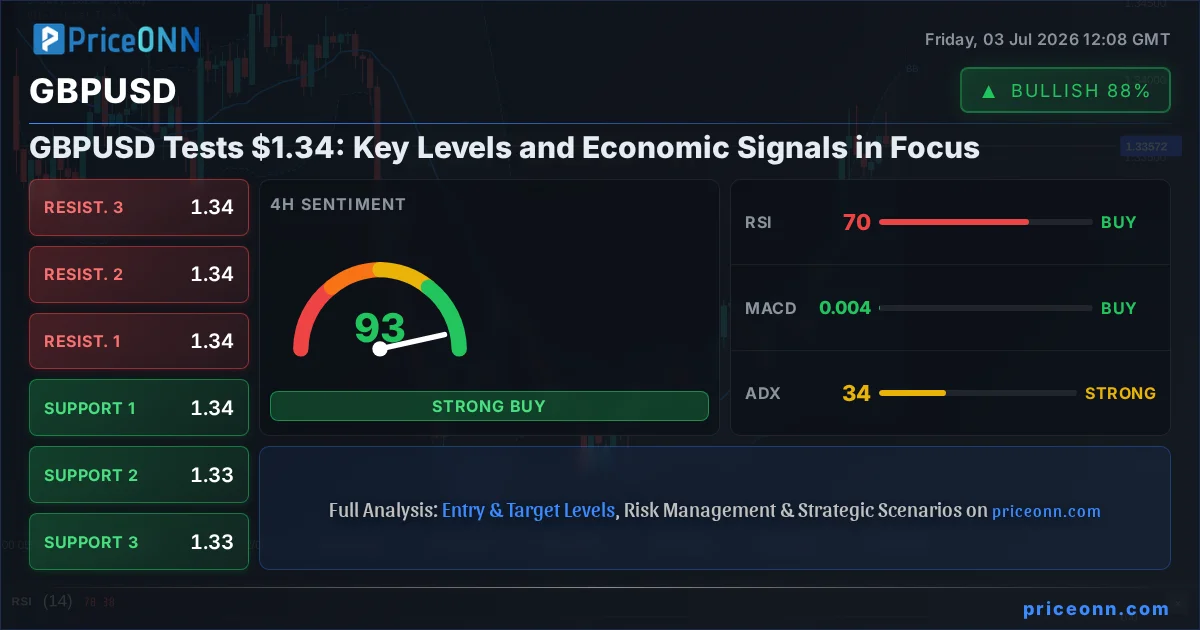
The recent US Nonfarm Payrolls report, which fell short of expectations, has injected a dose of volatility into currency markets, particularly impacting the GBP/USD pair. While the Sterling has managed to carve out gains above the 1.3350 level, its ascent appears constrained, remaining below the significant 100-day moving average. This juxtaposition highlights market uncertainty and the delicate balance of factors influencing major currency pairs.
The weaker US jobs data suggests a potential moderation in the Federal Reserve's aggressive rate-hiking path, which could weigh on the US Dollar's broader strength. This environment creates an opening for currencies like the Sterling to regain some footing. However, the fact that GBP/USD is still capped below its 100-day average indicates lingering caution among traders, possibly due to ongoing concerns about the UK's economic outlook or broader geopolitical risks.
Traders are now closely monitoring upcoming economic releases from both the US and the UK. Key levels to watch include the aforementioned 100-day moving average as a resistance point for GBP/USD, and the 1.3300 psychological level as a potential support. The interplay between US inflation data, Federal Reserve commentary, and Bank of England policy expectations will be crucial in determining the next directional move for Cable.
Track markets in real-time
Empower your investment decisions with AI-powered analysis, technical indicators and real-time price data.
Join Our Telegram Channel
Get breaking market news, AI analysis and trading signals delivered instantly to your Telegram.
Join Channel PriceONN News
USD/IDR inches lower after opening at a bullish gap, remaining in the positive territory for the fourth consecutive day, trading around 18,030 during the Asian hours on Thursday.
PriceONN News
The GBP/USD pair gains traction to near 1.3290 during the Asian trading hours on Thursday. The British Pound (GBP) strengthens against the US Dollar (USD) as the UK's likely next Prime Minister, Andy Burnham, has eased market concerns by pledging strict fiscal discipline.
PriceONN News
The GBP/JPY cross attracts fresh sellers in the vicinity of mid-215.00s and slides to the lower end of its daily range during the early European session on Friday.
PriceONN News
The AUD/JPY cross trades in positive territory around 111.75 during the early European trading hours on Friday. The Australian Dollar (AUD) strengthens against the Japanese Yen (JPY) following the Chinese economic data.
PriceONN News
USD/IDR gains ground after registering minor losses in the previous day, trading around 18,000 during the Asian hours on Friday. The pair appreciates as the US Dollar (USD) holds its position despite a disappointing set of domestic labor data released on Thursday.
PriceONN News
The NZD/USD pair gathers strength to around 0.5705 during the Asian trading hours on Friday. The New Zealand (NZD) remains strong following the Chinese economic data. The US markets will be closed on Friday in observance of Independence Day.
PriceONN News
The GBP/USD pair trades with mild gains near 1.3350 during the early Asian trading hours on Friday. The US Dollar (USD) edges lower against the British Pound (GBP) on a weaker-than-expected US Nonfarm Payrolls (NFP) report. The US markets will be closed on Friday in observance of Independence Day.
PriceONN News
Thursday belonged to the US Dollar, not the Aussie. A soft American payrolls print sent AUD/USD spiking toward 0.6950 on release, before it gave most of that back to close well off its high.
PriceONN News
USD/CAD has lost its recent gains from the previous day, trading around 1.4190 during the European hours on Thursday. Traders adopt a cautious stance ahead of the highly anticipated June Nonfarm Payrolls (NFP) report.
PriceONN News
USDJPY needs interventions and rate hikes. Monetary policy divergence is pushing EURUSD lower. The US dollar found no clues in Kevin Warsh’s comments, and attention shifted to the US labour market report for June. The Fed Chair noted a reduction in inflationary risks and reaffirmed the central bank’s commitment to bringing inflation back to the […] The post Will USDJPY Reach 200 Without Intervention? appeared first on ActionForex.
PriceONN News
Japan may not have spent a dollar today, but it may have achieved one of the key goals of intervention anyway. USD/JPY plunged from 162.59 to below 161.30, a move large enough to trigger immediate speculation that Tokyo had stepped into the market. There is no confirmation of actual intervention yet, but that may be […] The post USD/JPY’s 150 Pips Fall: A Tactical “Intervention” Masterclass by Japan Ahead of NFP appeared first on ActionForex.
PriceONN News
The Australian Dollar (AUD) remains practically flat against the US Dollar (USD) on Thursday, consolidating losses after having depreciated nearly 4% in June. The AUD/USD pair is trading within a broadly 65-pip range, with downside attempts contained at 0.6865 and bulls limited below 0.6930 so far.