
British Pound strengthens to near 1.3350 as cooling US labor market weighs US Dollar
 PriceONN Editorial Desk
Multi-source verification
PriceONN Editorial Desk
Multi-source verification
Sterling Edges Higher on US Economic Signals
The British Pound found a footing on Friday, climbing to approach 1.3350 against the US Dollar in early Asian trading. This upward movement was largely fueled by a key economic release from the United States that painted a picture of a cooling labor market. With US financial markets observing Independence Day, trading volumes are expected to be subdued, potentially amplifying currency movements on lighter liquidity.
Recent employment figures released for the US fell short of expectations, a development that typically weighs on the dollar. For traders watching the GBP/USD pair, often referred to as 'Cable', this data point provided the impetus for the Sterling's gains. The contrast between a US economy showing signs of a slowdown and a potentially more stable outlook elsewhere has become a significant driver for currency pairs.
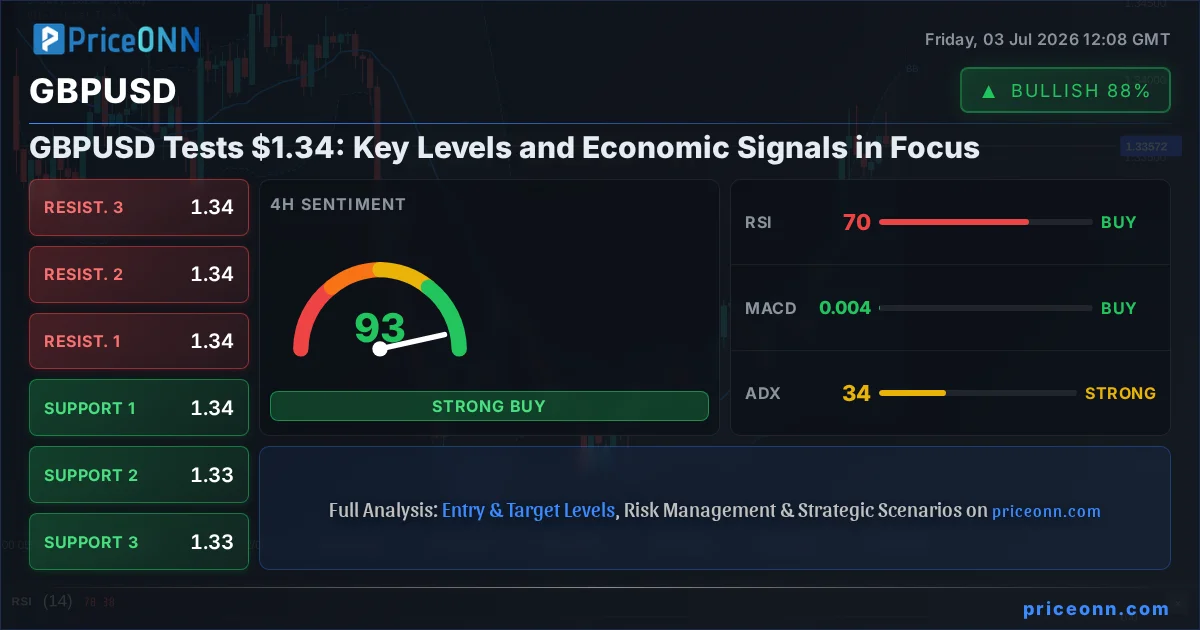
Understanding the Pound's Foundations
The British Pound, a currency with a history stretching back to 886 AD, stands as the official tender of the United Kingdom. It holds a prominent position in global foreign exchange markets, ranking as the fourth most actively traded currency. Data from 2022 indicates it participates in approximately 12% of all transactions, with daily volumes averaging a substantial $630 billion. Its most significant trading partners are the US Dollar, forming the 'Cable' pair which accounts for 11% of all FX trades, the Japanese Yen (the 'Dragon', 3%), and the Euro (2%).
The Bank of England (BoE) is the institution responsible for issuing the Pound. The core determinant of the Sterling's value is the monetary policy enacted by the BoE. This policy is primarily shaped by the central bank's objective to maintain "price stability," defined as an inflation rate hovering around 2%. The primary instrument used to achieve this target is the manipulation of interest rates.
When inflation trends too high, the BoE typically responds by increasing interest rates. This action makes borrowing more expensive for individuals and businesses, serving as a brake on economic activity. From an investment perspective, higher interest rates can make the UK a more attractive destination for international capital seeking yield, thereby supporting the GBP.
Conversely, a persistent decline in inflation can signal an economic slowdown. In such scenarios, the BoE might consider reducing interest rates to stimulate borrowing and encourage investment in growth-oriented ventures. Economic indicators serve as vital gauges of the economy's health and can directly influence the Sterling's trajectory. Key metrics like Gross Domestic Product (GDP), Purchasing Managers' Indexes (PMIs) for manufacturing and services sectors, and employment data all play a role in shaping the GBP's direction.
A robust domestic economy generally bolsters the Pound. It not only attracts foreign investment but can also prompt the BoE to adopt a tighter monetary stance through interest rate hikes, which directly enhances the currency's strength. Conversely, weaker economic data often leads to a depreciation of the Sterling.
Reading Between the Lines
The recent US Nonfarm Payrolls report showing a softer-than-expected outcome is a critical signal for global markets. While it directly pressured the US Dollar, creating an opportunity for pairs like GBP/USD to advance, it also prompts a broader assessment of global economic momentum. Investors will be closely watching how other major central banks, particularly the Bank of England, react to this evolving global economic landscape. The implications extend beyond just currency trading, potentially influencing equity markets and commodity prices as risk appetite shifts.
The divergence in economic performance and monetary policy expectations between major economies like the US and the UK is a key theme to monitor. For traders, this means paying close attention to upcoming UK economic data, such as inflation reports and employment figures, as well as any forward guidance from the BoE. The market's reaction to the US jobs data highlights the sensitivity of currency markets to employment statistics, which are seen as a direct indicator of economic health and a significant factor in central bank decision-making.
The upcoming trade balance figures for the UK also warrant attention. A consistent surplus in the UK's trade balance, indicating that exports are outpacing imports, would provide further underlying support for the Sterling. Conversely, a widening deficit could introduce headwinds, especially if global demand for UK exports falters. The interplay between domestic economic strength, central bank policy, and international trade flows will continue to dictate the path of the Pound Sterling in the coming weeks and months.
Track markets in real-time
Empower your investment decisions with AI-powered analysis, technical indicators and real-time price data.
Join Our Telegram Channel
Get breaking market news, AI analysis and trading signals delivered instantly to your Telegram.
Join Channel PriceONN News
The Australian Dollar (AUD) remains practically flat against the US Dollar (USD) on Thursday, consolidating losses after having depreciated nearly 4% in June. The AUD/USD pair is trading within a broadly 65-pip range, with downside attempts contained at 0.6865 and bulls limited below 0.6930 so far.
PriceONN News
EUR/GBP may have passed a turning point that extends well beyond this week’s inflation data. The sharp break below key technical support reflects more than a softer Eurozone CPI report-it signals that one of the market’s biggest policy trades of recent months is beginning to unwind, and intensifying. Investors are no longer betting that the […] The post EUR/GBP Accelerates Through Key Support as ECB/BoE Yield Convergence Trade Reverses appeared first on ActionForex.
PriceONN News
GBPUSD continues to show an incomplete bearish sequence from the January 27, 2026 high, keeping the bias tilted lower. The potential target can be measured using the 100% to 161.8% Fibonacci extension from that peak. This calculation defines a zone between 1.252 and 1.295, which remains the key area of interest for traders. The near‑term […] The post GBPUSD Elliott Wave Bearish Structure Calls for Further Weakness appeared first on ActionForex.
PriceONN News
The GBP/USD pair gains traction to near 1.3290 during the Asian trading hours on Thursday. The British Pound (GBP) strengthens against the US Dollar (USD) as the UK's likely next Prime Minister, Andy Burnham, has eased market concerns by pledging strict fiscal discipline.
PriceONN News
UK business activity weakened further in June as the services sector recorded its sharpest contraction in nearly three and a half years, highlighting a loss of economic momentum during the second quarter. The final S&P Global UK Services PMI Business Activity Index fell to 48.8 from 49.3 in May, its lowest reading since January 2023. […] The post UK Services PMI Falls to Lowest Since 2023 as Demand Weakens Despite Cooling Cost Pressures appeared first on ActionForex.
PriceONN News
The GBP/JPY cross attracts fresh sellers in the vicinity of mid-215.00s and slides to the lower end of its daily range during the early European session on Friday.
PriceONN News
The GBP/USD pair trades in positive territory around 1.3360 during the early European session on Friday. The British Pound (GBP) gathers strength against the US Dollar (USD) on a weaker-than-expected US Nonfarm Payrolls (NFP) report.
PriceONN News
The AUD/JPY cross trades in positive territory around 111.75 during the early European trading hours on Friday. The Australian Dollar (AUD) strengthens against the Japanese Yen (JPY) following the Chinese economic data.
PriceONN News
USD/IDR gains ground after registering minor losses in the previous day, trading around 18,000 during the Asian hours on Friday. The pair appreciates as the US Dollar (USD) holds its position despite a disappointing set of domestic labor data released on Thursday.
PriceONN News
The NZD/USD pair gathers strength to around 0.5705 during the Asian trading hours on Friday. The New Zealand (NZD) remains strong following the Chinese economic data. The US markets will be closed on Friday in observance of Independence Day.
PriceONN News
Thursday belonged to the US Dollar, not the Aussie. A soft American payrolls print sent AUD/USD spiking toward 0.6950 on release, before it gave most of that back to close well off its high.
PriceONN News
USD/CAD has lost its recent gains from the previous day, trading around 1.4190 during the European hours on Thursday. Traders adopt a cautious stance ahead of the highly anticipated June Nonfarm Payrolls (NFP) report.