
New Zealand Dollar remains firm above 0.5700 after Chinese services PMI data
 PriceONN Editorial Desk
Multi-source verification
PriceONN Editorial Desk
Multi-source verification

Asian Session Strength for the Kiwi
The New Zealand Dollar (NZD), affectionately known as the Kiwi, demonstrated a firm footing above the 0.5700 handle early Friday. This upward momentum materialized as trading commenced in the Asian session, with the pair gathering strength to hover around 0.5705. The currency's performance was significantly influenced by the release of China's services Purchasing Managers' Index (PMI), which offered a more optimistic economic outlook for New Zealand's largest trading partner.
In a quiet trading environment for North American participants, with US markets closed for Independence Day, the focus remained squarely on Asian economic indicators. The resilience of the NZD/USD pair underscores the currency's sensitivity to external economic health, particularly from its key trading ally, China. Investors are closely watching how these developments might shape the currency's trajectory in the coming sessions.
Understanding the Kiwi's Drivers
The valuation of the New Zealand Dollar is intrinsically linked to a confluence of domestic and international factors. At its core, the health of the New Zealand economy and the monetary policy stance of the Reserve Bank of New Zealand (RBNZ) are primary determinants. However, unique global economic relationships also play a critical role. China's economic performance is a major influence; as New Zealand's foremost trading partner, any downturn in the Chinese economy typically translates to reduced export demand for Kiwi goods. This directly impacts New Zealand's export revenues, subsequently weighing on the national currency.
Furthermore, global dairy prices represent another significant lever for the NZD. The dairy sector forms the backbone of New Zealand's export earnings. Robust dairy prices translate into a higher influx of foreign currency, bolstering the nation's economic standing and, by extension, strengthening the Kiwi. The RBNZ's mandate to maintain inflation between 1% and 3% is central to its interest rate decisions. When inflation trends higher than the desired midpoint of 2%, the RBNZ may hike interest rates to temper economic activity. Higher interest rates can attract foreign capital seeking better yields, thereby boosting the NZD. Conversely, a reduction in interest rates typically exerts downward pressure on the currency.
The 'rate differential' – the gap between New Zealand's interest rates and those set by major central banks like the US Federal Reserve – is also a key consideration for NZD/USD traders. Shifts in this differential can significantly influence capital flows and currency valuations. Domestically, macroeconomic data releases from New Zealand are paramount. Strong economic growth, coupled with low unemployment and high business confidence, generally supports the Kiwi. Such conditions can attract foreign investment and, if accompanied by rising inflation, may prompt the RBNZ to tighten monetary policy, further supporting the currency. Weak economic data, conversely, often leads to NZD depreciation.
The New Zealand Dollar also exhibits a distinct behavior during different market sentiment phases. It tends to perform well during 'risk-on' periods, when investor optimism about global growth is high and perceived market risks are subdued. This environment is typically favorable for commodities and commodity-linked currencies like the Kiwi. However, during times of heightened market volatility or economic uncertainty, investors often divest from riskier assets and seek refuge in safer havens, causing the NZD to weaken.
Reading Between the Lines
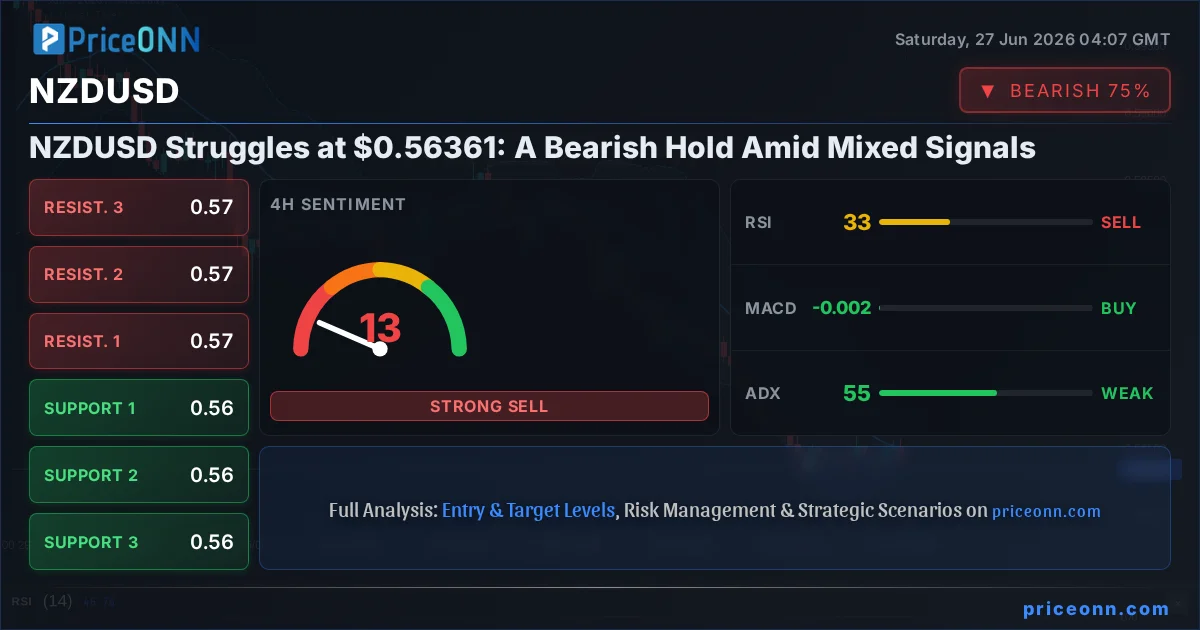
The latest uptick in the NZD/USD pair, pushing it above 0.5700, is a clear signal that market sentiment is currently favoring the Kiwi, at least in the short term. The positive interpretation of China's services PMI data appears to be the primary catalyst, overshadowing other potential headwinds. This suggests that traders are prioritizing growth signals from major trading partners. The fact that US markets are closed means liquidity might be thinner, potentially amplifying any existing price movements. The resilience of the Kiwi, even with broader global economic uncertainties, highlights its sensitivity to specific trade partner data. This suggests that for the NZD, localized and regional economic news can often take precedence over global risk sentiment, particularly when major trading partners show signs of stabilization or recovery.
Looking ahead, the focus will remain on how this positive sentiment from Chinese data translates into sustained buying pressure for the New Zealand Dollar. Traders will also be monitoring upcoming domestic data releases from New Zealand and any shifts in global risk appetite as US markets reopen. The interplay between commodity prices, particularly dairy, and RBNZ policy expectations will continue to be critical factors in determining the Kiwi's path forward. The current price action indicates a short-term bullish bias, but the sustainability of this move will depend on a broader set of economic indicators.
Track markets in real-time
Empower your investment decisions with AI-powered analysis, technical indicators and real-time price data.
Join Our Telegram Channel
Get breaking market news, AI analysis and trading signals delivered instantly to your Telegram.
Join Channel PriceONN News
The GBP/JPY cross attracts fresh sellers in the vicinity of mid-215.00s and slides to the lower end of its daily range during the early European session on Friday.
PriceONN News
To achieve its development ambitions, China’s industrial might must pay off for households. The first half of 2026 has highlighted China’s industrial strength, the trade surplus widening back to near record highs and investment in high-tech manufacturing and services continuing at pace while authorities’ strategic reserves and pro-active decision making offered robust protection against an […] The post China’s Greatest Opportunity and Biggest Threat appeared first on ActionForex.
PriceONN News
The GBP/USD pair trades in positive territory around 1.3360 during the early European session on Friday. The British Pound (GBP) gathers strength against the US Dollar (USD) on a weaker-than-expected US Nonfarm Payrolls (NFP) report.
PriceONN News
The AUD/JPY cross trades in positive territory around 111.75 during the early European trading hours on Friday. The Australian Dollar (AUD) strengthens against the Japanese Yen (JPY) following the Chinese economic data.
PriceONN News
USD/IDR gains ground after registering minor losses in the previous day, trading around 18,000 during the Asian hours on Friday. The pair appreciates as the US Dollar (USD) holds its position despite a disappointing set of domestic labor data released on Thursday.
PriceONN News
The GBP/USD pair trades with mild gains near 1.3350 during the early Asian trading hours on Friday. The US Dollar (USD) edges lower against the British Pound (GBP) on a weaker-than-expected US Nonfarm Payrolls (NFP) report. The US markets will be closed on Friday in observance of Independence Day.
PriceONN News
Thursday belonged to the US Dollar, not the Aussie. A soft American payrolls print sent AUD/USD spiking toward 0.6950 on release, before it gave most of that back to close well off its high.
PriceONN News
USD/CAD has lost its recent gains from the previous day, trading around 1.4190 during the European hours on Thursday. Traders adopt a cautious stance ahead of the highly anticipated June Nonfarm Payrolls (NFP) report.
PriceONN News
USDJPY needs interventions and rate hikes. Monetary policy divergence is pushing EURUSD lower. The US dollar found no clues in Kevin Warsh’s comments, and attention shifted to the US labour market report for June. The Fed Chair noted a reduction in inflationary risks and reaffirmed the central bank’s commitment to bringing inflation back to the […] The post Will USDJPY Reach 200 Without Intervention? appeared first on ActionForex.
PriceONN News
Japan may not have spent a dollar today, but it may have achieved one of the key goals of intervention anyway. USD/JPY plunged from 162.59 to below 161.30, a move large enough to trigger immediate speculation that Tokyo had stepped into the market. There is no confirmation of actual intervention yet, but that may be […] The post USD/JPY’s 150 Pips Fall: A Tactical “Intervention” Masterclass by Japan Ahead of NFP appeared first on ActionForex.
PriceONN News
The Australian Dollar (AUD) remains practically flat against the US Dollar (USD) on Thursday, consolidating losses after having depreciated nearly 4% in June. The AUD/USD pair is trading within a broadly 65-pip range, with downside attempts contained at 0.6865 and bulls limited below 0.6930 so far.
PriceONN News
The British Pound (GBP) trades higher against its major currency peers, rising 0.1% to near 1.3290 against the US Dollar (USD) during the European trading session on Thursday.