
EUR/USD Starts the Week Quietly
 PriceONN Editorial Desk
Multi-source verification
PriceONN Editorial Desk
Multi-source verification

Market Stasis Amidst Geopolitical Crosscurrents
The opening hours of the trading week saw the EUR/USD currency pair hovering around the 1.1600 mark. Last week concluded with minimal movement for this primary exchange rate, leaving it virtually flat. Global financial arenas are intensely focused on developments emanating from the Middle East. A delicate dance of signals between the United States and Iran, despite the backdrop of considerable regional uncertainty, has paradoxically fanned the embers of hope for a diplomatic resolution among investors.
However, this flicker of optimism contends with a more tangible economic reality. Crude oil prices continue to exert significant upward pressure, remaining approximately 50% higher than their pre-conflict benchmarks. This sustained price shock is a potent contributor to ongoing inflationary concerns. Consequently, major global monetary authorities are compelled to tread with extreme caution regarding their policy stances. Recent minutes from the Federal Open Market Committee (FOMC) indicate a prevailing sentiment among most Federal Reserve officials: the possibility of further interest rate increases has not been ruled out, especially if inflation metrics stubbornly refuse to recede towards the desired 2% target.
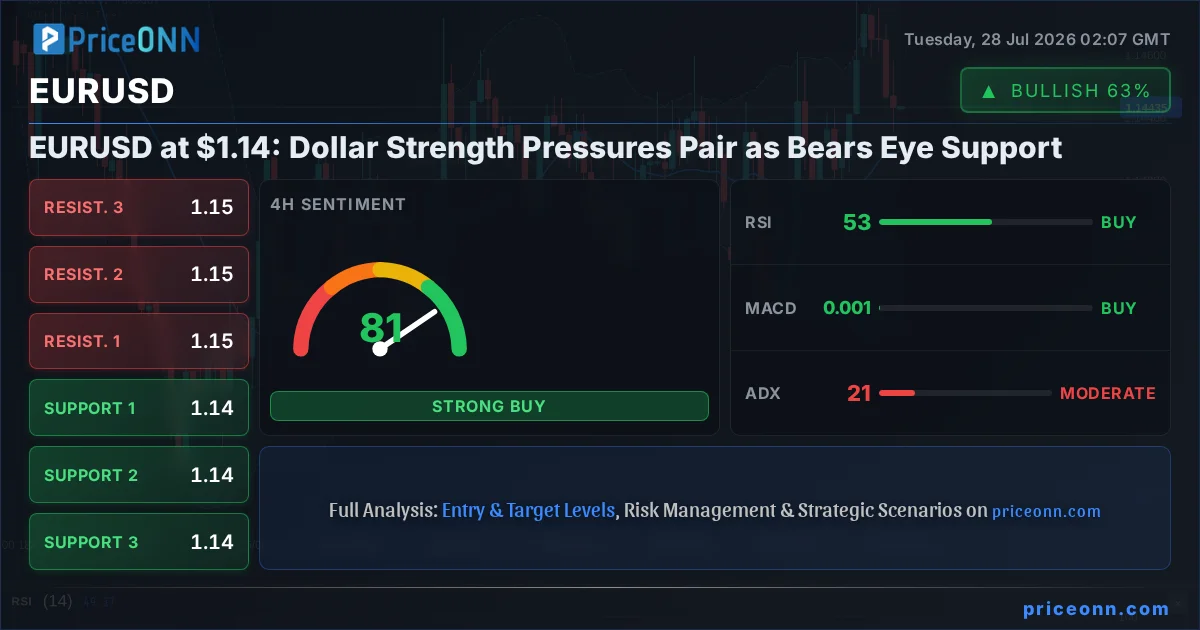
The financial markets are increasingly incorporating the probability of a 25-basis-point rate adjustment by the US central bank before the year concludes. Adding to the subdued sentiment for Monday, US financial markets are observing a public holiday, which is widely expected to dampen volatility across major currency pairs, including EUR/USD.
Reading Between the Lines
The current price action in EUR/USD reflects a market caught in a delicate equilibrium. Hopes for a de-escalation in Middle Eastern tensions are battling against the stubborn reality of high energy costs and their inflationary ripple effects. While diplomatic overtures, however tentative, can provide short-term relief to risk sentiment, the persistent elevation of oil prices presents a structural challenge to price stability.
This dynamic directly impacts central bank policy. The Federal Reserve's hawkish undertones, revealed in the FOMC minutes, suggest a commitment to combating inflation even at the risk of slowing economic growth. The market's pricing of a potential rate hike further underscores this stance. For traders, the key is to watch for any definitive shifts in the geopolitical landscape or concrete inflation data that could sway central bank decisions. The current consolidation suggests a market awaiting a clearer directional signal.
From a technical standpoint, the near-term outlook presents a mixed picture. The H4 chart analysis suggests a potential dip towards 1.1600, possibly extending to 1.1555, before any significant upward retracement towards 1.1660 could materialize. The MACD indicator's upward trajectory on the H4 chart offers a counterpoint, hinting at underlying bullish momentum. Conversely, the H1 chart's Stochastic oscillator points lower, suggesting immediate selling pressure is more probable. This divergence in technical signals reinforces the theme of indecision in the current market environment.
Market Ripple Effects
The interplay between geopolitical stability, energy prices, and monetary policy in the US has broader implications. The elevated oil prices, a direct consequence of the Middle East situation, not only fuel inflation but also directly impact commodity-linked currencies such as the Canadian Dollar (CAD). A sustained high-price environment for oil could lead to further weakness in the USD against the CAD, assuming other factors remain constant.
Furthermore, the anticipation of continued hawkishness from the Federal Reserve, as indicated by the FOMC minutes and market pricing, could bolster the strength of the US Dollar Index (DXY) against a basket of major currencies, particularly those with more dovish central banks. This could create headwinds for the Euro, potentially pushing EUR/USD lower if risk sentiment sours or if European economic data disappoints.
Investors and traders will also be observing the performance of global equity markets. While hopes for a diplomatic breakthrough might temporarily boost sentiment, persistent inflation and the threat of further rate hikes can weigh on risk assets. This could manifest as increased volatility in indices like the S&P 500, creating a risk-off environment that typically favors safe-haven assets and puts downward pressure on riskier currencies.
Track markets in real-time
Empower your investment decisions with AI-powered analysis, technical indicators and real-time price data.
Join Our Telegram Channel
Get breaking market news, AI analysis and trading signals delivered instantly to your Telegram.
Join Channel PriceONN News
The ceasefire in the Middle East has disrupted the greenback’s plans. Strong PMI data and falling oil prices are helping the euro. The US dollar faced a downward gap at the start of the week as the Middle East de-escalation of the conflict came as an unwelcome surprise to speculators who had built up net […] The post De-Escalation Undermines the Greenback appeared first on ActionForex.
PriceONN News
EUR/USD enters the final week of July at 1.1369. Friday’s modest decline in energy prices reduced expectations that the Federal Reserve could raise rates as early as its upcoming meeting, scheduled for Tuesday and Wednesday. At the same time, the main currency pair remains very close to the monthly low recorded in late June. Markets […] The post EUR/USD Ahead of a Key Week: Holding Near Lows appeared first on ActionForex.
PriceONN News
On 21 July, Stats NZ reported an acceleration in inflation: the Consumer Price Index rose 1.5% in the second quarter, while the annual inflation rate climbed to 4.1%, its highest level in more than two years and slightly above analysts’ consensus forecast of 4.0%. The increase was driven primarily by higher fuel prices amid tensions […] The post NZD/USD: Inflation Surge Meets Strong US Dollar Pressure appeared first on ActionForex.
PriceONN News
Gold fell to 4,047 USD per ounce on Tuesday, erasing gains from the previous session. Pressure on the metal is mounting amid fears that the Federal Reserve may raise rates as early as this week. Markets currently estimate the probability of such a move on Wednesday at over 33% – an unusually high level of […] The post Gold Declines, Focus on Fed and Falling Oil Prices appeared first on ActionForex.
PriceONN News
The de-escalation of the conflict in the Middle East has sent Brent prices tumbling. The oil market could return to a surplus as early as the end of 2026. The US dollar and oil have lost their correlation. Brent recorded its worst daily fall in three months after reports of a ceasefire in the Middle […] The post Oil: A Surplus on the Horizon appeared first on ActionForex.
PriceONN News
I am already riding two EURUSD sell entries. Another possible sell opportunity could be forming for traders that are not in yet. EURUSD Possible Bearish Scenario Watch for price to tap 4 Hour FVG (Purple) first. Watch for a bearish shift and bearish reversal signs in the FVG zone. Wait for all above to play […] The post Riding EURUSD Sellside appeared first on ActionForex.
PriceONN News
The US stock market is not factoring in the existing risks. Investors are increasingly focusing on the cash flows of S&P 500 companies. US stock indices have closed in the red the last two weeks, something that hasn’t happened since March. The stock market has weathered both the armed conflict in the Middle East and […] The post It’s Time to Weigh Up the Risks for the S&P 500 appeared first on ActionForex.
PriceONN News
The dollar heads into a pivotal week trading near 101.80, just off a 15-month high, with the Fed’s July 29 meeting standing as the clear focal point. Markets currently price roughly a 65% chance of a hold, though renewed Middle East escalation has kept a hike back on the table for later this year. Energy […] The post US Dollar Index: a Defining Week for the King of the Markets appeared first on ActionForex.
PriceONN News
European Central Bank Governing Council member Peter Kazimir from Slovak reinforced the hawkish bias on Monday, arguing that policymakers will likely need to raise interest rates at least once more and warning that a worsening energy shock could ultimately require even more tightening than markets currently anticipate. His remarks come just days after the ECB […] The post ECB’s Kazimir Sees At Least One More Rate Hike, Warns Oil Shock Could Require More appeared first on ActionForex.
PriceONN News
US business activity accelerated at the start of the third quarter, with S&P Global’s Flash Composite PMI Output Index rising from 51.9 to 53.6 in July, its highest level in eight months. The improvement was driven by the services sector, where the Business Activity Index climbed from 51.2 to 53.6, also an eight-month high. Manufacturing, […] The post US PMI Hits Eight-Month High,Yet Rising Costs and Supply Delays Raise Caution appeared first on ActionForex.
PriceONN News
Market Overview The crypto market trended lower at the end of Monday, mirroring the US equity market, as it fell from a peak of $2.23T to $2.16T before returning to recent local lows of $2.18T by Tuesday morning. This marks yet another test of the 50-day moving average (MA) as support, which sellers have been […] The post Bitcoin Has Failed to Break Away from Its Long-Term Trend appeared first on ActionForex.
PriceONN News
The Trump administration is weighing whether to extend access to some Chinese rare earth materials beyond the January 1, 2027 cutoff after U.S. producers acknowledged they cannot build sufficient domestic processing and magnet capacity before the deadline, Reuters reported on Monday. Industry executives and Pentagon suppliers told Reuters that U.S. processing and magnet manufacturing capacity remains insufficient to meet despite billions of dollars in federal support for new mines, separation...