
EUR/USD: US Inflation Will Determine Everything
 PriceONN Editorial Desk
Multi-source verification
PriceONN Editorial Desk
Multi-source verification
Market Pulse Awaits US Inflation Echoes
The EUR/USD currency pair is navigating choppy waters, opening the week trading around the 1.1433 mark. Global investors remain intently focused on the simmering geopolitical tensions in the Middle East, a persistent source of market unease. Earlier this week, oil prices experienced a notable pullback after an initial surge, spurred by indications that the United States and Iran might resume peace discussions. Yet, the fragile calm was shattered by fresh exchanges of fire between the involved parties, reigniting fears of a potential escalation and casting doubt over the sustainability of the existing ceasefire.
These resurgent hostilities have reawakened concerns about a potential resurgence of inflationary pressures. This development is bolstering expectations for further monetary tightening from the Federal Reserve. Current market pricing suggests a 62% probability of a rate hike in September, a slight increase from 58% a week prior, though this figure had briefly climbed above 70% mid-week. Adding another layer to the inflation narrative, New York Federal Reserve President John Williams highlighted the significant role of burgeoning demand, particularly that fueled by advancements in artificial intelligence technology, as a key contributor to the inflationary landscape in the United States.
The Critical CPI Crossroads
This week's economic calendar is dominated by a single, high-impact event: the release of the US Consumer Price Index (CPI) for June. The implications for the EUR/USD pair are stark and bifurcated. Should the inflation data print higher than anticipated, it would strongly reinforce the Federal Reserve's inclination to maintain its restrictive monetary policy. Such an outcome would likely provide a substantial tailwind for the US dollar, pushing the exchange rate lower.
Conversely, a CPI report that falls short of market expectations would significantly alter the calculus. Weaker inflation figures would intensify pressure on the US dollar, prompting traders and investors to recalibrate their expectations. The market would then begin to price in a more dovish monetary policy trajectory from the Fed, potentially paving the way for a rebound in the euro against the greenback.
Technical Undercurrents Signal Caution
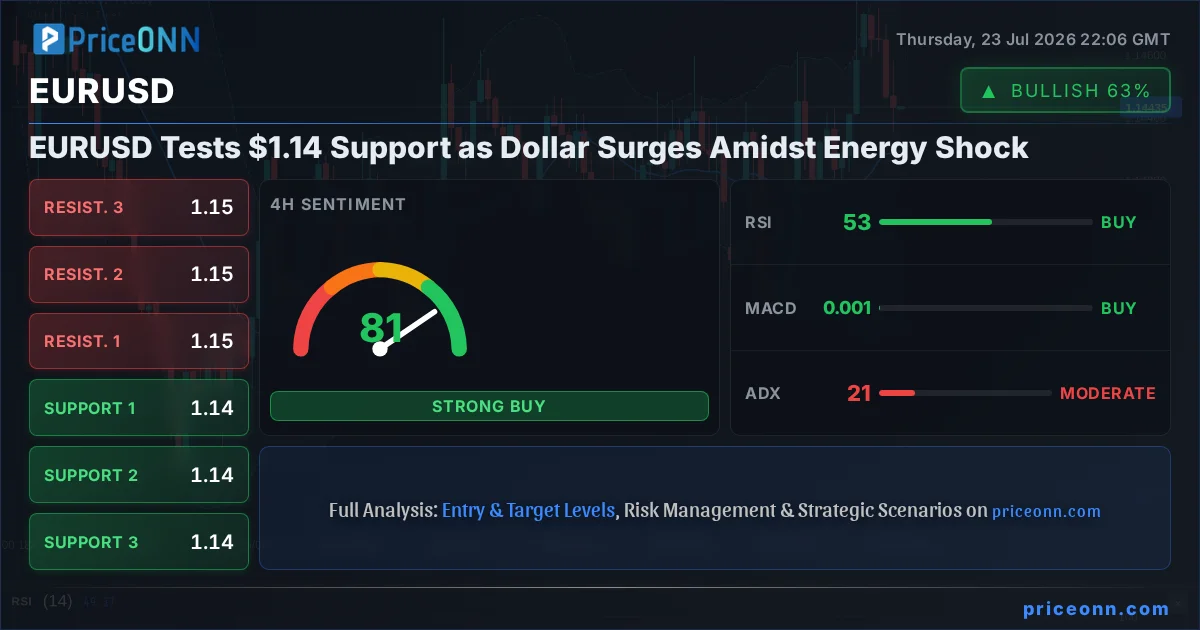
Examining the EUR/USD pair through a technical lens reveals a complex picture. On the 4-hour chart, the market appears to be locked in a consolidation pattern, oscillating within a tight range roughly between 1.1388 and 1.1410. This period of indecision is nearing a conclusion.
An upward breach of this range could signal the initiation of a corrective rally, potentially targeting the 1.1450 level, before a subsequent decline towards 1.1260. Alternatively, a decisive break below the current consolidation zone would open the door for a more significant downward move, with 1.1260 serving as a key psychological and technical target. The MACD indicator on this timeframe supports a bearish bias; while its signal line hovers above zero, its downward trajectory suggests that bearish momentum is building, potentially driving prices lower.
Further granularity is provided by the 1-hour chart. Here, the pair recently completed a modest upward move to approximately 1.1412. A consolidation range is now forming below this recent high. Today's trading session is anticipated to see range expansion, with potential movements towards 1.1366 on the downside and 1.1400 on the upside, before a projected decline toward the 1.1260 objective. The Stochastic oscillator on the H1 chart also points to a potential short-term reversal, with its signal line moving upwards towards 80, but the underlying expectation remains for a subsequent fall to lower levels.
Reading Between the Lines
The current price action in EUR/USD reflects a market in holding pattern, primarily dictated by anticipation of crucial US inflation data. Geopolitical instability in the Middle East continues to inject an element of risk aversion, with conflicting developments – peace overtures juxtaposed with military actions – keeping market participants on edge. The renewed tensions have, perhaps counterintuitively, amplified inflation expectations, nudging up the probability of a September Federal Reserve rate hike, despite a mid-week softening of this sentiment.
The commentary from NY Fed President Williams regarding AI's role in demand-driven inflation adds a fascinating, forward-looking dimension to the inflation debate. The upcoming CPI release is the linchpin; a hotter-than-expected report could solidify the dollar's strength, while a cooler print might trigger a significant dollar sell-off. From a technical standpoint, the prevailing bearish sentiment for EUR/USD appears to be entrenched, with the 1.1260 level representing a significant medium-term downside target.
The interplay between geopolitical risk, inflation expectations, and central bank policy creates a complex environment. Traders are closely watching how these forces converge. The market's reaction to the US CPI data will be critical. A stronger-than-expected print could embolden the Fed to maintain its hawkish stance, offering support to the USDX, while potentially pressuring risk-sensitive assets like EUR/USD. Conversely, a weak inflation report might lead to a reassessment of Fed policy, potentially weakening the dollar and providing a boost to the Euro. The ongoing developments in the Middle East also warrant attention, as any significant escalation could trigger a flight to safe-haven assets, indirectly impacting currency pairs like USD/CAD if oil prices react sharply.
Track markets in real-time
Empower your investment decisions with AI-powered analysis, technical indicators and real-time price data.
Join Our Telegram Channel
Get breaking market news, AI analysis and trading signals delivered instantly to your Telegram.
Join Channel PriceONN News
EUR/USD rose to 1.1429 on Thursday, with the US dollar continuing its moderate decline from the previous session. The market is assessing rising inflation risks driven by elevated energy prices against a backdrop of weakening economic data, while seeking further signals on Federal Reserve policy. At next week’s meeting, the regulator is expected to keep […] The post EUR/USD Recovers as Dollar Weakens appeared first on ActionForex.
PriceONN News
EURUSD is rising on expectations of ‘hawkish’ rhetoric from the ECB. The rally in Brent crude and Treasury yields is not helping the US dollar. The US dollar has retreated, despite rising oil prices and the resulting increase in US Treasury yields. Houthi attacks on tankers in the Red Sea have heightened geopolitical risks and […] The post Euro Focuses on the ECB appeared first on ActionForex.
PriceONN News
EUR/CHF may already be telling investors what to expect from today’s European Central Bank meeting. The cross broke decisively above 0.9278 this week, extending its recent rally as surging oil prices revived inflation concerns across Europe. The move suggests markets have begun positioning for a relatively more hawkish ECB even though policymakers are almost universally […] The post EUR/CHF Rally Points to Hawkish ECB Hold as Oil Reignites Inflation Risks appeared first on ActionForex.
PriceONN News
We expect the Federal Reserve to remain on hold in the July meeting, in line with consensus. Markets price in 20-25% probability for a hike. Without new projections or forward guidance from Warsh, the focus will be on the vote split. We think the most likely outcome is 2-4 votes in favour of a hike. […] The post US – Fed Preview: A Divided Hold appeared first on ActionForex.
PriceONN News
The Japanese Yen tumbled to another four-decade low today, with USD/JPY breaking above the 163 mark as investors continued to unwind Yen positions against the backdrop of widening global yield differentials and surging energy prices. The move has once again thrust Japan’s currency policy into the spotlight, raising familiar questions over whether authorities will step […] The post Yen Hits Fresh 40-Year Low. Can Japan Still Defend Its Currency? appeared first on ActionForex.
PriceONN News
Gold traded around 4,080 USD per ounce on Wednesday, having risen nearly 2% the previous day. Investors continue to assess developments in the Middle East and the impact of elevated oil prices on inflation and interest rates. Donald Trump has played down the prospects of an imminent resumption of negotiations with Iran and warned of […] The post Gold Rises Amid Heightened External Risks appeared first on ActionForex.
PriceONN News
The Euro’s (EUR) modest upside attempt against the US Dollar (USD) witnessed during Wednesday’s Asian session has been short-lived. The EUR/USD pair was capped below 1.1420, before pulling back to levels a few pips above 1.1400 during the European trading session.
PriceONN News
The Japanese Yen (JPY) attracts significant bids against its major currency peers during the European trading session on Wednesday. The USD/JPY pair falls vertically to near 162.65, but quickly recovers some losses and rebounds to around 162.90.
PriceONN News
UK retail sales volumes jumped 1.0% mom in June, far exceeding expectations for a -0.3% mom decline, following an unrevised 1.2% mom increase in May. The stronger-than-expected performance points to resilient consumer demand despite elevated borrowing costs and persistent cost-of-living pressures. Retailers credited sales promotions and warm weather for boosting spending, particularly at online and […] The post UK Retail Sales Surge 1.0% mom as Online Spending Leads Broad-Based June Rebound...
PriceONN News
Germany’s GfK Consumer Climate edged down from -29.3 to -29.6 for August, highlighting that household confidence remains deeply depressed despite modest improvement in some underlying indicators. The slight deterioration was driven by weaker income expectations and a renewed rise in precautionary saving, offsetting gains in willingness to buy and economic expectations. Income expectations fell from […] The post Germany’s GfK Consumer Climate Slips to -29.6 as Income Outlook Weakens and Saving...
PriceONN News
TL;DR: Gold and Silver tumbled as markets returned to the oil-rates relationship that governed Q2, with Brent above $100 and 10-year Treasury yields above 4.7% restoring pressure on the metals - leaving their next move hostage to Trump’s binary decision on Iran. Why This Matters Gold and Silver tumbled as markets returned to trading precious […] The post Gold and Silver Tumble as Oil Link Returns; Trump’s Looming Decision on Iran Adds Binary Risk appeared first on ActionForex.
PriceONN News
Australia’s private sector gained momentum in July, with the S&P Global Flash Composite PMI rising from 50.4 to 52.6, its highest reading since the start of the year. The improvement was driven primarily by the services sector, where the Services PMI Business Activity Index climbed from 50.5 to 53.0, while Manufacturing PMI edged up from […] The post Australia PMI Composite Hits 2026 High at 52.6 as Domestic Demand Rebounds appeared first on ActionForex.