
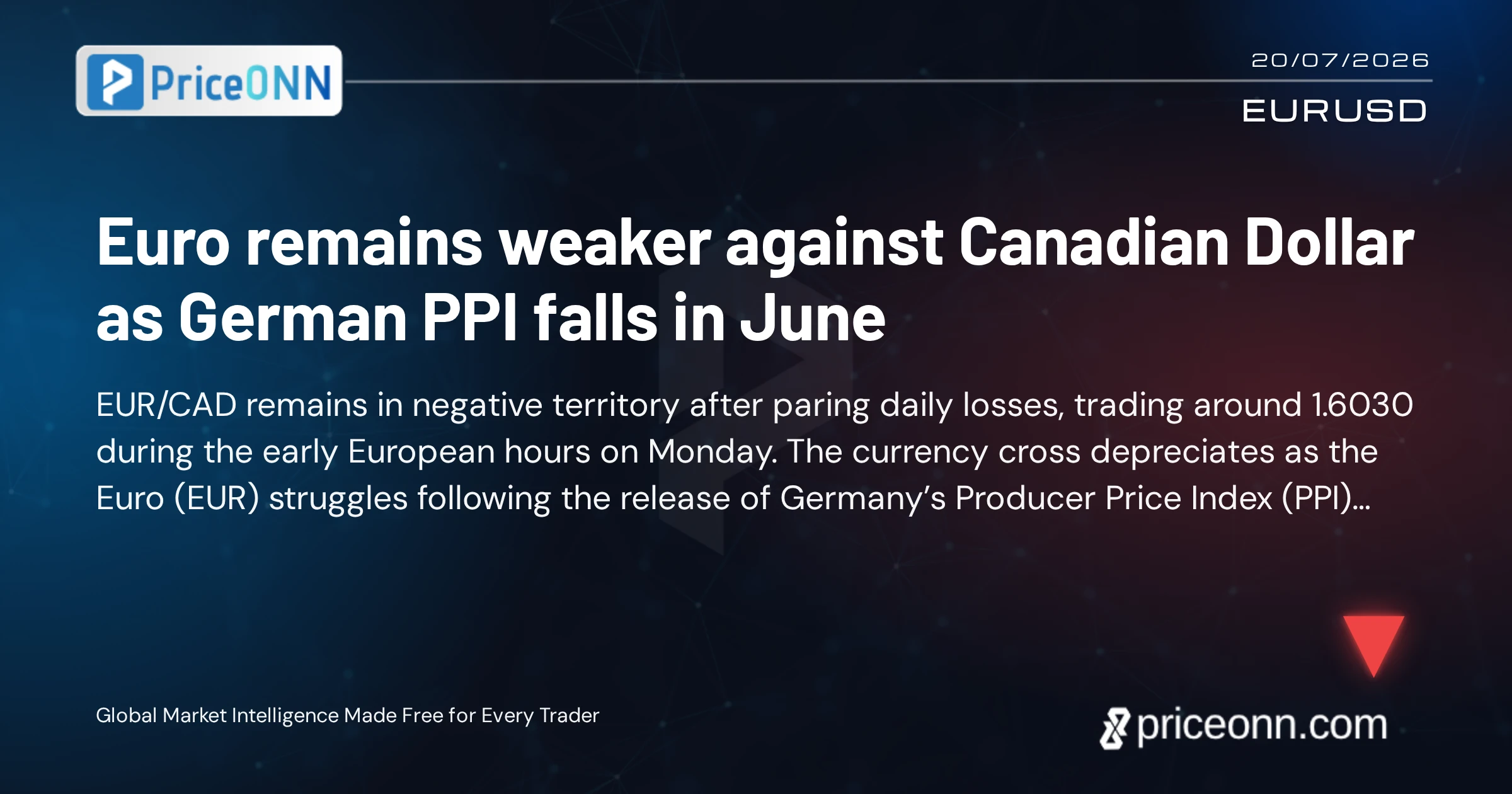
Euro remains weaker against Canadian Dollar as German PPI falls in June
 PriceONN Editorial Desk
Multi-source verification
PriceONN Editorial Desk
Multi-source verification
European Economic Signals Cast Shadow Over Euro
The Euro found itself on the defensive early Monday, trading at approximately 1.6030 against the Canadian Dollar. This pullback occurred after the pair managed to pare some of its earlier declines, a move that did little to alleviate pressure on the single currency. The catalyst for this weakness appears to be the latest economic readout from Europe's largest economy, Germany, which revealed a steeper than anticipated fall in its industrial costs.
Data released Monday showed that Germany's Producer Price Index (PPI) experienced a decline in June. This indicator, which tracks the average change over time in the selling prices received by domestic producers for their output, offers a crucial glimpse into inflationary pressures further up the supply chain. A significant contraction in producer prices can signal weakening demand, potential margin squeezes for businesses, and could, in turn, influence future consumer price inflation. The extent of this decline is a key point of attention for market observers.
The Eurozone's monetary policy, steered by the European Central Bank (ECB) in Frankfurt, remains a central theme for currency traders. The ECB's primary objective is to maintain price stability, a mandate that often translates to controlling inflation. Interest rate adjustments are their principal lever; higher rates typically bolster the Euro by attracting foreign capital seeking better returns, while lower rates can exert downward pressure.
The ECB's Governing Council convenes eight times annually to chart the course of monetary policy. Decisions are collectively made by the leaders of the Eurozone's national central banks and a core group of six permanent members, including ECB President Christine Lagarde. Inflation figures, specifically the Harmonized Index of Consumer Prices (HICP), are closely scrutinized. Should inflation accelerate beyond the ECB's 2% target, it creates a strong imperative for the bank to tighten policy through rate hikes.
Beyond inflation, the broader economic vitality of the Eurozone is paramount. Indicators such as Gross Domestic Product (GDP) growth, Purchasing Managers' Indexes (PMIs) for manufacturing and services sectors, employment statistics, and consumer confidence surveys all contribute to the overall narrative surrounding the single currency. A robust economic performance not only draws in international investment but also provides the ECB with greater latitude to implement interest rate increases, thereby strengthening the Euro. Conversely, weakening economic data typically leads to a depreciation of the Euro.
The economic health of the four largest Eurozone economies – Germany, France, Italy, and Spain – carries disproportionate weight, collectively representing approximately 75% of the bloc's economic output. Consequently, significant data releases from these nations are watched with heightened intensity. Another vital metric for the Euro is the Trade Balance, which quantifies the disparity between a nation's export earnings and its import expenditures. A surplus in the trade balance, driven by strong demand for a country's exports from international buyers, naturally enhances the currency's value.
Market Ripple Effects
The persistent weakness in the Euro, underscored by the disappointing German PPI figures, presents a complex picture for related markets. The immediate impact is felt in the EUR/CAD cross, which continues to trade under pressure. This suggests that the Canadian Dollar is finding underlying strength, potentially supported by factors not directly linked to European economic woes, such as commodity prices or diverging monetary policy expectations between the Bank of Canada and the ECB.
Traders will be closely monitoring the reaction of the European Central Bank. While a single PPI print might not immediately alter policy, a pattern of weakening industrial costs could feed into broader inflation concerns, potentially tempering expectations for aggressive rate hikes in the medium term. This could create headwinds for the Euro against a basket of currencies, including the US Dollar (USD), especially if the Federal Reserve maintains a more hawkish stance.
Furthermore, the implications extend to European equities. Companies heavily reliant on domestic demand or those with significant export exposure within the Eurozone might see their valuations affected by the economic sentiment signaled by the PPI data. Investors might pivot towards safer havens or currencies perceived as more resilient. The current trading environment highlights the sensitivity of currency markets to national economic indicators within a currency bloc.
Key levels to watch for EUR/CAD include the recent lows around 1.6000. A decisive break below this psychological barrier could trigger further downside, while a sustained recovery above 1.6050 might indicate a temporary stabilization. The market's focus will also be on upcoming inflation data from the Eurozone and any forward guidance from ECB officials regarding their policy outlook.
Track markets in real-time
Empower your investment decisions with AI-powered analysis, technical indicators and real-time price data.
Join Our Telegram Channel
Get breaking market news, AI analysis and trading signals delivered instantly to your Telegram.
Join Channel PriceONN News
The Consumer Price Index (CPI) rose by 0.1% month-on-month (m/m) in July – in line with expectations. On a twelve-month basis, CPI edged down to 3.4% (from 3.5% in June). Energy costs fell by 1.5% m/m, led by a 2.9% m/m decline in prices at the pump. Food prices rose 0.1% m/m – its softest […] The post US: Inflationary Pressures Remain Subdued in July appeared first on ActionForex.
PriceONN News
US inflation eased as expected in July, reinforcing case for Fed to stay on hold while it waits for clearer evidence on both prices and labor market. Headline CPI rose from -0.4% to 0.1% m/m, while annual rate slowed from 3.5% y/y to 3.4%. Core CPI increased from 0.0% to 0.2% m/m, with annual core […] The post US CPI Slows to 3.4% as Core Inflation Eases to 2.5% appeared first on ActionForex.
PriceONN News
Whatever the inflation figures may be, the precious metal will come out on top. Japan and the US don’t want to give the yen’s fate to speculators. The US dollar continues to recover from the blow dealt by the labour market statistics. A rally in Treasury bond yields is driving the rise in the USD […] The post Gold as a Sure-Fire Bet appeared first on ActionForex.
PriceONN News
Germany’s benchmark index just made history, breaking above 26,500 for the first time ever, extending a rally that has already delivered close to 10% over the past twelve months. The move came on fresh optimism around a potential resolution to the Iran conflict, though that optimism proved short-lived: President Trump’s latest demands, that Tehran compensate […] The post DAX 40: Record Highs, Real Fundamentals, One Channel Left to Test appeared first on ActionForex.
PriceONN News
Brent oil price rose to the highest in over one week on Tuesday, in extension of Monday’s nearly 5% advance, following the latest verbal escalation by President Trump that quickly changed the sentiment and countered efforts of Iran and Oman to find solution for reopening of strategic Hormuz strait. The latest demands from President Trump […] The post Brent Oil Price Falls After Recovery Failed to Clear Important $90 Barrier appeared first on ActionForex.
PriceONN News
Hello fellow traders. In this technical article we’re going to take a look at the Elliott Wave charts charts of Copper (HG_F) commodity published in members’ area of the website. As our members know, Copper Futures recently completed a pullback that provided a high-probability trading setup. The decline unfolded as a clear Elliott Wave Zig […] The post Copper (Hg_F) Elliott Wave: Targeting a Buy at the Blue Box appeared first on ActionForex.
PriceONN News
The NFIB’s Small Business Optimism Index rose 2.4 points to 99.8 in July, soundly beating expectations for a roughly flat reading of 97.5. Eight out of the ten index subcomponents improved during the month and two deteriorated. The largest improvement came from the net share of firms planning to increase employment (up 9 points to […] The post US: Small Business Optimism Spiked in July appeared first on ActionForex.
PriceONN News
Overnight, the RBA held its cash rate steady at 4.35%, as widely expected after June’s inflation data came in softer than forecast at 3.8% headline. Yet the accompanying statement struck a notably cautious tone, warning that trimmed mean inflation remains elevated and largely unchanged from the March quarter, with oil and related commodities still trading […] The post EUR/AUD: Two Central Banks on Hold, One Triangle About to Break appeared first on ActionForex.
PriceONN News
A deal to reopen the Strait of Hormuz is not inevitable. Oil prices are rising amid growing risks of an escalation of the conflict in the Middle East. The US dollar continued to recover from losses caused by the jobs report, against a backdrop of rising geopolitical tensions in the Middle East with traders squaring […] The post Brent Is Following a Path of Demands Rather Than Commitments appeared first on ActionForex.
PriceONN News
Gold rose to 4,400 USD per ounce on Tuesday, reaching a two-month high. Demand for the precious metal is growing rapidly, even amid heightened inflation risks and expectations of higher interest rates driven by elevated oil prices. Chinese institutional investors continue to build positions in gold as a defensive asset amid heightened volatility in other […] The post Gold Rallies: Long-Awaited Rise and Growing Safe-Haven Demand appeared first on ActionForex.
PriceONN News
RBA on hold as expected, recognising the data has broken against its hawkish narrative. Base case clearly an extended period on hold, but RBA will hike if upside risks to inflation materialise. As widely expected, the RBA Monetary Policy Board (MPB) kept the cash rate on hold at 4.35% at its August meeting. The accompanying […] The post RBA Holds at 4.35%, Narrows Risk of Hikes appeared first on ActionForex.
PriceONN News
Easing concerns over the situation in the Strait of Hormuz provided support for risk-sensitive assets. On 8 August, the Iranian side reported progress in talks with Oman over a possible new route through the strait, although the implementation of any agreement remains dependent on additional conditions. Reduced concerns over potential disruptions to energy supplies helped […] The post Ethereum Analysis: Attempted Breakout from the Sideways Structure appeared first on ActionForex.