
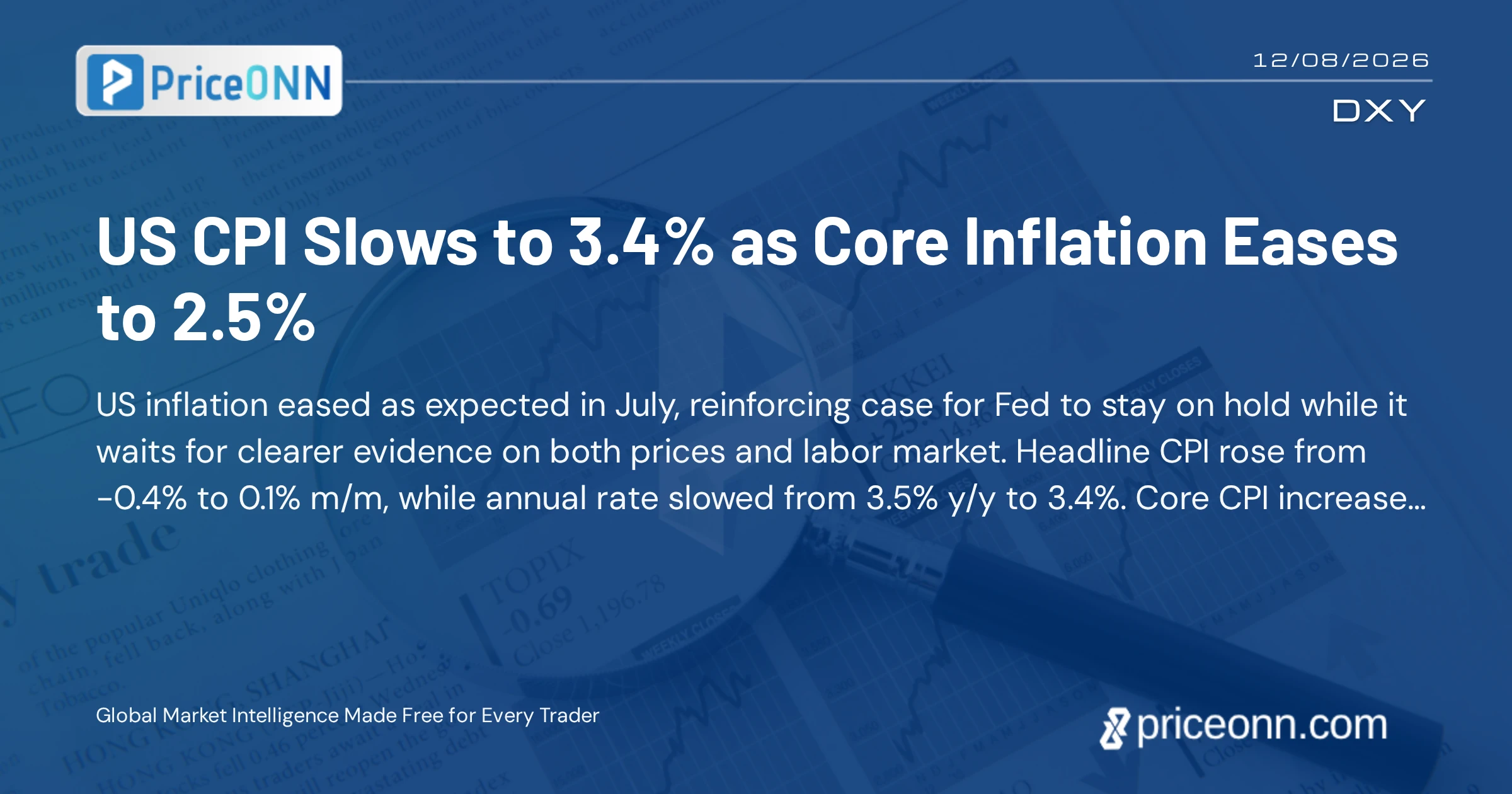
US CPI Slows to 3.4% as Core Inflation Eases to 2.5%
 PriceONN Editorial Desk
Multi-source verification
PriceONN Editorial Desk
Multi-source verification
Headline Inflation Moderates as Expected
The United States witnessed a welcome deceleration in consumer price inflation during July, a development that aligns precisely with economists' projections. This cooling trend provides a crucial data point for the Federal Reserve as it contemplates its next monetary policy move, leaning towards a period of watchful waiting.
The broad consumer price index (CPI) experienced a monthly uplift of 0.1%, a stark contrast to the prior month's slight contraction of -0.4%. On an annualized basis, the headline inflation rate softened from 3.5% to 3.4%. Simultaneously, the core CPI, which excludes volatile food and energy components, saw a monthly increase of 0.2%, ticking up from a flat 0.0%. The annual core inflation rate also receded, moving from 2.6% down to 2.5%.
These figures precisely matched the consensus estimates, offering the market not a policy shock, but rather a confirmation of a gradual disinflationary path. The nuances within the report suggest contained pressures. Shelter costs, a significant driver, rose by a modest 0.1% month-over-month, contributing approximately two-thirds of the overall headline increase. Food prices saw a similar minimal gain of 0.1%.
On the other side of the ledger, energy prices registered a notable decline of -1.5% for the month. Despite this monthly dip, the year-over-year energy inflation remained elevated at 14.7%, a figure that warrants attention given recent market movements.
Core Pressures Show Resilience Amidst Broader Slowdown
Digging deeper into the core inflation components reveals a mixed picture. Price gains were observed in categories such as medical care, airline fares, communication services, and education related expenses. However, these increases were partially offset by a decline in motor vehicle insurance costs.
Critically, the annual core inflation rate has now settled back to 2.5%. This level mirrors the readings seen in January and February, prior to geopolitical tensions in the Middle East, after having peaked at 2.9% in May. This return to a specific benchmark level is a key focus for policymakers.
For the Federal Reserve, the July inflation report offers a strengthened rationale for maintaining its current policy stance. The recent moderation in employment growth, indicated by weaker payroll figures, already presented a higher barrier for further interest rate hikes. Coupled with core inflation still above the Fed's target, the case for immediate easing remains unconvincing.
The July CPI data therefore supports a strategy of patience and observation. The central bank's attention will now pivot towards upcoming August employment and inflation figures, which will be crucial inputs before its September policy meeting. The recent uptick in oil prices also suggests that the disinflationary impact from energy costs observed in July might be a fleeting phenomenon. Consequently, the August CPI report will serve as a more significant test to determine if the latest energy price surge begins to permeate into broader inflation metrics.
| Indicator | Actual | Expected | Previous |
|---|---|---|---|
| CPI m/m | 0.1% | 0.1% | -0.4% |
| CPI y/y | 3.4% | 3.4% | 3.5% |
| Core CPI m/m | 0.2% | 0.2% | 0.0% |
| Core CPI y/y | 2.5% | 2.5% | 2.6% |
Market Ripple Effects
The July CPI report, confirming a steady disinflationary trend, presents a complex picture for market participants. While the headline numbers meet expectations, the underlying components and the Fed's current dilemma suggest continued market sensitivity to incoming data. Traders will be closely watching the interplay between sticky core inflation and volatile energy prices.
This inflation print directly impacts the outlook for US Treasury yields. A sustained moderation in inflation could reduce pressure on the Federal Reserve to raise rates further, potentially capping yield increases or even prompting a decline, particularly at the shorter end of the yield curve. Conversely, any signs of inflation re-accelerating, especially driven by energy costs, could reignite hawkish sentiment and push yields higher.
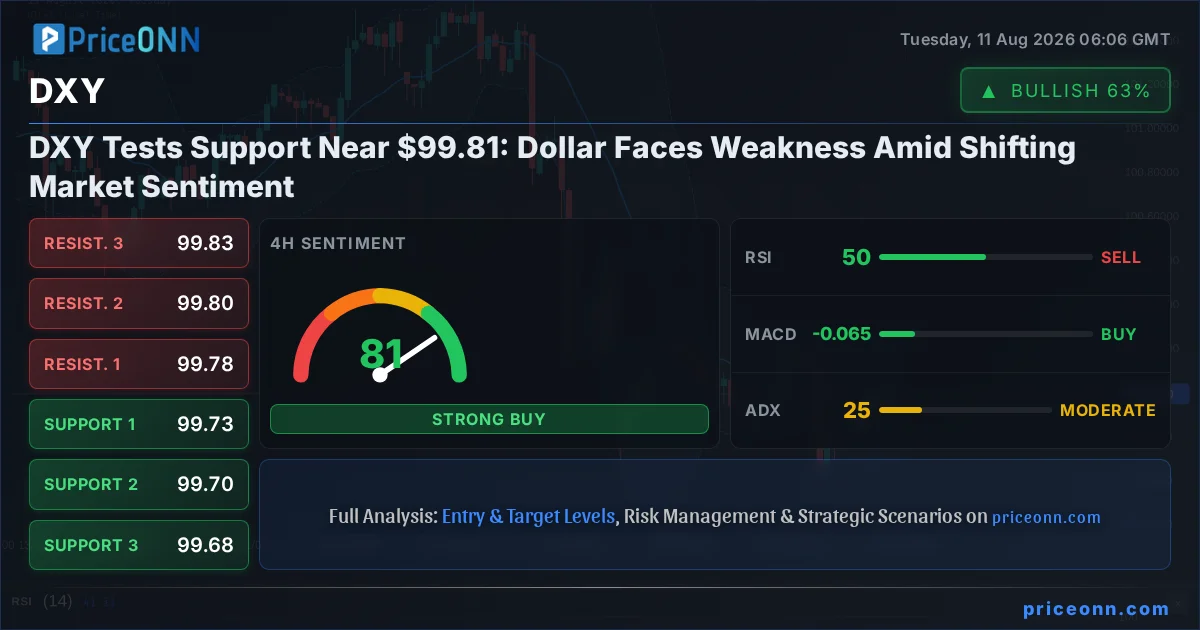
The US Dollar Index (DXY) also remains a key barometer. If the Fed's patient stance is perceived as dovish relative to other central banks, or if inflation fears resurface, the dollar could face headwinds. However, if the US economy continues to show relative resilience compared to other major economies, the dollar might find support. The market's interpretation of the Fed's next move, heavily influenced by inflation and employment data, will be critical for DXY's trajectory.
Furthermore, the energy sector's performance, particularly oil prices, becomes a central point of analysis. The recent surge in crude oil prices, which contributed negatively to July's CPI but poses an upside risk for August, could affect energy stocks and broader commodity markets. Investors will be assessing whether this price momentum sustains and translates into wider inflationary pressures, impacting sectors sensitive to input costs.
Finally, the broader equity markets, particularly growth-oriented sectors, are sensitive to interest rate expectations. A prolonged period of stable or declining inflation, coupled with a Fed on hold, could be supportive for equities. However, the persistent level of core inflation at 2.5% means the Fed is unlikely to pivot to aggressive easing anytime soon, suggesting that market participants must remain vigilant for any shifts in economic data that could alter the Fed's calculus.
Track markets in real-time
Empower your investment decisions with AI-powered analysis, technical indicators and real-time price data.
Join Our Telegram Channel
Get breaking market news, AI analysis and trading signals delivered instantly to your Telegram.
Join Channel PriceONN News
The Consumer Price Index (CPI) rose by 0.1% month-on-month (m/m) in July – in line with expectations. On a twelve-month basis, CPI edged down to 3.4% (from 3.5% in June). Energy costs fell by 1.5% m/m, led by a 2.9% m/m decline in prices at the pump. Food prices rose 0.1% m/m – its softest […] The post US: Inflationary Pressures Remain Subdued in July appeared first on ActionForex.
PriceONN News
RBA on hold as expected, recognising the data has broken against its hawkish narrative. Base case clearly an extended period on hold, but RBA will hike if upside risks to inflation materialise. As widely expected, the RBA Monetary Policy Board (MPB) kept the cash rate on hold at 4.35% at its August meeting. The accompanying […] The post RBA Holds at 4.35%, Narrows Risk of Hikes appeared first on ActionForex.
PriceONN News
Markets Core bonds sold off yesterday with the belly of the curve slightly underperforming in the US while European curves showed more of a bear flattening. Daily changes on the US curve varied between +4.7 bps (2-yr) and +6.4 bps (7-yr). The US 30-yr yield is again within reach of the multi-annual high reached end […] The post Sunrise Market Commentary appeared first on ActionForex.
PriceONN News
RBA accepted that inflation has improved, but refused to turn that improvement into a declaration that rate hikes are finished. Cash rate was left unchanged at 4.35% unanimously, yet Board described policy as only “somewhat restrictive” and explicitly kept another increase on table, saying it could still raise rates “if upside risks materialise.” That is […] The post RBA Accepts Softer Inflation but Still Leaves Scope for One More Hike appeared first on ActionForex.
PriceONN News
The USD index plummeted amid a decline in US employment. Gold is benefiting from the Fed’s reluctance to raise interest rates. The US dollar touched a seven-week low after an unexpected labour market report. Employment in July unexpectedly fell by 23K. The figures for May were revised down from 129K to 63K, and those for […] The post The Dollar Let the Labour Market Down appeared first on ActionForex.
PriceONN News
Whatever the inflation figures may be, the precious metal will come out on top. Japan and the US don’t want to give the yen’s fate to speculators. The US dollar continues to recover from the blow dealt by the labour market statistics. A rally in Treasury bond yields is driving the rise in the USD […] The post Gold as a Sure-Fire Bet appeared first on ActionForex.
PriceONN News
Germany’s benchmark index just made history, breaking above 26,500 for the first time ever, extending a rally that has already delivered close to 10% over the past twelve months. The move came on fresh optimism around a potential resolution to the Iran conflict, though that optimism proved short-lived: President Trump’s latest demands, that Tehran compensate […] The post DAX 40: Record Highs, Real Fundamentals, One Channel Left to Test appeared first on ActionForex.
PriceONN News
Brent oil price rose to the highest in over one week on Tuesday, in extension of Monday’s nearly 5% advance, following the latest verbal escalation by President Trump that quickly changed the sentiment and countered efforts of Iran and Oman to find solution for reopening of strategic Hormuz strait. The latest demands from President Trump […] The post Brent Oil Price Falls After Recovery Failed to Clear Important $90 Barrier appeared first on ActionForex.
PriceONN News
Hello fellow traders. In this technical article we’re going to take a look at the Elliott Wave charts charts of Copper (HG_F) commodity published in members’ area of the website. As our members know, Copper Futures recently completed a pullback that provided a high-probability trading setup. The decline unfolded as a clear Elliott Wave Zig […] The post Copper (Hg_F) Elliott Wave: Targeting a Buy at the Blue Box appeared first on ActionForex.
PriceONN News
The NFIB’s Small Business Optimism Index rose 2.4 points to 99.8 in July, soundly beating expectations for a roughly flat reading of 97.5. Eight out of the ten index subcomponents improved during the month and two deteriorated. The largest improvement came from the net share of firms planning to increase employment (up 9 points to […] The post US: Small Business Optimism Spiked in July appeared first on ActionForex.
PriceONN News
Overnight, the RBA held its cash rate steady at 4.35%, as widely expected after June’s inflation data came in softer than forecast at 3.8% headline. Yet the accompanying statement struck a notably cautious tone, warning that trimmed mean inflation remains elevated and largely unchanged from the March quarter, with oil and related commodities still trading […] The post EUR/AUD: Two Central Banks on Hold, One Triangle About to Break appeared first on ActionForex.
PriceONN News
A deal to reopen the Strait of Hormuz is not inevitable. Oil prices are rising amid growing risks of an escalation of the conflict in the Middle East. The US dollar continued to recover from losses caused by the jobs report, against a backdrop of rising geopolitical tensions in the Middle East with traders squaring […] The post Brent Is Following a Path of Demands Rather Than Commitments appeared first on ActionForex.