
EURUSD Hovers Near $1.15 Resistance: Bullish Momentum Builds
EURUSD holds steady around $1.15 as traders await inflation data. Bullish sentiment is growing, but key resistance levels loom.
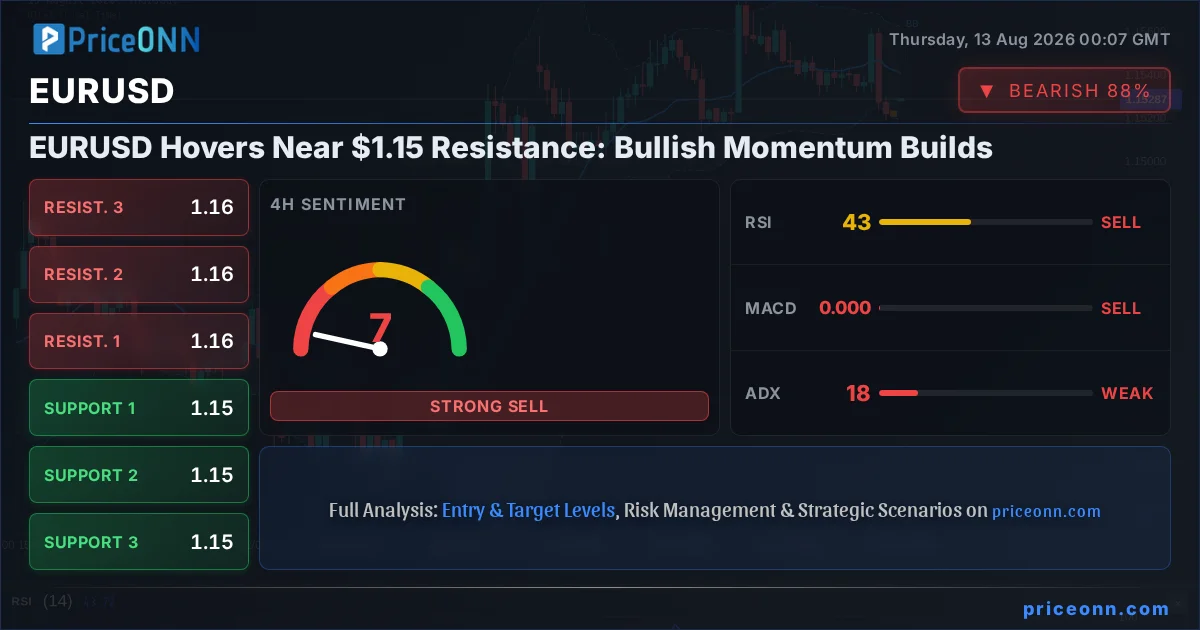
As the global financial stage braces for crucial July inflation figures, the EURUSD pair is navigating a delicate balance, currently finding itself near the $1.15 resistance mark. This pivotal juncture is not just a technical battleground but a reflection of shifting macroeconomic tides, where central bank policy expectations and lingering geopolitical concerns are creating a complex tapestry for currency traders. The recent subdued inflation data from the US, which saw the Consumer Price Index (CPI) rise by a mere 0.1% month-on-month in July, has provided a temporary reprieve for risk assets, but the overarching narrative remains one of cautious anticipation. Investors are keenly watching to see if this cooling inflation trend will deter the Federal Reserve from further aggressive tightening, a move that could significantly influence the dollar's trajectory and, consequently, the EURUSD's path forward.
- EURUSD is currently trading near the critical $1.15 resistance level.
- July US CPI data came in line with expectations at 0.1% m/m, potentially easing Fed tightening pressure.
- The DXY is showing mixed signals, trading around 99.97, indicating a cautious dollar stance.
- Technical indicators on the 1-day chart for EURUSD show a bullish bias with RSI at 55.99, but 4-hour and 1-hour charts suggest caution.
- Key upcoming economic events include further inflation data releases and central bank commentary.
The current market environment is characterized by a palpable sense of anticipation, with major economic releases on the horizon poised to inject significant volatility into currency markets. The subdued US inflation figures released on August 12th, showing the CPI rising by just 0.1% month-on-month and slowing to 3.4% year-on-year, have certainly tempered immediate expectations of a hawkish Federal Reserve pivot. This data point, falling precisely in line with forecasts, suggests that inflationary pressures, while still present, might be gradually receding. For the EURUSD pair, this is a critical development. A less aggressive Fed typically translates to a weaker US dollar, which, in turn, could provide the necessary catalyst for EURUSD to break above its current resistance levels. However, the market's reaction has been somewhat muted, indicating a wait-and-see approach as traders digest the implications alongside other ongoing economic and geopolitical factors.
The Dollar Index (DXY), a key barometer for the greenback's strength against a basket of major currencies, is currently hovering around 99.97. This level represents a psychological threshold, and its movement is closely tied to the EURUSD's direction, given the pair's significant weighting in the index. While the DXY has seen some upward movement, its gains are being capped, reflecting the mixed signals emanating from the US economic landscape. The subdued inflation data, coupled with a slightly weaker-than-expected Non-Farm Payrolls (NFP) report released earlier in the month, has led some analysts to question the Fed's aggressive rate hike trajectory. This uncertainty is reflected in the DXY's current trading range, suggesting that while the dollar retains some strength, it is not yet exhibiting the kind of momentum that would decisively push EURUSD lower.
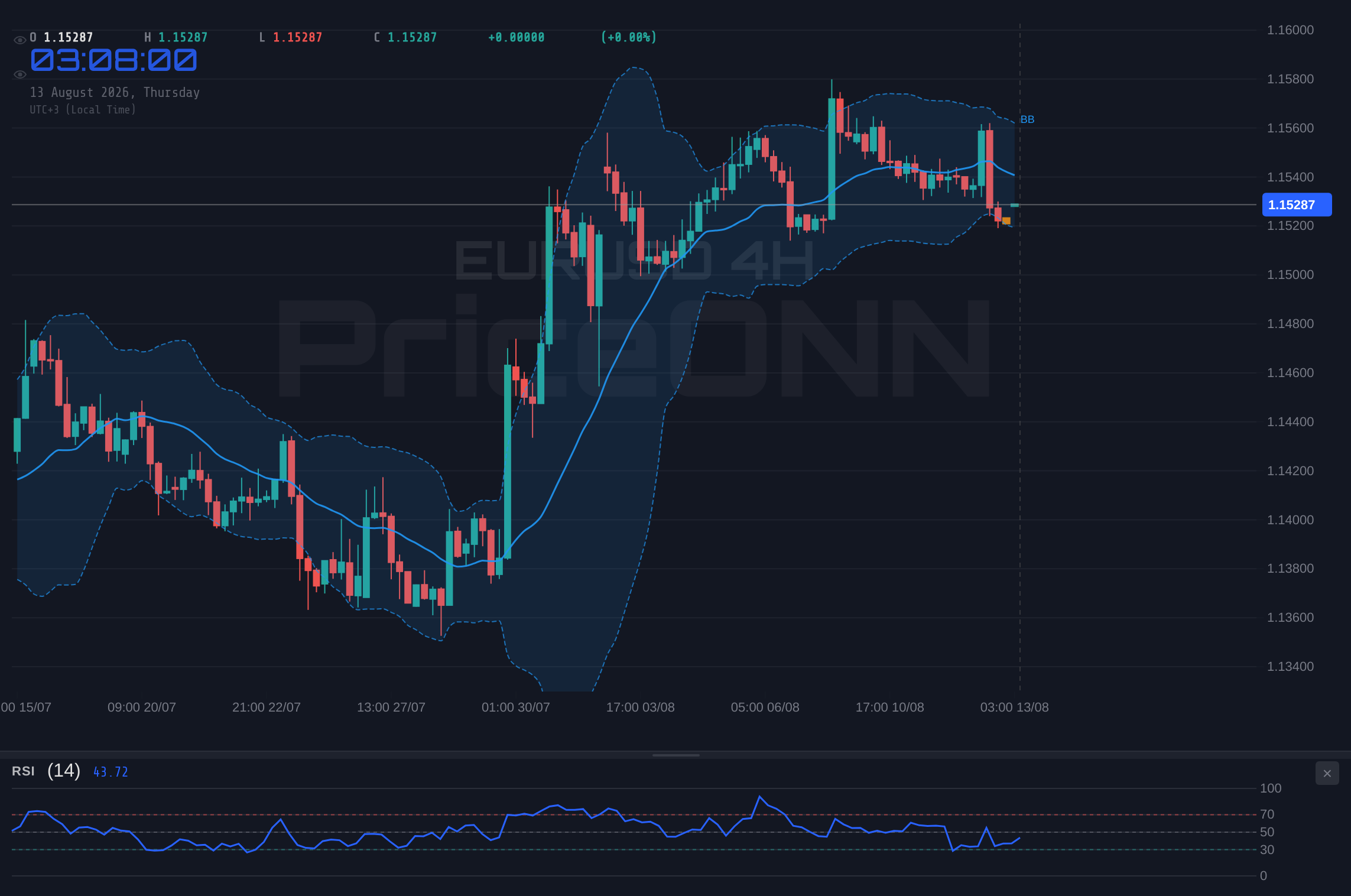
From a technical perspective, EURUSD is at a crucial juncture. On the 1-day timeframe, the pair exhibits a bullish bias, supported by an RSI reading of 55.99, which, while in the neutral zone, leans towards upward momentum. The MACD is also positive, and the price is trading above the middle Bollinger Band, indicating a generally constructive outlook. However, this bullish picture is nuanced when viewed across shorter timeframes. The 4-hour chart shows the RSI at 43.36, suggesting a pullback or consolidation, and the MACD is negative, signaling bearish momentum. The 1-hour chart reinforces this caution, with an RSI of 43.6 and a negative MACD, indicating downward pressure in the immediate term. This divergence across timeframes highlights the indecision in the market and the importance of the upcoming economic data to provide a clearer directional signal.
Navigating the Resistance at $1.15
The immediate price action for EURUSD is centered around the $1.15 level, which is acting as a significant resistance. The 1-day chart identifies the key resistance at $1.15491, with further levels at $1.15582 and $1.15675. For the bulls to gain sustained control, a decisive break and hold above these levels would be necessary. Such a move would likely be fueled by data that strongly suggests a less hawkish stance from the Federal Reserve or a significant improvement in the European economic outlook. Conversely, failure to break this resistance could lead to a pullback, with immediate support found at $1.15307, followed by $1.15214 and $1.15123. The current neutral to slightly bearish signals on the shorter timeframes suggest that the immediate pressure might be to the downside, making the $1.15 level a formidable barrier.
The recent news flow has also contributed to the cautious optimism surrounding EURUSD. Reports on August 12th indicated that US inflationary pressures remain subdued, with July CPI data aligning with expectations. This aligns with the broader narrative that the Fed might be nearing the end of its aggressive rate-hiking cycle. Furthermore, news outlets like Reuters and Bloomberg have highlighted the growing demand for safe-haven assets like gold, which has been trading near two-month highs. While gold's movement is often inversely correlated with the dollar, its strength can also reflect broader economic uncertainty. The fact that gold has rallied even as Brent crude oil prices have recovered suggests that markets may be betting against a Fed tightening that would significantly dampen economic activity, a sentiment that could indirectly benefit the Euro.
Looking at the broader macroeconomic correlations, the relationship between EURUSD, the DXY, and US Treasury yields is crucial. While the DXY is currently consolidating, a sustained move lower, perhaps triggered by further dovish signals from the Fed or stronger economic data from the Eurozone, would be a significant tailwind for EURUSD. Similarly, declining US Treasury yields would typically reduce the attractiveness of dollar-denominated assets, potentially prompting capital flows into other currencies, including the Euro. The current yield environment, though sensitive to inflation expectations, has not yet presented a clear signal to decisively break the EURUSD's current range. Traders are essentially waiting for a clearer confirmation from upcoming data releases.
The Eurozone's Economic Pulse
While much of the focus has been on US inflation, the economic health of the Eurozone remains a critical factor for EURUSD. Recent Purchasing Managers' Index (PMI) data from key European economies has painted a mixed picture, with some sectors showing resilience while others grapple with slowing growth. The European Central Bank (ECB) is walking a tightrope, balancing the need to combat inflation with the risk of stifling economic recovery. Any hints of a more hawkish stance from the ECB, perhaps driven by persistent inflation or a stronger Eurozone growth outlook, could provide significant support to the pair. Conversely, signs of economic weakness or a dovish tilt from the ECB would likely weigh on EURUSD, especially if the US Federal Reserve maintains a relatively hawkish bias.
The interplay between inflation expectations and central bank policy is the dominant theme. Gold's recent rally, as reported by sources like Bloomberg, suggests that markets are pricing in a scenario where oil prices might not force the Fed back into aggressive tightening. This divergence between oil prices and gold's safe-haven appeal is noteworthy. If inflation continues to moderate, as suggested by the July CPI data, the Fed might indeed pause its rate hikes sooner rather than later. This would weaken the dollar and could pave the way for EURUSD to challenge higher resistance levels. However, the geopolitical landscape remains a wildcard, with any escalation in global tensions capable of reigniting safe-haven demand for the dollar and putting pressure on EURUSD.
On the technical front, the ADX indicator provides insight into trend strength. On the 4-hour chart, the ADX stands at 35, indicating a strong upward trend, which, paradoxically, is present despite the RSI and MACD suggesting caution. This often points to a strong trend that is consolidating rather than reversing. However, the 1-hour ADX at 15.81 signals a weak trend, reinforcing the current indecision. The Stochastic oscillator on the 1-hour chart is in oversold territory (K=19.66, D=41.27), suggesting a potential short-term bounce, but this needs to be confirmed by other indicators and broader market sentiment. The daily Stochastic, however, is in the overbought region (K=92.26, D=83.14), which could signal a coming correction if not managed carefully.
Looking Ahead: Inflation Data and Fed Signals
The immediate future for EURUSD hinges significantly on upcoming economic data and central bank commentary. Beyond the July CPI, traders will be scrutinizing any remarks from Federal Reserve officials for clues about future monetary policy. The market is constantly trying to price in the probability of future rate hikes or pauses, and any deviation from current expectations could trigger substantial price movements. The CME FedWatch tool, if available, would offer precise probabilities, but even without it, the general sentiment derived from speeches and meeting minutes is closely watched. A truly dovish signal from the Fed could see EURUSD break above $1.15491, targeting $1.15582 and potentially higher.
Conversely, if inflation proves stickier than anticipated, or if geopolitical risks escalate, the dollar could find renewed strength. In such a scenario, EURUSD might falter at the $1.15 resistance, retesting support levels around $1.15307 and $1.15214. The market's reaction to the current subdued inflation data suggests a degree of complacency regarding Fed tightening, which could be a risky position if subsequent data points indicate persistent price pressures. The divergence between the strong upward trend indicated by the 4-hour ADX (48.5 for XAUUSD, 35 for XAGUSD, 27.7 for EURUSD 1D) and the mixed signals from oscillators like RSI and Stochastic across different timeframes for EURUSD underscores the current market's indecision.
The correlation analysis remains vital. A strengthening DXY above 100.00 would typically exert downward pressure on EURUSD, making it harder to sustain moves above $1.15. Conversely, a DXY falling back below this psychological level, perhaps driven by a less hawkish Fed or a global risk-off sentiment favoring other currencies, could provide the necessary tailwind. The performance of equity markets, such as the SP500 currently trading at 6572.87, also plays a role. A significant risk-off move in equities, indicated by a drop in the SP500, might initially boost the dollar as a safe haven, but if the underlying cause is a US-specific economic slowdown, it could eventually weaken the dollar and support EURUSD.
The narrative of 'inflation cooling' versus 'inflation remaining sticky' is the central theme. If the cooling trend holds, the Fed may be in a position to pause, benefiting EURUSD. If inflation surprises to the upside in upcoming reports, the Fed might be forced to resume its hawkish path, strengthening the dollar and capping EURUSD's upside. The current technical setup, with EURUSD testing resistance at $1.15, suggests that the market is waiting for a fundamental catalyst to break the stalemate. The conflicting signals across timeframes mean that a breakout above $1.15491 needs to be confirmed by strong follow-through volume and sustained momentum, while a failure to do so could lead to a retest of the support levels.
Bullish Scenario: Breaking the Chains
35% ProbabilityNeutral Scenario: Consolidation Phase
60% ProbabilityBearish Scenario: Resistance Holds Firm
5% ProbabilityFrequently Asked Questions: EURUSD Analysis
What happens if EURUSD breaks above the $1.15491 resistance level?
A sustained move above $1.15491, confirmed by strong volume and momentum, could target the next resistance at $1.15582. This would likely be fueled by dovish signals from the Fed or positive Eurozone economic news.
Should I buy EURUSD at current levels near $1.15 given the mixed technical signals?
Caution is advised given the mixed signals across timeframes. A high-probability setup would require a confirmed breakout above $1.15491 or a clear bounce from support near $1.15214, rather than entering at current resistance.
Is the RSI at 55.99 on the daily chart a buy signal for EURUSD?
An RSI of 55.99 on the daily chart indicates a neutral-to-bullish bias but is not an immediate buy signal on its own. It suggests upward momentum is present but needs confirmation from other indicators and price action, especially given shorter-term bearish signals.
How will upcoming US inflation data affect EURUSD this week?
If inflation data comes in hotter than expected, it could strengthen the dollar, potentially pushing EURUSD below $1.15. Conversely, softer data could weaken the dollar, supporting a move above $1.15491 as the Fed might pause its tightening cycle.
The path forward for EURUSD remains intricately linked to the evolving inflation narrative and the subsequent policy responses from major central banks. While the recent US CPI data has offered a glimmer of hope for a less aggressive Fed, the market is still on edge, awaiting further confirmation. The $1.15 resistance level represents a critical psychological and technical barrier that will likely dictate the short-to-medium term direction. Patience and a data-driven approach are paramount for traders navigating this uncertain landscape. The confluence of technical levels and fundamental drivers suggests that the current consolidation around $1.15 might be a precursor to a significant move, but the direction will ultimately be determined by the incoming economic signals.
Track markets in real-time
AI-powered analysis, technical indicators and real-time price data.
Join Our Telegram Channel
Breaking market news, AI analysis and trading signals instantly.
Join Channel