
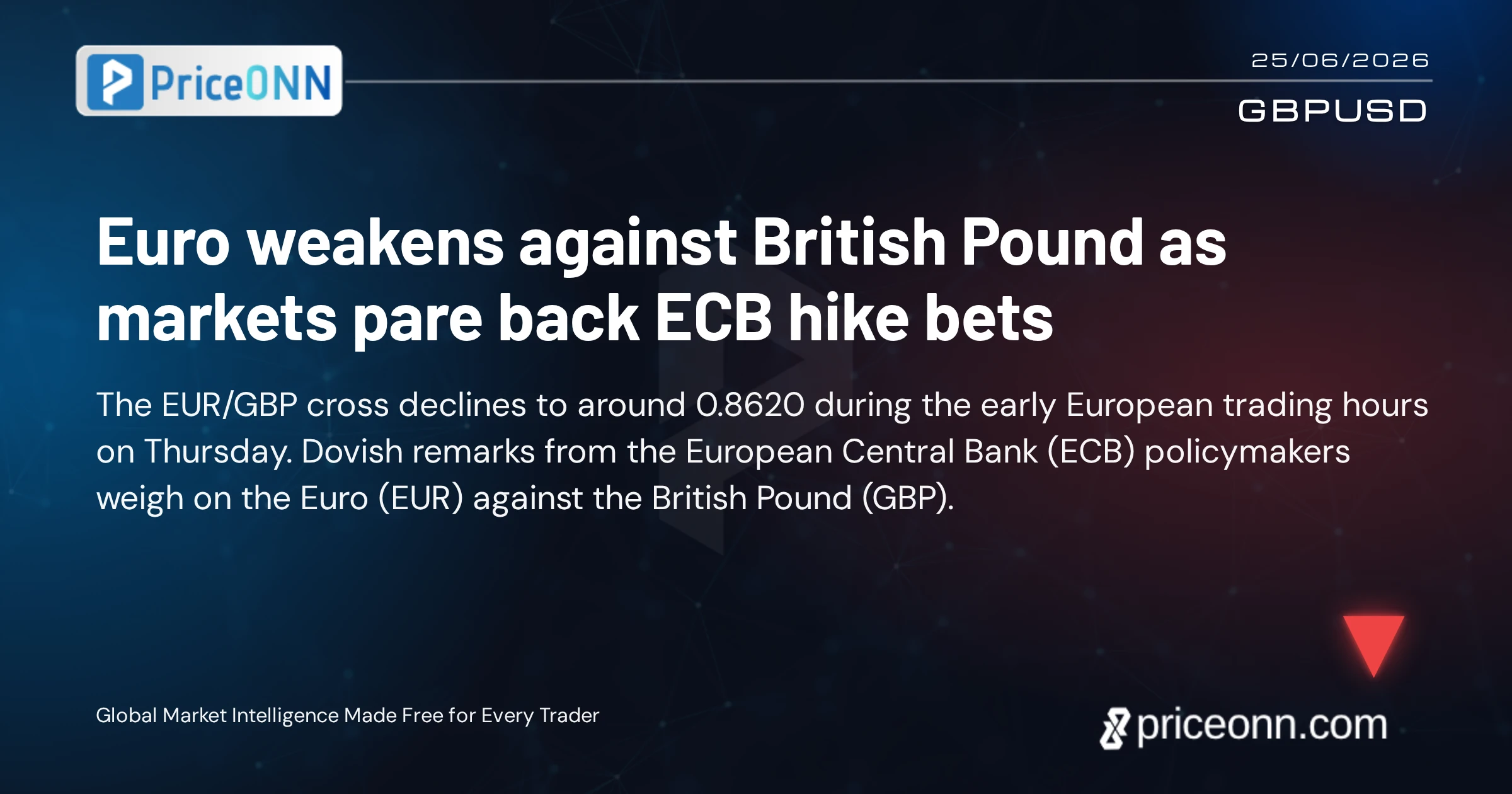
Euro weakens against British Pound as markets pare back ECB hike bets
 PriceONN Editorial Desk
Multi-source verification
PriceONN Editorial Desk
Multi-source verification
Sterling Ascends on Shifting Monetary Policy Winds
The British Pound, a currency with roots stretching back to the 9th century, is currently experiencing a notable upswing. This movement is directly linked to a perceived shift in monetary policy expectations surrounding the European Central Bank (ECB). Traders are actively reassessing the likelihood of future interest rate hikes from the ECB, leading to a weakening Euro (EUR) and a strengthening Pound Sterling (GBP).
Early Thursday trading saw the EUR/GBP cross dip to approximately 0.8620. This downward pressure on the Euro is largely attributed to recent commentary from ECB policymakers. Their remarks have been interpreted as signaling a potential pause or slowdown in the pace of rate increases, a stark contrast to the more hawkish stance some market participants had anticipated. This divergence in monetary policy outlook is creating a clear advantage for the Sterling.
The Bank of England (BoE), the institution responsible for issuing the Pound Sterling, bases its monetary strategy on achieving price stability, targeting an inflation rate of roughly 2%. The BoE's primary instrument for this is the adjustment of interest rates. When inflation pressures mount, the central bank typically raises rates. This action increases the cost of borrowing, aiming to cool down economic activity and curb rising prices. For the GBP, higher interest rates generally translate into a more attractive investment environment, drawing global capital seeking better yields.
Conversely, a scenario where inflation dips too low signals a potential economic slowdown. In such instances, the BoE might consider reducing interest rates to make credit cheaper, thereby encouraging investment and stimulating economic expansion. Economic indicators such as Gross Domestic Product (GDP) figures, Purchasing Managers' Indexes (PMIs) for manufacturing and services, and employment data are closely watched. These releases provide crucial insights into the UK's economic health and can significantly sway the direction of the Pound.
A robust domestic economy not only attracts foreign investment but can also embolden the BoE to pursue tighter monetary policy, directly benefiting the Sterling. Weak economic data, however, tends to exert downward pressure on the currency. Furthermore, the UK's Trade Balance, which measures the difference between the value of exports and imports, plays a critical role. A healthy net trade balance, driven by strong demand for British goods and services abroad, can provide a significant boost to the Pound purely through increased foreign exchange demand.
Reading Between the Lines
The current market action, with EUR/GBP retreating, highlights a critical recalibration of expectations regarding the ECB's future actions. While the Bank of England has been navigating its own path toward inflation targets, the market's focus has now sharpened on the potential for the ECB to pivot towards a less aggressive tightening cycle. This shift is not just about interest rate differentials; it reflects a broader sentiment about economic resilience and future growth prospects within the Eurozone versus the UK.
For traders, this development opens up several avenues. The immediate implication is a potential for further downside in the EUR/GBP pair if the ECB continues to signal a more dovish stance. Key levels to watch will be the recent lows around 0.8600 and any significant breaches below this psychological mark. On the flip side, any unexpected hawkish commentary from the BoE, or a significant positive economic surprise from the Eurozone, could quickly reverse this trend.
We should also consider the broader market implications. A weaker Euro can have ripple effects across other currency pairs, particularly those involving emerging markets that are sensitive to European economic health. Concurrently, a strengthening Pound might influence global trade dynamics and commodity prices denominated in GBP. Institutional desks are likely scrutinizing options market positioning for EUR/GBP, looking for signs of capitulation or renewed conviction in either direction. The term structure of interest rate futures will also be key, revealing how deeply market participants have priced in the ECB's potential policy shift.
The Sterling's ascent, fueled by a less hawkish ECB, presents an interesting dynamic. It suggests that global capital may be rotating towards economies perceived as offering more stable or predictable monetary policy environments, even if inflation remains a concern. Investors and traders will need to monitor upcoming economic data from both the Eurozone and the UK closely, as well as any further communication from central bank officials, to gauge the sustainability of this currency move.
Track markets in real-time
Empower your investment decisions with AI-powered analysis, technical indicators and real-time price data.
Join Our Telegram Channel
Get breaking market news, AI analysis and trading signals delivered instantly to your Telegram.
Join Channel PriceONN News
Whatever the inflation figures may be, the precious metal will come out on top. Japan and the US don’t want to give the yen’s fate to speculators. The US dollar continues to recover from the blow dealt by the labour market statistics. A rally in Treasury bond yields is driving the rise in the USD […] The post Gold as a Sure-Fire Bet appeared first on ActionForex.
PriceONN News
Markets Core bonds sold off yesterday with the belly of the curve slightly underperforming in the US while European curves showed more of a bear flattening. Daily changes on the US curve varied between +4.7 bps (2-yr) and +6.4 bps (7-yr). The US 30-yr yield is again within reach of the multi-annual high reached end […] The post Sunrise Market Commentary appeared first on ActionForex.
PriceONN News
The Consumer Price Index (CPI) rose by 0.1% month-on-month (m/m) in July – in line with expectations. On a twelve-month basis, CPI edged down to 3.4% (from 3.5% in June). Energy costs fell by 1.5% m/m, led by a 2.9% m/m decline in prices at the pump. Food prices rose 0.1% m/m – its softest […] The post US: Inflationary Pressures Remain Subdued in July appeared first on ActionForex.
PriceONN News
US inflation eased as expected in July, reinforcing case for Fed to stay on hold while it waits for clearer evidence on both prices and labor market. Headline CPI rose from -0.4% to 0.1% m/m, while annual rate slowed from 3.5% y/y to 3.4%. Core CPI increased from 0.0% to 0.2% m/m, with annual core […] The post US CPI Slows to 3.4% as Core Inflation Eases to 2.5% appeared first on ActionForex.
PriceONN News
Germany’s benchmark index just made history, breaking above 26,500 for the first time ever, extending a rally that has already delivered close to 10% over the past twelve months. The move came on fresh optimism around a potential resolution to the Iran conflict, though that optimism proved short-lived: President Trump’s latest demands, that Tehran compensate […] The post DAX 40: Record Highs, Real Fundamentals, One Channel Left to Test appeared first on ActionForex.
PriceONN News
Brent oil price rose to the highest in over one week on Tuesday, in extension of Monday’s nearly 5% advance, following the latest verbal escalation by President Trump that quickly changed the sentiment and countered efforts of Iran and Oman to find solution for reopening of strategic Hormuz strait. The latest demands from President Trump […] The post Brent Oil Price Falls After Recovery Failed to Clear Important $90 Barrier appeared first on ActionForex.
PriceONN News
Hello fellow traders. In this technical article we’re going to take a look at the Elliott Wave charts charts of Copper (HG_F) commodity published in members’ area of the website. As our members know, Copper Futures recently completed a pullback that provided a high-probability trading setup. The decline unfolded as a clear Elliott Wave Zig […] The post Copper (Hg_F) Elliott Wave: Targeting a Buy at the Blue Box appeared first on ActionForex.
PriceONN News
The NFIB’s Small Business Optimism Index rose 2.4 points to 99.8 in July, soundly beating expectations for a roughly flat reading of 97.5. Eight out of the ten index subcomponents improved during the month and two deteriorated. The largest improvement came from the net share of firms planning to increase employment (up 9 points to […] The post US: Small Business Optimism Spiked in July appeared first on ActionForex.
PriceONN News
Overnight, the RBA held its cash rate steady at 4.35%, as widely expected after June’s inflation data came in softer than forecast at 3.8% headline. Yet the accompanying statement struck a notably cautious tone, warning that trimmed mean inflation remains elevated and largely unchanged from the March quarter, with oil and related commodities still trading […] The post EUR/AUD: Two Central Banks on Hold, One Triangle About to Break appeared first on ActionForex.
PriceONN News
A deal to reopen the Strait of Hormuz is not inevitable. Oil prices are rising amid growing risks of an escalation of the conflict in the Middle East. The US dollar continued to recover from losses caused by the jobs report, against a backdrop of rising geopolitical tensions in the Middle East with traders squaring […] The post Brent Is Following a Path of Demands Rather Than Commitments appeared first on ActionForex.
PriceONN News
Gold rose to 4,400 USD per ounce on Tuesday, reaching a two-month high. Demand for the precious metal is growing rapidly, even amid heightened inflation risks and expectations of higher interest rates driven by elevated oil prices. Chinese institutional investors continue to build positions in gold as a defensive asset amid heightened volatility in other […] The post Gold Rallies: Long-Awaited Rise and Growing Safe-Haven Demand appeared first on ActionForex.
PriceONN News
RBA on hold as expected, recognising the data has broken against its hawkish narrative. Base case clearly an extended period on hold, but RBA will hike if upside risks to inflation materialise. As widely expected, the RBA Monetary Policy Board (MPB) kept the cash rate on hold at 4.35% at its August meeting. The accompanying […] The post RBA Holds at 4.35%, Narrows Risk of Hikes appeared first on ActionForex.