
Fed’s Kashkari Warns of Rising Inflation Risks, But Says It’s Too Soon to Predict Rate Hike
 PriceONN Editorial Desk
Multi-source verification
PriceONN Editorial Desk
Multi-source verification

Inflationary Pressures Mount, Policy Path Uncertain
Minneapolis Federal Reserve President Neel Kashkari has voiced significant concerns regarding the escalating risks of inflation. He pointed directly to the ongoing conflict in the Middle East as a key catalyst, exacerbating pressures on global energy prices and intricate supply chains. Speaking from Tokyo, Kashkari articulated that the prevailing economic data suggests a clear upward trend in inflationary risks rather than a decline.
The persistence of elevated price levels over the past five years has apparently shifted the Federal Reserve's perspective. What might have once been dismissed as a temporary energy shock is now viewed with greater caution. "We've had high inflation all around the world for five years now," Kashkari stated, emphasizing the pervasive nature of the issue and its connection to the Iran conflict, which he noted impacts nearly every global economy.
This inflationary shockwave, originating from rising energy costs, is anticipated to gradually permeate other economic sectors. Kashkari warned that the duration of this impact could potentially exceed current market expectations. The implications for monetary policy are significant, as the central bank grapples with the dual challenge of maintaining price stability without unduly stifling economic activity.
Labor Market vs. Inflation: A Policy Tightrope
In a critical assessment of current economic priorities, Kashkari suggested that inflation concerns are currently eclipsing labor market vulnerabilities for policymakers. He characterized the U.S. labor market as being in a "decent place." However, he drew a stark contrast, stating, "the risk to inflation appeared to be higher than the risk of a worsening labour market." This framing underscores the delicate balancing act facing the Federal Reserve.
Furthermore, Kashkari issued a stern warning about the potential erosion of the Fed's credibility. He explained that a failure to adequately address sustained inflationary pressures could lead the public to question the central bank's commitment to restoring price stability. This sentiment highlights the importance of decisive action, or at least clear communication, in maintaining public trust.
Despite the growing market anticipation, with some pricing in a possible rate hike as early as October, Kashkari remained noncommittal on immediate policy tightening. "I think it's far too soon for me to make such a prediction," he responded when pressed about future rate moves. This cautious stance suggests a data-dependent approach will continue to guide the Fed's decisions.
Navigating Forward: Data Dependency and Neutral Guidance
Kashkari reiterated the Federal Reserve's commitment to maintaining "neutral guidance." This approach signals that interest rates could still be adjusted either upward or downward, contingent upon the flow of incoming economic data. Key factors influencing this outlook include developments in the Iran negotiations, the trajectory of energy markets, and the progress towards normalizing global supply chains.
The central bank's strategy appears to be one of watchful waiting, seeking clarity on multiple fronts before committing to a definitive policy pivot. The interplay between geopolitical events, commodity prices, and the underlying health of the global economy presents a complex puzzle for monetary authorities worldwide. Investors and traders are keenly observing these developments for clues about future economic direction.
Market Ripple Effects
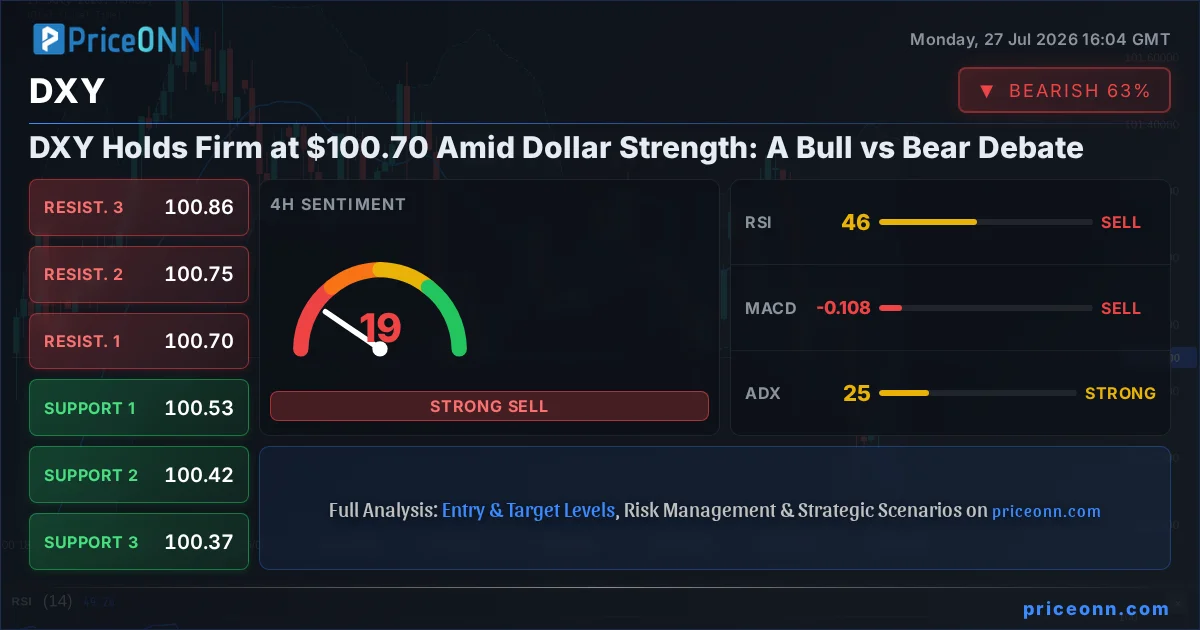
The heightened inflation rhetoric from a key Federal Reserve official, particularly when linked to geopolitical events, sends ripples across various markets. The immediate focus often falls on Treasury yields, which tend to rise as inflation expectations climb, reflecting a greater risk premium demanded by bondholders. The US Dollar Index (DXY) may also see upward pressure, as higher potential interest rates or perceived safe-haven flows can strengthen the currency.
Commodities, especially crude oil, are directly in the spotlight. Any escalation in Middle East tensions, as alluded to by Kashkari, could trigger further price surges, not just in oil but potentially in other energy products and industrial metals. This, in turn, can influence inflation expectations for consumer goods and services, impacting the broader economy.
Furthermore, equities, particularly growth-oriented sectors sensitive to interest rate changes, might face headwinds. Higher borrowing costs and the prospect of sustained inflation can dampen corporate profit margins and consumer spending. Traders will be monitoring the volatility in these interconnected markets closely, seeking to understand the duration and depth of these inflationary pressures and the Fed's ultimate response.
Track markets in real-time
Empower your investment decisions with AI-powered analysis, technical indicators and real-time price data.
Join Our Telegram Channel
Get breaking market news, AI analysis and trading signals delivered instantly to your Telegram.
Join Channel PriceONN News
EUR/USD enters the final week of July at 1.1369. Friday’s modest decline in energy prices reduced expectations that the Federal Reserve could raise rates as early as its upcoming meeting, scheduled for Tuesday and Wednesday. At the same time, the main currency pair remains very close to the monthly low recorded in late June. Markets […] The post EUR/USD Ahead of a Key Week: Holding Near Lows appeared first on ActionForex.
PriceONN News
Gold fell to 4,047 USD per ounce on Tuesday, erasing gains from the previous session. Pressure on the metal is mounting amid fears that the Federal Reserve may raise rates as early as this week. Markets currently estimate the probability of such a move on Wednesday at over 33% – an unusually high level of […] The post Gold Declines, Focus on Fed and Falling Oil Prices appeared first on ActionForex.
PriceONN News
The US stock market is not factoring in the existing risks. Investors are increasingly focusing on the cash flows of S&P 500 companies. US stock indices have closed in the red the last two weeks, something that hasn’t happened since March. The stock market has weathered both the armed conflict in the Middle East and […] The post It’s Time to Weigh Up the Risks for the S&P 500 appeared first on ActionForex.
PriceONN News
(RTTNews) - Gold prices traded higher on Monday as oil prices tumbled amid eased Middle East tensions, helping ease inflation and interest-rate concerns ahead of crucial Fed, BoE and BoJ central bank meetings due this week.
PriceONN News
The dollar heads into a pivotal week trading near 101.80, just off a 15-month high, with the Fed’s July 29 meeting standing as the clear focal point. Markets currently price roughly a 65% chance of a hold, though renewed Middle East escalation has kept a hike back on the table for later this year. Energy […] The post US Dollar Index: a Defining Week for the King of the Markets appeared first on ActionForex.
PriceONN News
The de-escalation of the conflict in the Middle East has sent Brent prices tumbling. The oil market could return to a surplus as early as the end of 2026. The US dollar and oil have lost their correlation. Brent recorded its worst daily fall in three months after reports of a ceasefire in the Middle […] The post Oil: A Surplus on the Horizon appeared first on ActionForex.
PriceONN News
The ceasefire in the Middle East has disrupted the greenback’s plans. Strong PMI data and falling oil prices are helping the euro. The US dollar faced a downward gap at the start of the week as the Middle East de-escalation of the conflict came as an unwelcome surprise to speculators who had built up net […] The post De-Escalation Undermines the Greenback appeared first on ActionForex.
PriceONN News
European Central Bank Governing Council member Peter Kazimir from Slovak reinforced the hawkish bias on Monday, arguing that policymakers will likely need to raise interest rates at least once more and warning that a worsening energy shock could ultimately require even more tightening than markets currently anticipate. His remarks come just days after the ECB […] The post ECB’s Kazimir Sees At Least One More Rate Hike, Warns Oil Shock Could Require More appeared first on ActionForex.
PriceONN News
On 21 July, Stats NZ reported an acceleration in inflation: the Consumer Price Index rose 1.5% in the second quarter, while the annual inflation rate climbed to 4.1%, its highest level in more than two years and slightly above analysts’ consensus forecast of 4.0%. The increase was driven primarily by higher fuel prices amid tensions […] The post NZD/USD: Inflation Surge Meets Strong US Dollar Pressure appeared first on ActionForex.
PriceONN News
US business activity accelerated at the start of the third quarter, with S&P Global’s Flash Composite PMI Output Index rising from 51.9 to 53.6 in July, its highest level in eight months. The improvement was driven by the services sector, where the Business Activity Index climbed from 51.2 to 53.6, also an eight-month high. Manufacturing, […] The post US PMI Hits Eight-Month High,Yet Rising Costs and Supply Delays Raise Caution appeared first on ActionForex.
PriceONN News
Market Overview The crypto market trended lower at the end of Monday, mirroring the US equity market, as it fell from a peak of $2.23T to $2.16T before returning to recent local lows of $2.18T by Tuesday morning. This marks yet another test of the 50-day moving average (MA) as support, which sellers have been […] The post Bitcoin Has Failed to Break Away from Its Long-Term Trend appeared first on ActionForex.
PriceONN News
I am already riding two EURUSD sell entries. Another possible sell opportunity could be forming for traders that are not in yet. EURUSD Possible Bearish Scenario Watch for price to tap 4 Hour FVG (Purple) first. Watch for a bearish shift and bearish reversal signs in the FVG zone. Wait for all above to play […] The post Riding EURUSD Sellside appeared first on ActionForex.