
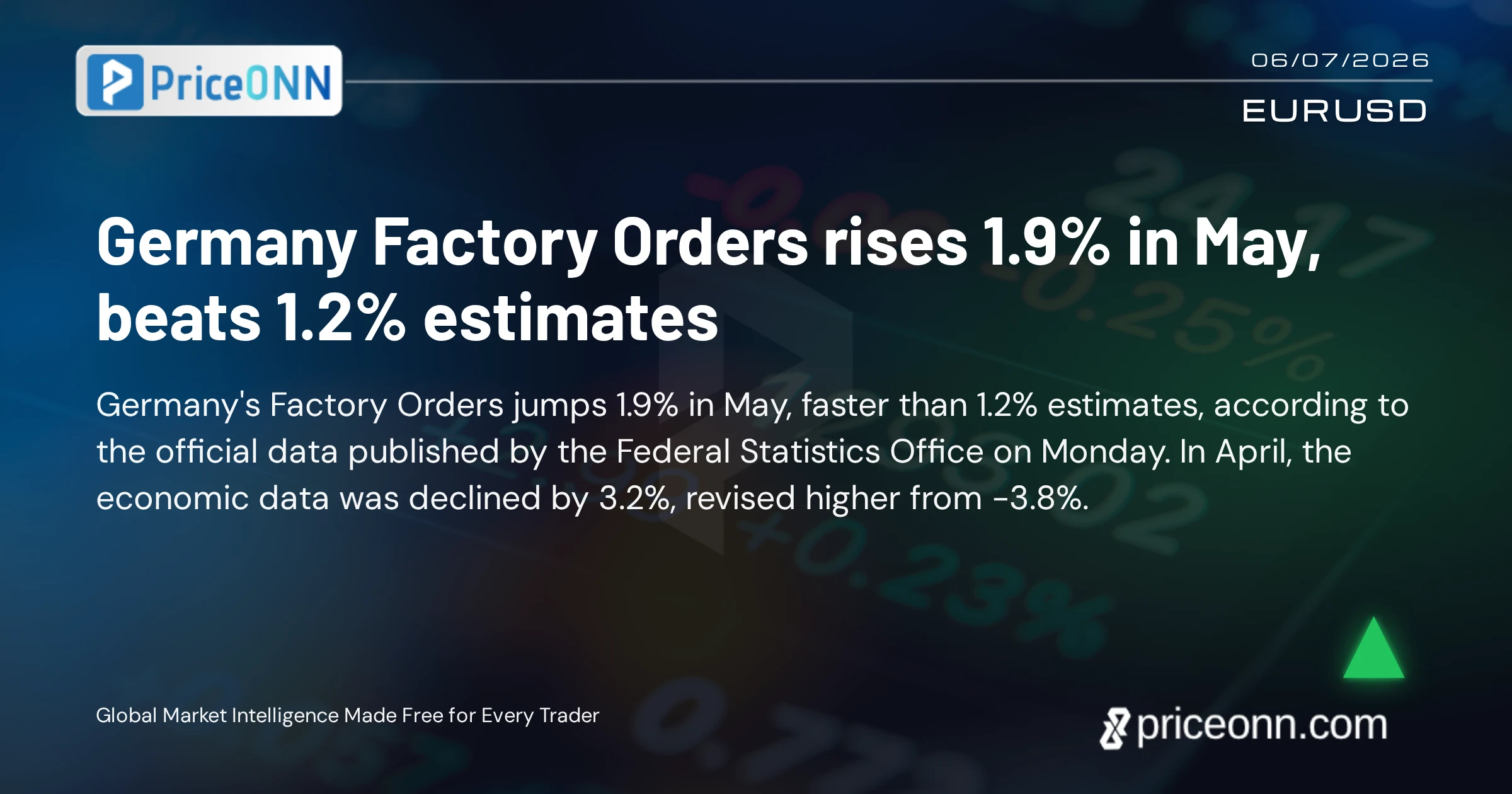
Germany Factory Orders rises 1.9% in May, beats 1.2% estimates
 PriceONN Editorial Desk
Multi-source verification
PriceONN Editorial Desk
Multi-source verification
Industrial Activity Shows Unexpected Strength
Manufacturing orders within Germany experienced a significant upswing in May, defying market expectations. The Federal Statistics Office reported a 1.9% increase, a welcome acceleration from the previous month's contraction. This figure comfortably outpaced the consensus estimate of 1.2%, offering a glimmer of optimism for the industrial sector.
The prior month, April, saw a contraction of 3.2%, a figure that has now been revised upwards from an initial report of -3.8%. While still a decline, the revised data suggests the downturn in April might have been less severe than first thought. The May rebound, however, is the key data point indicating renewed momentum.
Economic Powerhouse of the Eurozone
Germany's economic vitality is inextricably linked to the health of the Euro. As the Eurozone's largest economy, its performance profoundly influences the currency's stability and global perception. A strengthening German economy tends to bolster the Euro, while weakness can exert downward pressure.
Historically, Germany has played a central role in navigating economic turbulence within the bloc. During the sovereign debt crisis a decade ago, its leadership was instrumental in establishing stability funds and implementing stricter fiscal rules through the 'Fiscal Compact'. This approach fostered a culture of financial discipline that many member states sought to emulate, solidifying Germany's economic model as a benchmark for growth and stability across the Eurozone.
Understanding German Government Bonds
German government bonds, known as Bunds, are a cornerstone of the European fixed-income market. These instruments provide holders with regular interest payments, or coupons, and the return of the principal at maturity. Given Germany's economic standing, Bunds are widely regarded as a benchmark for other European sovereign debt.
Long-term Bunds are particularly prized by investors as a virtually risk-free asset, fully backed by the German nation's creditworthiness. Consequently, they often act as a safe-haven asset. Their value typically rises during periods of global economic uncertainty or crisis, while declining during times of widespread prosperity and optimism. This inverse relationship is critical for understanding their role in investor portfolios.
Bund Yields and Central Bank Influence
The yield on German Bunds reflects the annual return an investor can anticipate. While the coupon rate is fixed, the yield fluctuates with the bond's market price. A falling price increases the effective yield, and conversely, a rising price reduces it. This dynamic means Bund yields move inversely to bond prices.
The Bundesbank, Germany's central bank, plays a critical role in monetary policy and maintaining price stability, aiming for low and predictable inflation. Its conservative stance, often prioritizing inflation control over immediate growth stimulation, has significantly shaped the European Central Bank's policies. The Bundesbank's influence ensures a continued focus on financial prudence within the broader Eurozone framework.
Market Ripple Effects
The uptick in German factory orders provides a crucial data point for assessing the Eurozone's economic trajectory. It suggests that the industrial engine of Europe may be finding its footing after a period of slowdown. This development could have tangible effects across several financial instruments and markets.
Firstly, the Euro (EUR) itself is likely to find some support. A stronger German economy bolsters confidence in the Eurozone's overall health, potentially leading to appreciation against other major currencies, particularly those sensitive to European economic sentiment like the Swiss Franc (CHF). Secondly, German government bonds, or Bunds, might see their yields stabilize or even slightly decline if this data suggests a more robust economic outlook, reducing the immediate need for safe-haven inflows. This could also indirectly influence broader European equity markets, such as the DAX index, by improving the outlook for corporate earnings. Finally, the underlying strength of industrial production can be a leading indicator for commodity demand, though the immediate impact on broad commodity prices may be muted without broader global confirmation.
Reading Between the Lines
This unexpected surge in German industrial orders offers a vital counterpoint to recent narratives of persistent Eurozone weakness. While a single month's data does not guarantee a sustained recovery, it does suggest that the industrial sector, a critical component of Europe's largest economy, is showing resilience.
Traders and portfolio managers will be scrutinizing subsequent data releases for confirmation. Key areas to watch include the breakdown of the order types (domestic vs. international, capital goods vs. consumer goods) to understand the drivers of this growth. Furthermore, the reaction of the European Central Bank (ECB) will be closely observed. While this data might temper immediate calls for aggressive stimulus, the ECB is likely to maintain a cautious stance, emphasizing that inflation remains the primary concern. Investors should monitor German Bund yields for any shifts that might indicate changing expectations about future interest rate policy or economic growth prospects.
Track markets in real-time
Empower your investment decisions with AI-powered analysis, technical indicators and real-time price data.
Join Our Telegram Channel
Get breaking market news, AI analysis and trading signals delivered instantly to your Telegram.
Join Channel PriceONN News
(RTTNews) - Gold prices have tumbled on Thursday as the Middle East crisis deepens after Iran-backed Houthi militants of Yemen attacked two Saudi Arabian vessels in the Red Sea, raising concerns of intense oil supply disruption for an extended period. The possibility of an intere
PriceONN News
(RTTNews) - Gold prices fell from a two-week high on Thursday as escalating West Asia tensions rekindled inflation fears and clouded the outlook for interest rates.
PriceONN News
(RTTNews) - Gold prices traded higher on Wednesday, extending gains for a fourth consecutive session and hitting a two-week high as investors reacted to escalating Middle East tensions and looked ahead to next week's Federal Reserve meeting.
PriceONN News
(RTTNews) - Oil prices traded sharply higher on Wednesday to hit a seven-week high as risks to global supply spread beyond the Middle East to the Black Sea.
PriceONN News
Dow Jones futures lose 0.30% to trade around 52,290 during European trading hours on Wednesday. Meanwhile, S&P 500 futures and Nasdaq 100 futures decline 0.38% and 0.85%, trading near 7,520 and 29,070, respectively.
PriceONN News
Gold’s rally this week may prove to be one of the more important developments across financial markets-not simply because prices have reclaimed the $4,100 level, but because the move appears to contradict the macro forces that have governed precious metals for much of the second quarter. Silver has joined the advance, climbing back toward $60, […] The post Gold Defies Higher Oil and Yields. Is the Market Entering a New Regime? appeared first on ActionForex.
PriceONN News
Gold (XAU/USD) rallies to an over two-week high, around the $4,140-$4,141 area, during the Asian session on Wednesday amid hopes that US-Iran diplomacy could ease energy prices and temper hawkish US Federal Reserve (Fed) expectations.
PriceONN News
Silver price (XAG/USD) gains ground for the fourth successive day, trading around $59.70 per troy ounce during the Asian hours on Wednesday. Silver prices are surging despite rising rate-hike expectations, as powerful market forces outweigh the drag of higher interest rates.
PriceONN News
US President Donald Trump approved a landmark agreement with Saudi Arabia that could potentially provide the kingdom with uranium enrichment capability for its civilian nuclear program, the Wall Street Journal reported on Wednesday.
PriceONN News
Yemen’s Houthis said that they have closed the Bab el-Mandeb Strait to Saudi-linked shipping in retaliation for the kingdom’s blockade on Yemen and a recent attack on the international airport in Yemen’s rebel-held capital, Sanaa, the Guardian reported on Wednesday.
PriceONN News
Gold (XAU/USD) edges higher on Tuesday as buying interest around the $4,000 psychological level supports prices, while traders assess developments in the Middle East and their potential economic fallout. At the time of writing, XAU/USD trades around $4,058, up 1.27% on the day.
PriceONN News
Gold price (XAU/USD) is up 1.5% to near $4,067 during the European trading session on Tuesday. The precious metal outperforms as the rally in oil prices has stalled, with investors turning confident that negotiations between the United States (US) and Iran towards peace have resumed.